


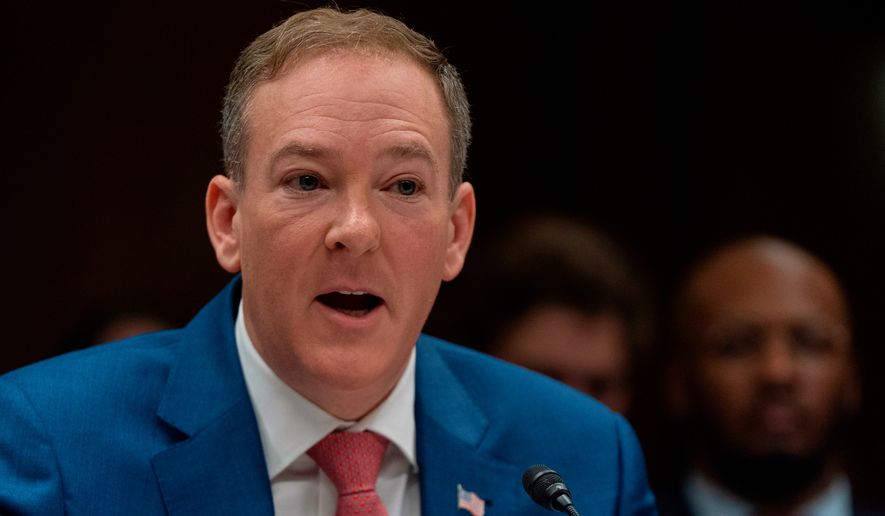

The Trump administration will not implement nationwide environmental standards for artificial intelligence data centers, Environmental Protection Agency Administrator Lee Zeldin said.
Instead, he urged states and local governments to adopt appropriate restrictions on water usage and air pollution.
“Ten times out of 10, I’m not going to sit inside of an agency building in Washington, D.C., and that we say that we know that local community in Georgia or Florida or Arizona or elsewhere, better than everyone there locally,” Mr. Zeldin said at the POLITICO Energy Summit in Washington on Wednesday.
People were interested in these podcasts
Because each data center’s environmental conditions, electricity needs and water usage are different, local communities should regulate the booming industry’s environmental impact.
“You can’t just across the board act as if every data center project is equal, like they’re all following the same exact model in how they power their project in various ways, or how they cool their data center, so it really depends on how the deal gets done,” he said.
Mr. Zeldin cited two reasons for passing on nationwide requirements: closed-loop data center designs and President Trump’s ratepayer protection pledge.
Closed-loop data center designs eliminate the need for water evaporation in cooling by continually recirculating a fixed supply of fluid, such as water, through sealed pipes, thus reducing daily water consumption.
The ratepayer protection pledge is the voluntary agreement with major tech and AI companies committing them to fully cover the energy costs, power supply and infrastructure upgrades for their data centers.
The EPA’s role regarding data centers remains advisory, aside from permitting decisions.
“EPA is not the party that is negotiating and or mediating or refereeing that deal that gets struck between the parties, but we are happy to engage as much as we possibly can to share that technical expertise and the best practices from what we’re seeing elsewhere around the country,” he said.
Clara Vondrich, senior policy counsel for the Climate Program at Public Citizen, a consumer advocacy organization, said that Mr. Zeldin’s inaction “dooms communities to higher asthma rates, noise and light pollution, and new fossil fuel infrastructure the climate can’t afford.”
“Yet the Administration insists on enabling Big Tech companies in the race to be first and fastest, cosigning their reckless buildout of behemoth AI data centers with a combination of gas, diesel, and even coal,” she said in a statement.
As 7 in 10 Americans oppose constructing AI data centers in their local area, according to a March Gallup poll, Ms. Vondrich called the Trump administration “out of touch.”
At the summit, Mr. Zeldin acknowledged the importance of following “best practices.”
“While we hear these stories of the worst-case data center that is most controversial and has the most amount of opposition, we might hear less about the data center that is following all the best practices,” he said. “It is important, as more builds are getting done, that they are following those best practices, not the worst practices.”
Contact the author


Please read our comment policy before commenting.