



LONDON — The British government acted lawfully when it banned the protest group Palestine Action as a terrorist organization, the Court of Appeal in London ruled on Monday.
Chief Justice Sue Carr said the group went far beyond staging non-violent demonstrations to launch destructive attacks on defense companies, banks and a military base.
“It is not, as claimed, a direct action civil disobedience protest group like the suffragettes, operating transparently in the open,” Carr said. “It is a covert organization which operates with secret cells to avoid the detection and prosecution of those using violence to destroy property and cause injury.”
The ruling overturned a February decision by three senior High Court judges who found that, despite the group promoting its political cause through some crimes, the scale of its activities did not warrant a ban.
Five judges on the appellate panel said the lower court understated the latitude then-Home Secretary Yvette Cooper had in banning the group and that her decision was “justified and proportionate” when balanced against free expression rights.
Palestine Action co-founder Huda Ammori said the group will fight the decision all the way to the Supreme Court and the European Court of Human Rights to overturn “one of the most extreme attacks on free speech and the right to protest in modern British history.”
PHOTOS: UK’s ban on Palestine Action under terror legislation was lawful, Court of Appeal says
The government outlawed the group after activists broke into a Royal Air Force base in June 2025 to protest British military support for Israel’s military offensive in Gaza, which killed tens of thousands of Palestinians. That incident followed several other destructive acts of vandalism by the group.
Palestine Action was declared a terrorist organization alongside the likes of al-Qaida and Hamas, making membership in or support for the group a crime punishable by up to 14 years in prison.
Supporters of Palestine Action and civil liberties groups said arrests of peaceful protesters had trampled on free speech and protest rights.
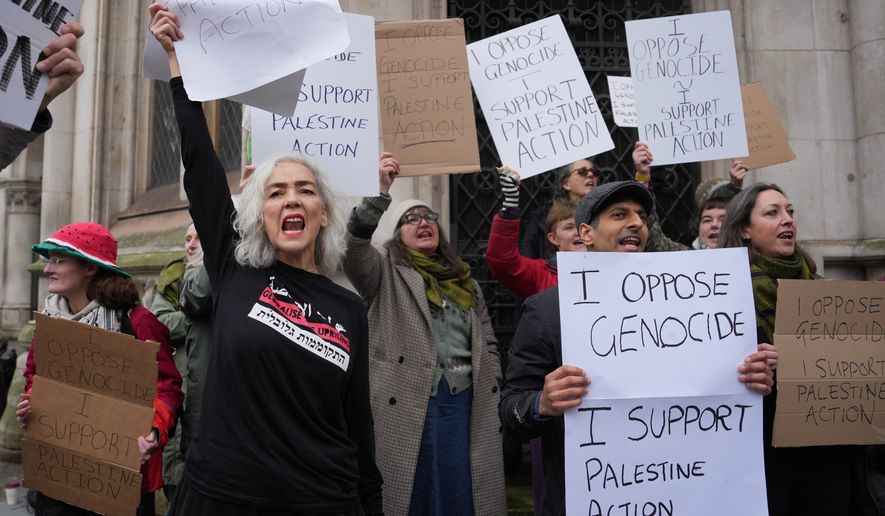
The ban was never lifted during the appeal, and more than 3,300 people have been arrested at protests for actions as simple as holding signs saying, “I oppose genocide. I support Palestine Action.”
More than 700 have been charged under the U.K.’s Terrorism Act, although no one has yet been convicted, as the cases were put on hold pending the appellate decision. A judge will decide on June 30 whether those court cases proceed.
The backlog is likely to keep growing as protesters appear undeterred following the ruling. Police arrested more than 115 people in the large crowd of Palestine Action supporters outside the Royal Courts of Justice.
The group Defend Our Juries criticized the ruling and said it would lead to more police resources being wasted locking up peaceful protesters.
“It appears the courts have been instrumentalized to suppress opposition to genocide, when they should be doing the precise opposite,” the group said in a statement issued after the ruling.
Carr said the court understood that the ruling could create a “chilling effect” to dissuade law-abiding people from supporting the Palestinian cause for fear of being swept up with supporters of Palestine Action.
“It is one thing for people voluntarily to hold a placard supporting Palestine Action which they know to be a proscribed organization. That is a criminal act,” Carr wrote. “As a matter of law, the proscription decision will not prevent public expressions of support for the Palestinian cause or opposition to Israel and to the Israeli Defense Force.”
Palestine Action has carried out direct action protests at military and industrial sites in the U.K. since it was formed in 2020, including breaking into facilities owned by Israeli weapons manufacturer Elbit Systems UK. Officials said the group’s actions have caused millions of pounds in damage that affect national security.
The High Court judges said that while some of those crimes amounted to terrorist acts, they could be criminally prosecuted regardless of proscription.
On Friday, four members of the group who broke into the Elbit factory in Bristol, in southwest England, in 2024 and smashed equipment were imprisoned after a judge found they acted as terrorists. The group clashed with security guards and law enforcement, and a police sergeant suffered a fractured spine after being struck with a sledgehammer.
The group has been around since at least 2020, when it launched its first attack on Elbit’s London headquarters by smearing red paint on the building. But it has grown in prominence on the streets since Israel launched its military offensive in Gaza following Hamas’ Oct. 7, 2023, attack that killed some 1,200 people and saw 250 others taken hostage.
The Palestinian Health Ministry in Gaza says over 73,000 Palestinians have been killed since the war started. The ministry operates under the Hamas-run government and is staffed by medical professionals and maintains detailed records that are generally considered reliable by the international community. The ministry does not differentiate between civilians and combatants.

Please read our comment policy before commenting.