



Most public school districts nationwide are slashing staff and budgets this summer as rising costs and falling enrollments squeeze their finances.
The school-tracking website Burbio recently highlighted 10 large districts that are making billions of dollars in cuts because dwindling headcount has reduced public funds. The districts include Denver Public Schools, Portland Public Schools, Baltimore City Public Schools, Dallas Independent School District and Fairfax County Public Schools in Virginia.
“It will be a more difficult year than last year,” Burbio President Dennis Roche said in an email. “The major factors driving it include enrollment declines, rising costs of special education and student services programs, and benefit costs for employees.”
Burbio previously reported that most districts trimmed their staffing, program and supply budgets last summer after the returning Trump administration ended access to pandemic stimulus grants.
Education insiders told The Washington Times that President Trump’s mass deportations and expansion of school choice incentives have only added to the pressure on public school budgets since then.
“Birth rates are down, immigration rates have decreased, and more parents are opting to homeschool their children,” said Tyrone Howard, a UCLA education professor specializing in racial equity. “There are fewer Latino immigrants to America, a huge part of the population coming to the U.S. over the past several decades.”
Public school enrollment nationwide dropped by an estimated 1.5 million students after pandemic restrictions shuttered campuses starting in 2020. Most switched to private or homeschooling options and never returned.
Patrick J. Wolf, an education reform professor at the University of Arkansas, noted a recent estimate that 30% of illegal-immigrant parents kept their children out of school during the past year for fear of deportation.
“The smart districts are laying off administrative and support staff, not teachers,” Mr. Wolf said. “Most districts have staffed up over the past few decades and are top-heavy with administrators.”
Burbio’s report noted that Baltimore City Public Schools adopted a $1.954 billion operating budget for 2026-27 – a 4.4% increase from the previous year, despite enrollment staying essentially flat at 71,486 students.
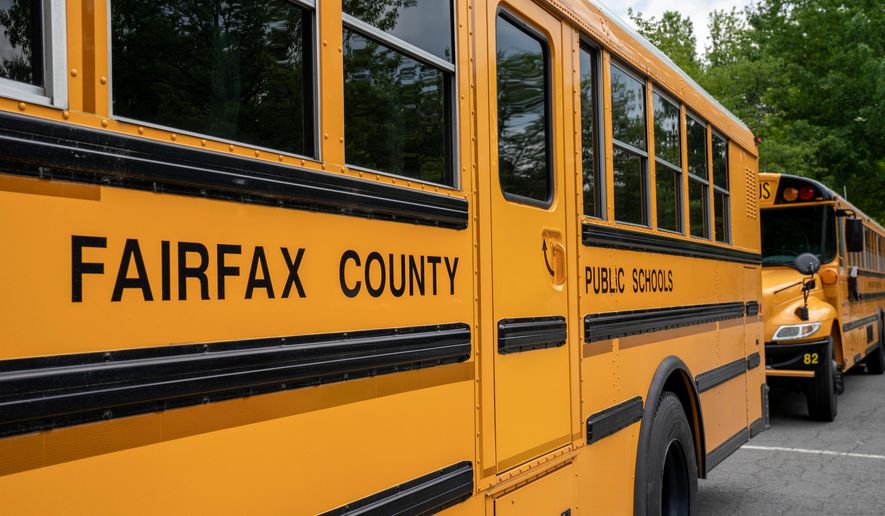
Fairfax County Public Schools reduced its initial budget request for the coming school year by $39.7 million – including the cancellation of 70 reserve staff positions – to address an estimated 2.7% fewer students.
But Fairfax school officials still approved a $4.08 billion operating budget, up $98.8 million or 4.3% from the year before.
“Budgets will always increase because the costs of goods and services always increase,” said Stewart D. Roberson, a University of Virginia education professor and former public high school principal in Fredericksburg. “And inflation is a significant influence.”
The Department of Education estimates that national public school enrollment declined from a historic peak of 50.8 million students in fall 2019 to 49.5 million in fall 2023, the most recent available data.
Meanwhile, U.S. birth rates have fallen to historic lows since peaking in 2007 and remain well below replacement levels.
Spending spree
Ramin Taheri, CEO of Magnet Schools of America, a national network of public magnet campuses, said public schools have “never fully recovered” from families jumping ship during the COVID pandemic.
“Many districts have responded by reducing staff, closing schools, consolidating campuses, or freezing hiring,” said Mr. Taheri, a former Biden Education Department official. “Districts in cities such as Chicago, Philadelphia, Denver, Portland, and others have faced difficult staffing and facility decisions due to enrollment losses and the expiration of federal pandemic aid.”
During the pandemic era, the federal government under Mr. Trump and President Biden allocated $189.5 billion in Elementary and Secondary School Emergency Relief grants for K-12 campuses to implement public health restrictions and offset learning losses.
Hundreds of schools with dwindling headcounts spent the money on support programs, technology upgrades and extra teachers, even as they extended virtual learning requirements.
“This combination of reduced enrollment and the loss of temporary federal funding is forcing some districts to make difficult choices, including staff layoffs, program reductions, and school closures,” said Gema Zamarro, a K-12 education market researcher at the University of Arkansas.
Conservative parental-rights groups say many families gave up on public schools after seeing them spend money to keep children home longer than private campuses during the pandemic.
“They watched schools close during COVID, saw what was happening in their children’s classrooms firsthand, and many never regained confidence in the system,” said Kimberly Fletcher, president of Moms for America.
“Schools continue to receive taxpayer money despite failing outcomes and declining enrollment,” added Sheri Few, president of U.S. Parents Involved in Education.
The New York City Department of Education, the nation’s largest school district, has projected that its enrollment will fall by 4.2% from 766,730 to 734,551 in the coming school year. That builds on a decline of 100,000 students between fall 2019 and 2022.
The conservative Manhattan Institute noted in a recent analysis that Mayor Zohran Mamdani has proposed raising the department’s budget by 7.4% to spend $42,000 per student in the coming year, despite roughly half of its pupils failing basic math and reading requirements.
“The city keeps financing an increasing number of underenrolled schools at the same level when they had more students,” said Danyela Egorov, a Manhattan Institute fellow who wrote the analysis. “Eventually, New York will have to adjust the budget if it wants to be on a fiscally responsible path.”
Michael J. Petrilli, president of the Thomas B. Fordham Institute, an education think tank in Washington, said the city’s plan to keep spending more to educate fewer students is “not financially sustainable” and “the height of irresponsibility.”
Glimmers of hope
Other districts have managed to shrink their budgets for the coming year, however.
The Portland Public Schools board adopted an $862.1 million General Fund budget for 2026-27, down 0.75% from the prior year. The budget will implement a 6% staffing reduction of 288 full-time positions to address a $50 million deficit and 1.6% enrollment decline.
And in Texas, the Dallas Independent School District board has approved a $2.491 billion operating budget, including a 2.2% decrease in non-debt spending as enrollment falls by 1,731 students to 132,577.
Officials at Caissa K12, a communications firm that works with Dallas ISD and other large districts to recruit students, said public campuses that rebuild trust with families will have the best chance of competing against alternative schooling options.
“The districts that are struggling most are not simply victims of declining birth rates,” said Brian J. Stephens, the Tennessee-based cofounder and CEO of Caissa K12.
“They are often districts that have not fully adjusted to the fact that families now shop for schools the way they shop for almost everything else,” he said.
Correction: An earlier version of this story misidentified the city where the Fordham Institute is based.
Contact the author


Please read our comment policy before commenting.