


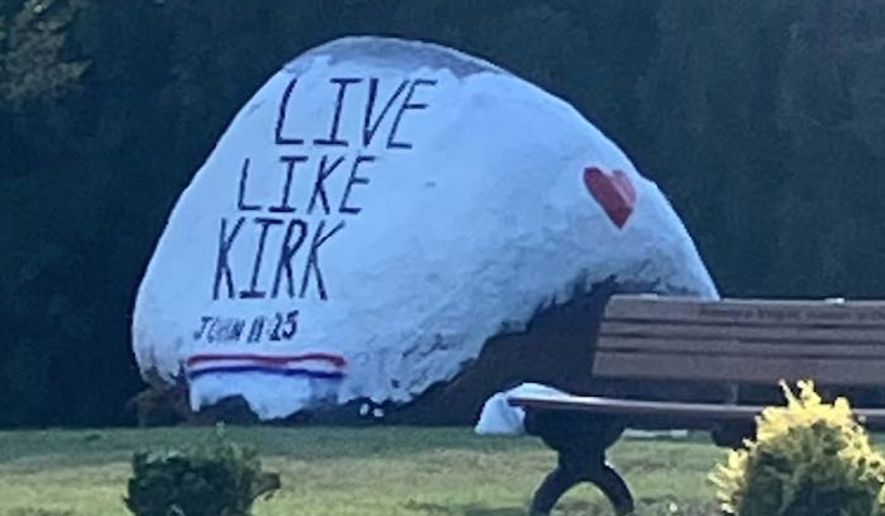

A North Carolina school district entered into a five-figure settlement to resolve a free-speech lawsuit filed after painting over a student’s tribute to Charlie Kirk on a campus forum known as “spirit rock.”
The Charlotte-Mecklenburg Board of Education will pay $95,000 in damages and attorneys’ fees; update its free-speech policy; and issue a statement exonerating the teen and expressing “regret that the student had this experience,” according to the Alliance Defending Freedom.
“What happened to this student is outrageous. School officials should never censor, punish, or shame a student simply for sharing her views,” Travis Barham, ADF senior counsel, said in a Monday statement.
The lawsuit filed in December accused the board of violating the First and Fourteenth Amendment rights of the student, a junior at Ardrey Kell High School, by muzzling her homage to Kirk shortly after his Sept. 10 assassination.
“Charlie Kirk boldly defended open and respectful discourse on school grounds literally until his last breath, and this courage inspired many across the country, including our client, whom Charlotte-Mecklenburg Schools officials treated so abominably,” Mr. Barham said.
The student identified in the complaint as G.S. painted “Freedom 1776” and “Live Like Kirk — John 11:25” on a large boulder near the school’s main entrance after obtaining the go-ahead from an office employee to post “something for Charlie Kirk who recently passed.”
Students frequently painted the boulder with messages, including “Black Lives Matter” and “Hands Up Don’t Shoot” in 2020, following the killing of George Floyd by a police officer in Minneapolis.
Even so, school officials ordered the Kirk tribute scrubbed, then contacted law enforcement about what the principal described as “vandalism.”
The student was called out of class to write an official statement and ordered to show administrators her phone logs without her parents’ permission.
The district followed up with a revised speech code that banned religious and political statements from the rock, restricting messages to those conveying “positive school spirit” and upholding “the inclusive values of our school community.”
The alliance argued that the policy allowed school officials to “subjectively decide what speech is ‘positive.’”
Three days later, school officials concluded that the student and her friends had not committed vandalism, but did not offer an apology or acknowledge that she had been under investigation.
The board voted June 9 to adopt its first district-wide policy on student free speech that prevents students from being disciplined for protected speech.
“Unless otherwise restricted by law or policy, non-disruptive student speech that does not impair the rights of others should be presumed to be protected under the First Amendment,” the Student Free Speech policy said. “In other words, the default position is that student speech is constitutionally protected. This includes, but is not limited to, political and religious speech.”
The district included exceptions for “disruptive speech, “speech that invades the rights of other students,” “profane speech,” and speech promoting illegal drug use.
“The policy committee, along with our legal department, are confident we have a policy that provides clarity and guidance for each of our school leaders that allows students to exercise their First Amendment rights while minimizing incidents that could cause disruption,” Gregory Ranking, board vice chair, told WCNC-TV in Charlotte.
The Washington Times has reached out to the school district for comment on the settlement.
Mr. Barham called it “long past time for school officials to learn that they cannot promote student viewpoints they like while punishing students whose views they dislike.”
“We hope the new policy prevents school officials from subjecting any other students to the abuse our client experienced and will instead force them to respect every student’s constitutional rights,” he said.
Contact the author


Please read our comment policy before commenting.