



President Trump drew a stark line Tuesday between his Iran nuclear agreement and his predecessor’s, calling former President Barack Obama’s 2015 deal “a road to a nuclear weapon” and insisting his own agreement leaves no such opening, warning Iran that any attempt to develop, buy or acquire a nuclear weapon will bring catastrophic retaliation.
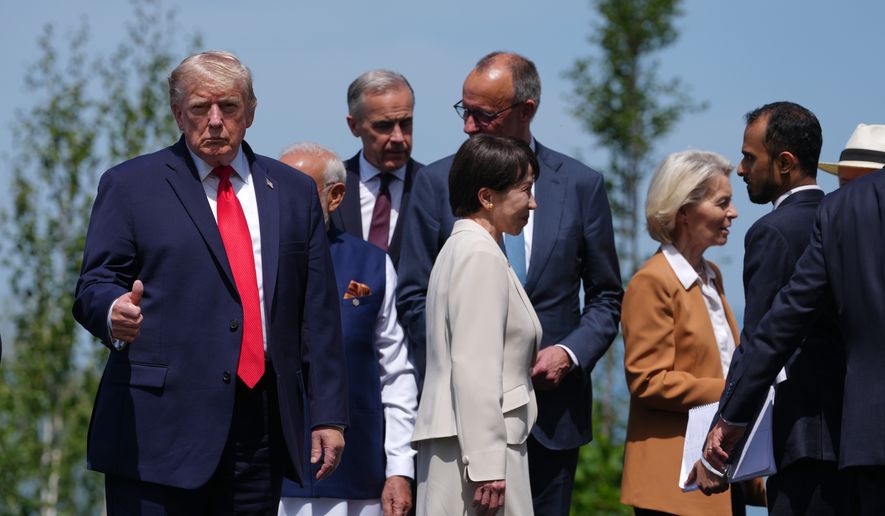
“This deal is a wall to a nuclear weapon. [Mr. Obama’s] deal was a road to a nuclear weapon. My deal — they can’t have a nuclear weapon,” Mr. Trump told reporters at the G7 summit in Evian, France.
“They’ll get blown up if they have a nuclear weapon. … In his deal, they were allowed to have a nuclear weapon.”
Mr. Trump also noted that the U.S. paid the Iranian regime “nothing,” while the Obama administration “paid them billions of dollars, and it was a disaster.”
The new agreement, brokered with Qatar’s mediation, contains no such expiration window, according to the president, and pairs its prohibitions with the implicit threat of military force demonstrated by last year’s B-2 bomber strikes on Iranian nuclear facilities.
Mr. Trump told reporters he pushed for stronger language in the deal, saying the Iranians “originally wrote that ’We will not develop a nuclear weapon.’ I said, ’No, no, you’re not going to develop it. You’re not going to buy either.’ That took another couple of days of time.”
Mr. Obama was among several Democrats who criticized Mr. Trump’s planned peace deal with Iran, telling ABC News last weekend it was “doubtful” any agreement would significantly improve on his 2015 nuclear pact with Iran.
“It is doubtful that any agreement that arises is going to be significantly different, or a significant improvement from the deal that we had in the first place,” Mr. Obama told the news organization, adding that the agreement “worked for a long stretch of time”
The Joint Comprehensive Plan of Action, reached 11 years ago between Iran and world powers, including the U.S., traded sanctions relief for limits on Tehran’s nuclear program — capping uranium enrichment, shrinking its stockpile and opening its facilities to expanded international inspections.
But the agreement came with an expiration date. Sunset clauses would have let Iran resume full-scale enrichment by the mid-2030s, a timeline critics warned was a delay, not a permanent fix.
Contact the author


Please read our comment policy before commenting.