


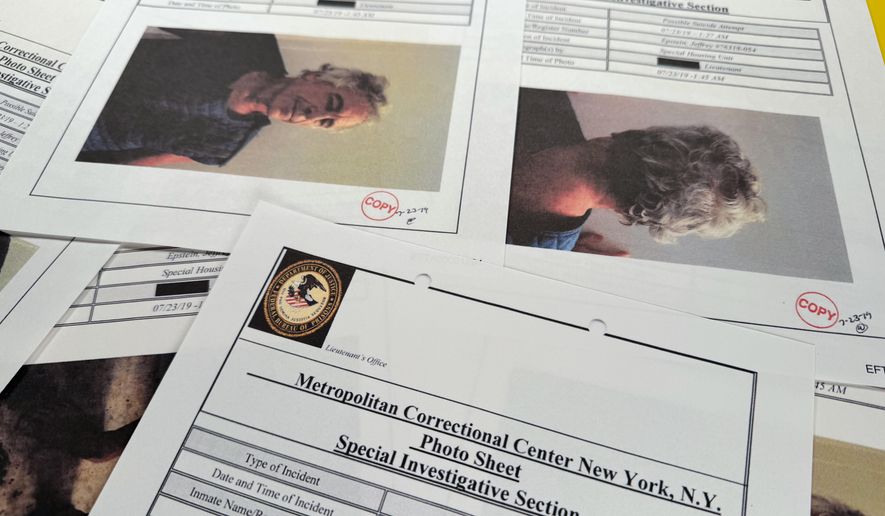

Democrats — whether from the East Coast, Rust Belt or Deep South — are making Jeffrey Epstein a centerpiece of their 2026 campaign strategies.
They wager that Republican candidates cannot shake the political toxicity of the administration’s initial — and, critics say, ongoing — resistance to releasing the Epstein files, tapping into voters’ appetite for accountability from the wealthy and powerful.
The strategy has even bled into ruby‑red Ohio, where former Sen. Sherrod Brown, a Democrat, has launched a comeback campaign against Republican Sen. Jon Husted. The two have spent weeks trading accusations that the other accepted campaign donations from associates of Epstein, the multimillionaire financier and convicted sex offender who authorities say hanged himself in a New York jail in 2019 while facing federal sex trafficking charges.
It is a sign of the combustibility of the Epstein issue.
Mr. Brown’s campaign accused Mr. Husted of accepting more than $116,000 in donations from Ohio billionaire Les Wexner, who had a long and documented relationship with Epstein. Mr. Husted’s campaign fired back with an ad accusing Mr. Brown of taking more than $124,000 from various alleged Epstein associates.
That back‑and‑forth, though, is only the local expression of a larger Democratic play.
Justin Buchler, a political science professor at Case Western Reserve University, said Mr. Brown’s posture mirrors a partywide strategy rather than an Ohio‑specific calculation.
“Regarding the Epstein files, Democrats as a party have made a strategic calculation, and Brown does not have any specific calculations unique to Ohio,” Mr. Buchler said. “He is a partisan, doing what everyone in his party is doing.”
The strategy has two layers. The first is tactical: Mr. Trump promised to release the Justice Department’s Epstein files, and then his administration fumbled the issue, frustrating his supporters and giving Democrats an opening. The second reflects a deeper shift in the party’s political identity.
“The Democratic Party has moved very far left, and one of its central features is a deep‑seated hatred of wealth and anyone with wealth,” Mr. Buchler said. “Any issue that directs their anger at what they perceive to be the evils of wealth is irresistible to the party at large.”
Republicans at the national level are pushing back hard on the Democratic strategy. They argue that it is Democrats, not Republicans, who have questions to answer on the Epstein files.
“Democrats like Sherrod Brown, Jon Ossoff and Graham Platner have taken hypocrisy to new heights by trying to weaponize the Epstein files while accepting campaign cash from individuals named in them,” said Bernadette Breslin, spokeswoman for the National Republican Senatorial Committee, the Senate Republicans’ campaign arm. Mr. Platner is the Democratic challenger to Republican Sen. Susan M. Collins in Maine.
“After decades of Democrat corruption, President Trump and congressional Republicans finally delivered transparency with the Epstein Files Transparency Act that released over 3.5 million pages to the public,” she said.
Republicans also say candidates such as Mr. Brown are trying to shift attention away from their flaws.
“This race won’t be decided by Epstein money; it will be decided by who delivers for Ohio families, and Senator Husted has provided tax cuts and safer communities — something Shady Sherrod can’t say he did,” said Hunter Lovell, spokesperson for the Republican National Committee.
Meanwhile, Democrats and a few Republicans still insist the Trump administration withheld critical files and over‑redacted others that the administration has been compelled to release by Congress.
The fight over the Epstein files is unfolding against a larger backdrop: Democrats likely need to win these marquee races — Ohio, Maine and Georgia — to have any realistic chance of flipping the Senate.
The same campaign scenario is playing out across several battlegrounds. Democrats deploy the Epstein smear, and Republicans try to throw it back on them.
In Maine, Mr. Platner — the Democratic challenger to Republican Sen. Susan Collins — made the Epstein files the focus of his first general election ad, targeting what he calls the “Epstein class” in an aggressive populist message designed to cast both parties as protectors of the rich and powerful.
“It seems the only thing the party establishments can agree on is a love of Jeffrey Epstein and a hatred of me,” Mr. Platner said in the 30‑second spot.
The Platner campaign said the ad underscores the central thrust of his message: that the rich and powerful have rigged the system against the working class and that elected leaders have failed to hold them accountable.
In Georgia, Mr. Ossoff hammered the issue on the stump, drawing sharp applause by linking Mr. Trump’s reluctance to release the Epstein files to his broader argument about economic inequality.
“While you pay more for everything, Donald Trump wants your tax dollars for what many are calling the Jeffrey Epstein Memorial Ballroom,” Mr. Ossoff told supporters earlier this year. “By the way, he forced out that Republican congressman — the one who made him release the Epstein files. Did you see that? That is true commitment to the cover‑up.”
Malcolm Kenyatta, co‑chair of the Democratic National Committee, said the Trump administration’s refusal to release more files underscores vividly what he described as Republicans’ unwillingness to serve as a check on the administration.
“You have an administration that is willing to release the UFO files but not release the Epstein files,” Mr. Kenyatta said. “The American people want accountability. Folks understand the wealthiest people play by a different set of rules — they understand that as it relates to the economy and accountability.
“Why won’t he release those documents?” he said.

Please read our comment policy before commenting.