


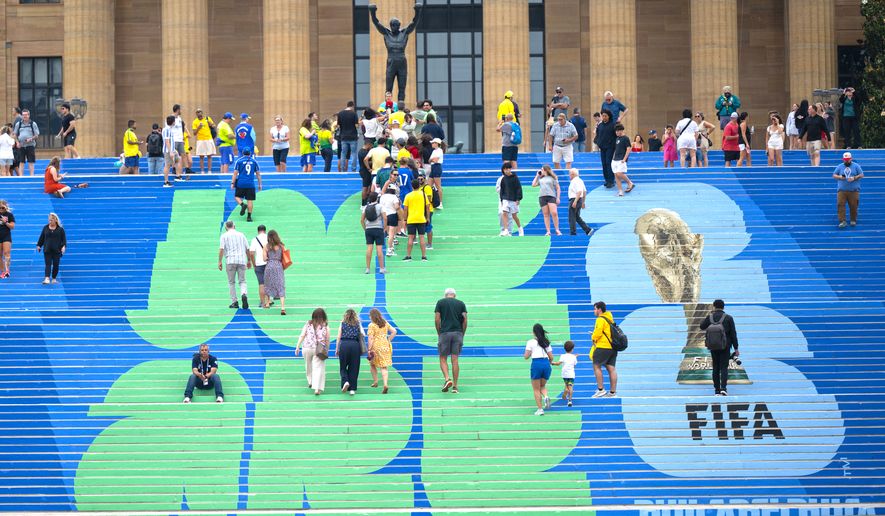

Sweltering temperatures, rampant crime and unfriendly locals. That was what the soccer fans who flocked to the U.S. for the World Cup were told to expect. Instead, international visitors told The Washington Times that they had fallen in love with great restaurants and bars, modern shops, supersize gas stations, historic sites and friendly Americans.
Through the first week of World Cup play, social media has been littered with viral moments of cultural exchange. One German fan’s online following has spiked as he shares experiences with local cuisine and communities. A Japanese fan, in limited English, has delighted local television viewers in Texas by proclaiming, “Texas is good; everything is big!”
“We’ve met a bunch of fans, and we’re all of the same mind,” Paul Rigby, an England supporter who attended the match Wednesday against Croatia in Dallas, told The Times. “We couldn’t have been welcomed more wholesomely if they tried.”
This is not Mr. Rigby’s first World Cup, nor is it his first time in the United States. He has been a regular visitor for decades, but this year’s event, he said, stands out, and not just because of England’s 4-2 opening match win.
The U.S. has received its share of bad international press in recent months and years, and criticism has intensified with the strikes on Iran that began Feb. 28.
Yet the World Cup has put the U.S. in a different light for some fans.
“America and the world needed this. The world has been a pretty dark place for 10 years,” Mr. Rigby said. “Just being in a situation where different fan groups, communities are coming together just to have fun and learn about each other and engage, it’s been really special.”
The conversations for locals and tourists at bars, diners and parks across the country are not centered on international policy. The action on the pitch, including an early hat trick by Argentine superstar Lionel Messi, has come first.
The culture shock regarding the wonders of Americana is a close second.
“Everything is way bigger than in Europe,” Nikolina Culjak, who is visiting from Croatia, told The Times.

That has applied to portion sizes, cars and even the kitchens in her friends’ homes. The kitchens, in particular, delighted Ms. Culjak, who said the dreaded American small talk was a worthwhile trade-off.
Americans love to talk to one another or to strangers about anything, whether it is the World Cup or the weather.
It has been an adjustment for some travelers, who were not fully prepared for the full-throated embrace from locals.
“In general, the Americans have been pretty welcoming,” Ms. Culjak said. “They have been really, very polite.”
There is no simple way to prepare the European mind for the wonders of American excess.
Social media is filled with posts from foreign fans who discover and fall in love with parts of the U.S. that do not make it into Hollywood films.
Buc-ee’s, the megasize gas stations endemic to the South, have become a sort of pilgrimage for tourists traveling to and from games.
“They’ve just been in awe of the size and scale of everything,” Mr. Rigby said of his fellow foreign fans. “We’re outside of a Buc-ee’s right now, and it’s the size of a shopping mall.”
A German fan who goes by Freddy on X has attracted a substantial following by documenting his experiences with American culture.
“Just had our first Waffle House experience at 1 a.m. Great food, great prices, and friendly staff,” he wrote. “We will be coming back.”
Staples such as Taco Bell, ranch dressing and the small-town diner have earned similarly stellar reviews.
“EUROPE WE NEED RANCH ASAP,” Swedish tourist Elsa Thora wrote on an X post that included a photo of fries.
The pre-tournament concerns of crime, scorching temperatures, aggressive border agents and unfriendly Americans have faded away for most fans in U.S. host cities. Initial worries about U.S. summers — FIFA instituted two hydration breaks per match — have proved unnecessary, as most of the nation has dodged particularly miserable heat waves, though temperatures will rise as the tournament continues.
A few visitors have experienced visa issues — a referee from Somalia and a few officials from the Iranian squad were denied entry — but most fans who made the trip have not lodged major complaints about the process.
Meanwhile, the American hosts have continued to wow their guests.
“They’ve been absolutely fantastic,” Mr. Rigby said. “I couldn’t speak highly enough of everyone that we’ve met in bars, restaurants, diners, on the drive. There’s a genuine curiosity about how and why we travel.”
The biggest complaints about this year’s World Cup — hosted through a joint bid by the U.S., Canada and Mexico — are not related to the nations at all, but rather to the prices and scheduling dictated by FIFA.
Fans around the world have criticized soccer’s governing body for “dynamic pricing,” which allows organizers to adjust prices in real time based on demand. It has resulted in sticker shock for fans who are often paying thousands of dollars for the once-in-a-lifetime experience.
The biggest problem is “FIFA’s price-gouging,” said Mr. Rigby, who still considered himself fortunate as he donated to a Dallas-area food bank before England’s opener.
“All of this should prompt reflection, even within FIFA,” Mexican President Claudia Sheinbaum said Monday regarding the pricing issues.
On a larger scale, those concerns have been overshadowed by the feel-good stories of gracious American hosts and similarly respectful foreign tourists.
Japanese fans continued a long tradition of cleaning up after themselves when they visited Dallas Stadium for their Group F opener.
Scotland’s supporters, widely known as the “Tartan Army,” have made an even greater impact in New England, where thousands of fans stayed before an opening match at Boston Stadium. They partied at Boston’s parks, playing bagpipes and donning kilts, and left the spaces cleaner than they found them.
They also drank the entire supply of Sam Adams Boston Lager at the Boston Taproom owned by Boston Beer Co. this past weekend.
In nearby Providence, Rhode Island, the Scottish community raised $30,000 for local charities as a thank-you for the region’s hospitality.
“The community has welcomed us with open arms — the other night, a local man stuck my drinks on his tab, and we got chatting. We’re now going to keep in contact, and I’ve told him to come to Scotland,” Scotland fan Robert Copland told the BBC. “We weren’t sure what to expect staying here, but it feels like a community.”
Contact the author


Please read our comment policy before commenting.