


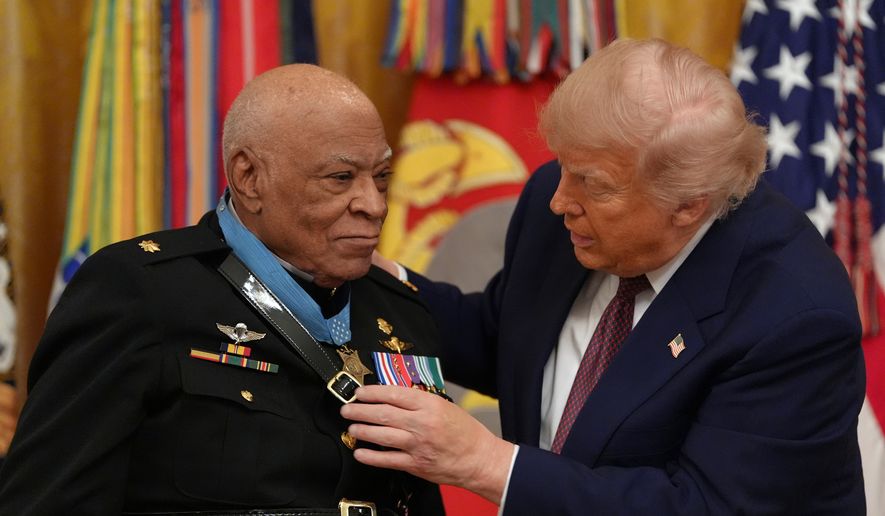

President Trump on Thursday awarded the Medal of Honor to two heroes from the Vietnam War and one from the Afghanistan War.
Retired U.S. Marine Maj. James Capers Jr., 88, the first Black American Marine officer recommended for the highest military award, waited nearly 60 years for his medal because of administrative and procedural snafus.
It took Congress passing legislation in March, a bipartisan effort led by Rep. Ralph Norman, South Carolina Republican, to finally give Mr. Capers the long-awaited recognition for his bravery and selfless act of heroism under enemy fire.
“Jim was recommended for the Medal of Honor in 1967, and everybody knew he should get it, but life is life. His commanding officer, who was his biggest fan, was tragically killed before the paperwork was done,” Mr. Trump said at the ceremony in the White House East Room.
“That’s a bad break, but maybe this is better. Jim, the nation kept you waiting far too long, so I say to you, congratulations, you made it,” Mr. Trump said.
Mr. Trump also awarded the Medal of Honor to retired U.S. Army Maj. Nicholas Dockery for distinguished service in Afghanistan and posthumously to U.S. Marine Col. John W. Ripley for heroism in Vietnam.
Mr. Capers, a native of Bishopville, South Carolina, became well known among his fellow servicemen through repeated acts of valor in 1967 while leading a Marine reconnaissance team near Phu Loc, Vietnam.
He sustained severe wounds during an ambush but refused to evacuate and continued to lead his team under enemy fire, making sure each corpsman made it out alive.
Only after every member of his team had been evacuated did he leave the battlefield.
Mr. Dockery received the medal for acts of gallantry and intrepidity above and beyond the call of duty on Oct. 2, 2012.
While serving as a platoon leader with 2nd Battalion, 12th Infantry Regiment, 4th Brigade, 4th Infantry Division in Kapisa Province, Afghanistan, a large and well-armed Taliban force ambushed his platoon.
Over the course of four hours, he fought and maintained contact with the enemy in extremely restricted urban terrain, risking his life repeatedly to protect and evacuate three wounded members of his platoon.
Ripley received the medal posthumously for acts of gallantry and intrepidity above and beyond the call of duty on April 2, 1972. While serving as a senior Marine adviser to the Third Vietnamese Marine Corps Infantry Battalion in the Republic of Vietnam, he played a pivotal role in halting a major North Vietnamese mechanized assault.
For three hours, he exposed himself to intense enemy fire as he climbed under a bridge to set explosives along its steel beams to emplace the charges at key structural points.
After successfully setting the explosives, he detonated the charges, destroying the bridge and stopping the enemy’s advance.
Contact the author


Please read our comment policy before commenting.