


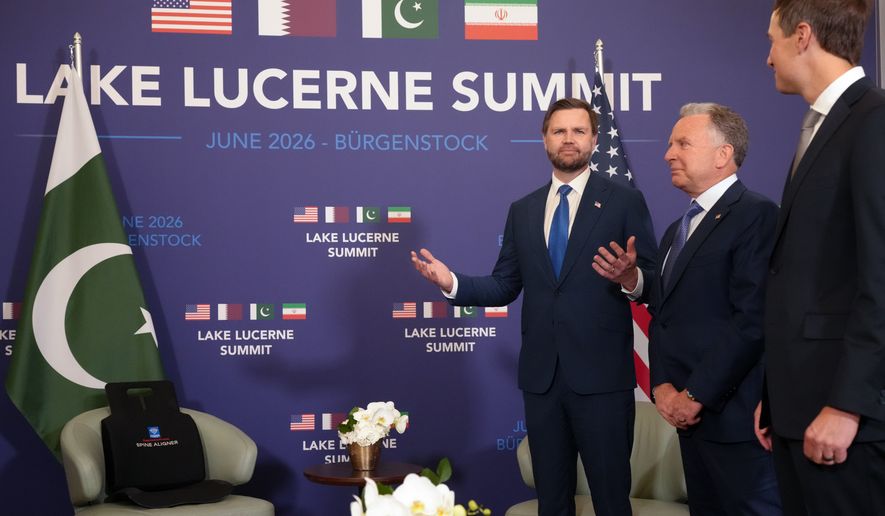

The U.S. and Iran presented differing narratives Tuesday on whether U.N. inspectors could visit nuclear sites and whether Tehran had any interest in buying American crops, underscoring a complex start to the 60-day negotiations.
President Trump insisted that Iran would agree to inspections of its nuclear sites as part of peace talks “despite their protestations and false statements to the contrary.”
“If they did not agree to this, there would be no further negotiations!” Mr. Trump said on social media.
Vice President J.D. Vance said Monday that Iran had agreed to the inspections as the two sides met in Switzerland to begin a 60-day negotiation window aimed at producing a final deal to end the Iran war.
On Tuesday, however, Iranian Foreign Ministry spokesman Esmail Baghaei denied that Tehran had agreed to accept inspections by the International Atomic Energy Agency.
Mr. Trump said Iran’s frozen funds would be placed in escrow so the country could buy American corn, wheat and soybeans.
“These are things that are desperately needed by Iran. This is a humanitarian crisis, and I feel it is necessary to help, NOW, before it is too late. Talks are going well!” Mr. Trump posted.
Again, however, Iran denied the claim, saying it had no current demand for U.S. crops.
“It is interesting that the philosophy and goal of the war, which was the destruction of the Iranian civilization and the collapse of Iran, has become enriching American farmers,” Mr. Baghaei said.
The differences in perspective underscore the complex road ahead for the negotiations and the implementation of the provisions in the already agreed-upon memorandum of understanding.
“To make a real estate analogy, Trump confused a blueprint with a finished skyscraper,” said Michael Rubin, a senior fellow at the American Enterprise Institute and director of policy analysis at the Middle East Forum. “The Iranian strategy has always been the same. Obfuscate, delay and stall.”
The U.S. and Israel launched a military operation against Iran on Feb. 28 to prevent Tehran from gaining a nuclear weapon, foster regime change and rein in its support for terrorist proxies in the Middle East.
Iran retaliated with strikes on its Persian Gulf neighbors and by closing the Strait of Hormuz, causing energy shortfalls and higher oil prices.
The U.S. and Iran signed a memorandum of understanding last week to end the fighting, reopen the Strait of Hormuz and enter into 60 days of talks about ways to prevent Iran from acquiring a nuclear bomb.
The agreement also lifted the U.S. blockade of Iranian ports and required the U.S. Treasury Department to issue waivers that allow Iran to sell its oil.
U.S. critics of the deal said it offered too many up-front concessions to Iran and that Tehran would use delay tactics to string along the American side.
“Much as we hope for successful negotiations ending the war, American leverage is essential,” former Sen. Richard Blumenthal, Connecticut Democrat, said Tuesday on X. “We’re losing bargaining power at the outset by immediately lifting sanctions.”
The administration says the deal is performance-based, so Iran will realize no benefits unless it agrees to curtail its nuclear program.
Underscoring his carrot-and-stick approach, Mr. Trump said Tuesday that he would not block Iranian ports, citing Iran’s “concession” to inspections, but that ships would remain in the region in case he needs to reimpose the blockade.
Oil prices dropped after the first-stage deal, settling at about $75 per barrel, down from more than $100 at the height of the war. Gas prices in the U.S. continued to fall, with drivers paying an average of $3.93 per gallon Tuesday, down from more than $4 a week earlier.
The International Maritime Organization said it had finalized an evacuation plan for 11,000 seafarers who have been stranded in the region because of violence around the Strait of Hormuz.
Mr. Trump said the U.S. economy will soar again because of the recent deal. He added that 19 million barrels of oil have moved through the Strait of Hormuz.
“This large-scale operation will be carried out in close cooperation with Iran, Oman, all other coastal states in the region, the United States and the maritime industry,” the maritime organization, a specialized agency of the United Nations that oversees the safety of international shipping, wrote in a statement. “We have secured the necessary safety guarantees and have thoroughly verified the conditions for safe navigation to support these operations.”
Meanwhile, Iran moved Tuesday to allow for more commercial ships to travel through the Strait of Hormuz while securing some sovereignty over the waterway, which has long been considered international waters.
Iran and Oman held talks aimed at creating an agreement on future “management of navigation” in the strait. According to a joint statement from the two countries, the agreement would include “associated costs in line with international standards,” suggesting that they could charge fees on commercial vessels transiting the waterway.
Iranian officials have repeatedly said during their war with Israel and the U.S. that they would retain control over the Strait of Hormuz even after the war concluded and would charge fees for ships attempting to transit.
Secretary of State Marco Rubio said the U.S. would not allow any country to charge fees in the strait, citing international law.
“No country is allowed to charge tolls or fees on an international waterway. That’s existing international law. That’s the way it is in international waterways all over the world, and that’s the way we expect it’ll be here. So I don’t think we have anybody to convince around here in that regard,” he told reporters soon after arriving in Abu Dhabi on Tuesday.
Renewed fighting in Lebanon also highlighted the fragility of the peace deal. Although the memorandum’s first provision calls for a ceasefire on all fronts, including in Lebanon, Iran-backed Hezbollah and the Israeli military have repeatedly clashed over the past week.
The Israel Defense Forces said it engaged militants after identifying an active Hezbollah cell close to troops in the Ali al-Taher Ridge, near the city of Nabatieh, which is part of Israel’s “security zone” in southern Lebanon.
Hezbollah said in a statement carried by Iranian media that the attack was a clear violation of the ceasefire agreement it reached with Israel on Sunday. The attack also targeted civilians, Hezbollah said.
Iran has previously threatened to abandon negotiations with the U.S. if Israel does not halt attacks on Hezbollah and remove its forces from Lebanon.
Israel, while agreeing to a ceasefire, said its military is prepared to strike Hezbollah at any time if threatened or attacked first. Israeli officials also have ruled out withdrawing troops from southern Lebanon, where they occupy about 232 square miles.
The Israeli military has said the occupied territory is intended to act as a buffer zone to protect citizens in northern Israel, who have come under infrequent rocket attacks from Hezbollah since March. More than 1 million people have been displaced as a result of Israel’s destruction of homes and continued military operations in Lebanon, according to UNICEF.
Contact the author



Please read our comment policy before commenting.