



A bill barring members of Congress and their family members from placing government-related bets on prediction markets narrowly passed a House panel.
The House Administration Committee voted 5-4 along party lines Wednesday to pass the Stop Lawmakers from Predicting Act, with Republicans voting in favor of the legislation.
The bill would prohibit lawmakers, their spouses and their dependent children from participating in prediction markets regarding specific government policy, governmental action, a political outcome or information learned through congressional service. It also places a fine on those who violate the proposed rule.
Rep. Bryan Steil, the committee chair and bill sponsor, said the bill aims to address concerns that lawmakers could profit from public policy- and election-focused bets, while avoiding a total ban on unrelated prediction market trading.
“Lawmakers elect to serve the American people, not to enrich themselves by wagering on outcomes from the decisions they make,” the Wisconsin Republican said. “We have a real opportunity to restore trust in Congress by taking necessary steps to eliminate even the appearance of impropriety.”
This proposed legislation would apply only to members of Congress and would not implement a blanket ban for all government officials.
In April, the Senate unanimously passed a resolution to ban members and staffers from trading on prediction markets altogether.
Democrats on the committee voted against the bill in protest of its limited ban, arguing that it doesn’t go far enough.
The panel’s top Democrat, Rep. Joseph D. Morelle of New York, proposed an amendment that would have rewritten the bill to more broadly ban lawmakers, their immediate families and staff, as well as candidates for federal office and their staff.
The bill “is meant to blunt the momentum on real reform” but is “so filled with loopholes that it looks more like a sieve than a bill,” Mr. Morelle said.
“We could solve this problem today — this bill won’t do that,” he added.
Mr. Steil opposed Mr. Morelle’s amendment, arguing the broader ban could unintentionally cover unrelated sports betting on prediction markets traded by congressional family members.
“Say an individual has a son or daughter who’s 18, goes to college. They get excited during the NCAA tournament. They turn on their phone, and they make an otherwise legal bet, or a prediction,” Mr. Steil said. “Under my colleague’s amendment, with a broad brush, their dependent child away at college would trigger a federal violation of the underlying member.”
Instead of passing the bill, Mr. Morelle coaxed his fellow Democrats toward following the Senate’s lead to approve a broader resolution.
“The Senate did it in a matter of minutes — no six-month grace period, no procedurally laborious process,” Mr. Morelle said. “They just went to the floor with a two-page resolution and banned it all unanimously. We should do the same.”
Having cleared the committee, the bill can now be brought to the House floor, but its viability is uncertain.
“The Senate is certainly not going to pass a bill that is a weaker version of what they already have done by rule,” Mr. Morelle said.
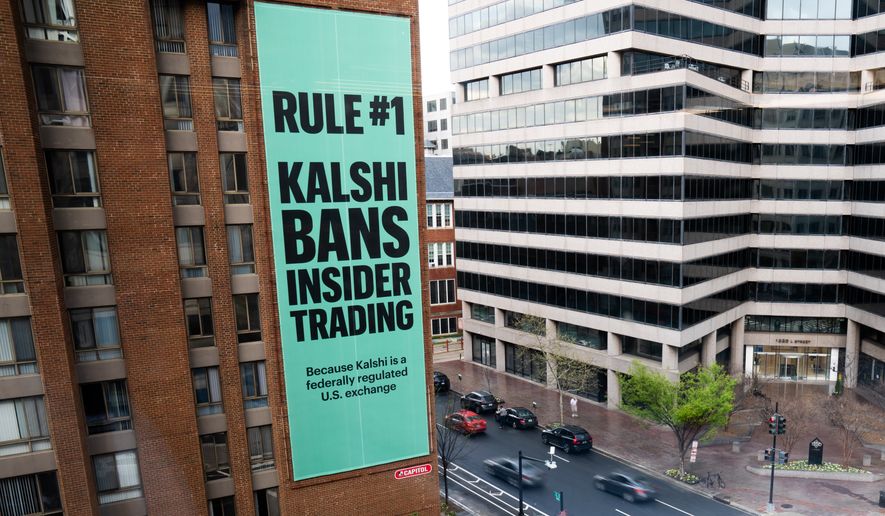
Its advancement underscores Capitol Hill’s efforts to curb numerous instances this year of alleged insider trading on prediction markets.
Since January, after the Trump administration captured Venezuelan President Nicolas Maduro, a series of well-timed trades resulted in massive payouts in the hundreds of thousands of dollars. A U.S. Army Special Forces soldier involved in the operation used classified mission details to place wagers on Polymarket that Maduro would be removed from power.
Prediction markets have seen over $2 billion in volume betting on the Iran war, with major platforms like Polymarket offering specific wagers on U.S. strikes, ceasefires, leadership changes and nuclear agreements.
Meanwhile, federal prosecutors are investigating former New York Rep. George Santos over betting against his attendance at President Trump’s State of the Union address in February after the involved prediction market alerted federal investigators.
Contact the author


Please read our comment policy before commenting.