


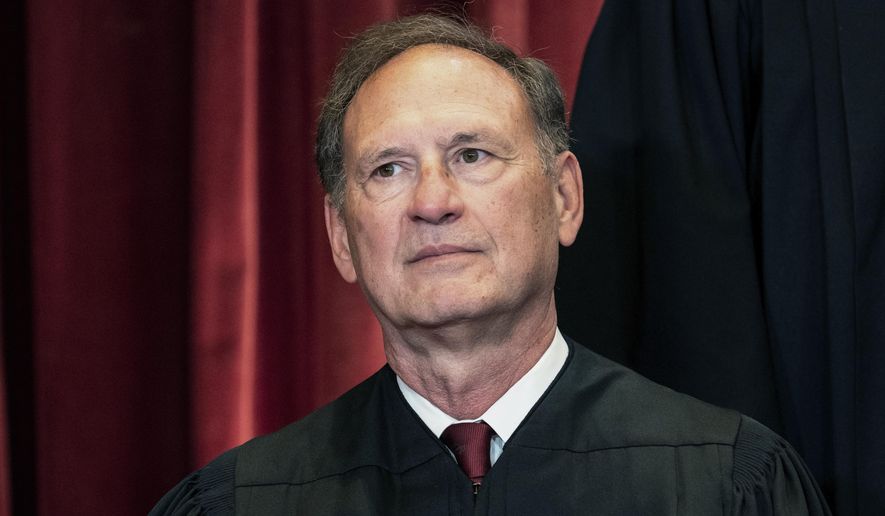


Justice Samuel A. Alito Jr. won’t retire until the Supreme Court overturns a roughly 30-year-old religious liberty precedent.
So says Mollie Hemingway, author of the recently released biography “Alito: The Justice Who Reshaped the Supreme Court and Restored the Constitution” (Basic Liberty). Ms. Hemingway, editor-in-chief of The Federalist online magazine, recently held a Q&A in Arlington, Virginia, where she offered her prediction.
People were interested in these podcasts
“I am just going to speculate here: I personally believe, if you study his jurisprudence going back to when he was a federal judge, he cares deeply about Employment Division v. Smith,” the conservative columnist and commentator said.
“You see Alito on the 3rd Circuit working around Employment Division v Smith,” she said, recalling when the conservative justice was a circuit court judge in the 1990s before being sworn onto the Supreme Court in 2006.
In Employment Division v. Smith, the Supreme Court ruled that a state can deny employment benefits to someone who had used illegal drugs. The issue was that an American Indian worker had used peyote as part of a religious exercise and claimed that denying him benefits ran afoul of the First Amendment.
“I do not see him leaving the court until that’s done, but that is me speculating,” Ms. Hemingway said of Justice Alito.
Court watchers have debated whether there’s a greater-than-usual chance that Justice Alito, 76, or Justice Clarence Thomas, 77, may retire before November’s midterm elections.
A court retirement with a GOP-led Senate would easily be filled by President Trump, giving him a fourth high court nominee. He had three during his first term: Justices Neil M. Gorsuch, Brett M. Kavanaugh and Amy Coney Barrett.
In “Alito,” Ms. Hemingway details Justice Alito’s role on the court as the justice who wrote the decision to overturn Roe v. Wade, the 1973 landmark decision that gave women a national right to abortion. The biography was published on April 12.
Contact the author


Please read our comment policy before commenting.