



A version of this story appeared in the daily Threat Status newsletter from The Washington Times. Click here to receive Threat Status delivered directly to your inbox each weekday.
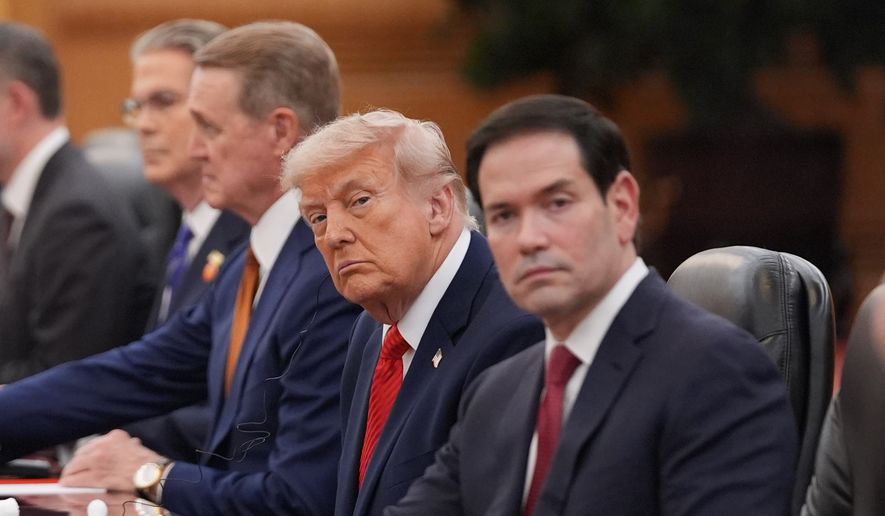
Secretary of State Marco Rubio said Chinese warnings of a conflict over Taiwan during the summit in Beijing have not altered the U.S. policy of supporting the island democracy.
“U.S. policy on the issue of Taiwan is unchanged as of today, and as of the meeting that we had here today, it was raised,” Mr. Rubio told NBC News.
The secretary said the Chinese always bring up Taiwan in discussions, and the summit was no different.
People were interested in these podcasts
Chinese President Xi Jinping told President Trump in talks Thursday that his regime views dealing with the self-ruled island of Taiwan — which China has vowed to annex using force, if necessary — as the most important issue for U.S.-Chinese relations.
“If it is handled properly, the bilateral relationship will enjoy overall stability. Otherwise, the two countries will have clashes and even conflicts, putting the entire relationship in great jeopardy,” Mr. Xi said, according to a Foreign Ministry readout of his statements during the meeting with Mr. Trump.
Mr. Xi said maintaining peace across the 100-mile-wide Taiwan Strait is “irreconcilable” with Taiwan’s formal independence. He urged the U.S. president to use “extra caution in handling the Taiwan question.”
SEE ALSO: Trump summit with Xi in China: Smiles amid stark threat of ‘clashes and even conflicts’
In Taipei, Taiwanese Executive Yuan spokeswoman Michelle Lee responded to Mr. Xi’s comment by saying, “China’s military threat is the sole source of insecurity in the Taiwan Strait and the broader Indo-Pacific region.”
Ms. Lee said Taiwan is continuing to bolster its defenses and joint deterrence efforts.
Taiwan “views all actions that contribute to regional stability and the management of potential risks from authoritarian expansion positively,” she said, noting that the United States “has also repeatedly reiterated its firm and clear position of support for Taiwan.”
A White House statement on the talks, posted on X, made no mention of the veiled Chinese threat on Taiwan and described the session as “a good meeting” between the two leaders.
Mr. Rubio said the United States always makes its position on Taiwan clear during talks and then the discussions move on to other topics.
“We know where they stand, and I think they know where we stand,” he said.
Regarding Taiwan’s importance to China, Mr. Rubio said the U.S. recognizes China’s position and that the exchange between the two presidents reflected past discussions on the subject.
“From our perspective, any forced change in the status quo and the situation that’s there now would be bad for both countries,” he said.
U.S. weapons sale to Taiwan
The leaders emphasized stability during the meeting aimed at achieving normal U.S.-Chinese relations “so that we don’t have misunderstandings that could lead to broader conflict,” Mr. Rubio said.
“And so we always reiterate the point we hear them when they say this, we always respond by saying anything that would compel or force a change in what we have now would be problematic and that we would certainly, our policies on that have not changed,” he said.
Mr. Rubio said Mr. Xi also raised the issue of U.S. arms sales to Taiwan. He noted that the question of arms sales is not limited to the executive branch because Congress also plays a role in supplying defensive weapons to Taiwan.
Trump administration leaders have avoided public mention of U.S. arms support for Taiwan.
However, the administration is preparing to sell a record-setting $14 billion in weapons to the democratically run island. The pending sale includes advanced missiles, Patriot anti-missile interceptors and anti-drone defenses.
The 1979 Taiwan Relations Act, passed after the transfer of diplomatic recognition from Taipei to Beijing, outlines U.S. policy of supporting Taiwan with defensive arms.
“It did not feature primarily in today’s discussion,” Mr. Rubio said of the arms sales. “We know what their position on that is already.”
U.S. arms were sold as recently as December, which upset the Chinese, he said.
“And that’s a decision the president gets to make as Congress appropriates and as Congress decides what to do with those topics, we will respond accordingly,” he added.
Defense of Taiwan
Asked whether the United States would defend Taiwan, Mr. Rubio said U.S. policy is “unchanged as of today, and as of the meeting that we had here today, it was raised.”
Mr. Trump has avoided saying how the United States would respond to a Chinese attack on Taiwan. However, he has said that Mr. Xi assured him that an attack would not take place while he is in the White House.
China and the United States take different approaches to Taiwan, and the island’s status remains unresolved after negotiations that led to full U.S. diplomatic recognition of Beijing in 1979.
China adopted its “One China” policy, and the United States acknowledged it. The mainland policy calls Taiwan a sovereign Chinese territory. The U.S. policy recognizes Taiwan as part of China but does not recognize mainland sovereignty over it.
U.S. policy calls for resolving the dispute peacefully, while China has not ruled out the use of force.
U.S. military commanders have warned that Mr. Xi ordered the People’s Liberation Army, the Chinese Communist Party-controlled military, to prepare to use force against Taiwan by 2027.
Military intelligence officials have said the PLA is making significant progress toward overwater military assault capabilities but still has a way to go before being ready.
Over the past several years, PLA forces have conducted large-scale military operations around Taiwan in saber-rattling that Navy Adm. Sam Paparo, commander of the Indo-Pacific Command, has called rehearsals for an attack.
Army Lt. Gen. Joel B. Vowell, deputy commanding general of U.S. Army Pacific, said recently that threatening PLA warship and warplane activities around Taiwan are designed to wear down its defenses.
“The ships would set up and look like they’re ready to start either a quarantine or a blockade. And that’s very provocative for an island nation,” Gen. Vowell said.
Chinese Foreign Ministry spokesman Guo Jiakun said Mr. Xi told Mr. Trump that bilateral relations can be built on “constructive strategic stability” and that, if Taiwan-related differences are handled properly, stable ties would result.
Chinese opposition to U.S. arms sales to Taiwan is “consistent and clear,” Mr. Guo said.
The ‘Thucydides Trap’
Regarding past Chinese sanctions, Mr. Rubio said those measures were imposed based on “actions and rhetoric on China,” when the secretary was a senator.
Former State Department official John Tkacik said most of the discussion about Taiwan came from Mr. Xi.
“The Chinese will do their best to separate [the president] from his advisers, and have Xi work him over one-on-one, on Taiwan, particularly,” Mr. Tkacik said.
“They usually will issue mendacious or prevaricating press statements that POTUS said thus-and-so, or this-and-that, which will muddy the waters until the U.S. side issues clarifications. I trust the president was briefed on this,” he said.
During the summit, Mr. Xi told the president that the global situation is fluid and turbulent and asked whether the two nations could overcome the “Thucydides Trap” and build better relations.
The theory was popularized by Harvard professor of government Graham Allison, based on ancient Greek historian Thucydides’ account of the Peloponnesian War. It posits the idea that conflict between China, a rising power, and the United States, an established global leader, is highly likely.
Critics have dismissed the Thucydides Trap argument as irrelevant in the nuclear power age.
Chinese propaganda has sought to weaponize the Thucydides Trap argument to promote Beijing’s narrative that China will eclipse the United States as the global superpower.
Mr. Xi raised the trap during the summit as something to be avoided as a way to promote Beijing as a responsible power while deflecting scrutiny of nefarious Chinese behavior, such as its cyberattacks, regional military bullying and human rights abuses.
During comments before the meeting, Mr. Trump repeated his flattering description of Mr. Xi as a good friend and a respected, great leader.
Contact the author

Please read our comment policy before commenting.