


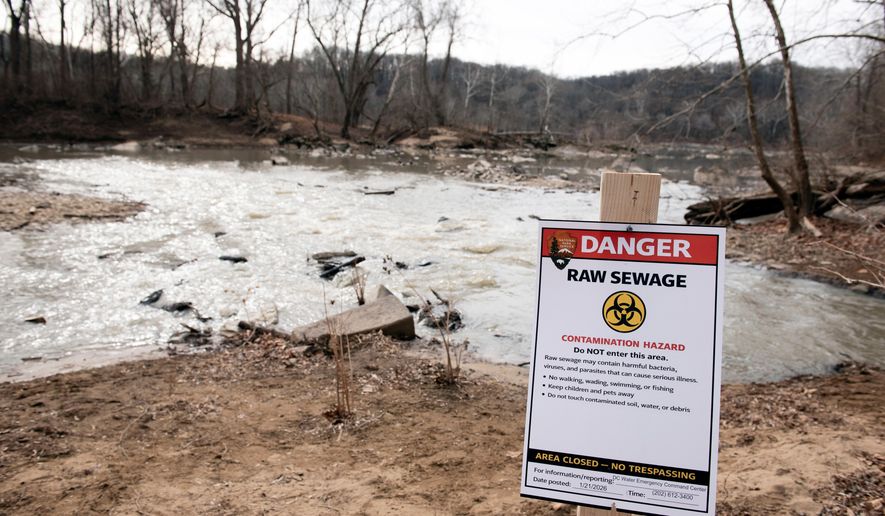

DC Water’s top executive told Congress Wednesday that federal officials still have not explained why they never approved repairs to the aging sewer line that ruptured this winter, spewing nearly 250 million gallons of untreated human waste into the Potomac River.
CEO David Gadis told lawmakers that the repair approval process, which began with the National Park Service in 2018, continues even after the Potomac Interceptor pipe ruptured in January, causing an ecological disaster in the waterway.
Rep. John Joyce, the Pennsylvania Republican who is chairman of the House Energy and Commerce subcommittee on oversight and investigations, pressed Mr. Gadis about whether the utility had asked the National Park Service to expedite its approval.
People were interested in these podcasts
Mr. Gadis said DC Water was told the utility “had to go through the process.”
“We do not feel that eight years is satisfying,” he said.
Mr. Gadis said no definitive cause has been determined for the pipe break, but he suggested that the sewer line, after 60-plus years of wear and tear, finally gave way, leading to the catastrophic rupture.
Compounding the cleanup, Mr. Gadis said, were boulders along the pipe’s path that fell into the fractured section and created a dam. He said the rock dam exacerbated the initial five-day span in which most of the sewage overflows occurred.
Disease-causing bacteria, including E. coli and MRSA, were found in water near the rupture site in Montgomery County, Maryland.
D.C. officials shut down recreational activities on the river and told residents that the water was so polluted they should avoid contact.
The sewage spill is considered one of the largest in U.S. history, and the incident helped cement the Potomac’s status as the nation’s most endangered river, according to the conservation nonprofit American Rivers.
Congressional representatives said the only saving grace was the location of the pipe break, which was near the C&O National Historic Park.
“Luck played a large part in keeping D.C.’s drinking water safe,” said Rep. Yvette Clarke, New York Democrat. “If the Potomac Interceptor collapse had been further upriver, the capital’s water supply could have been contaminated.”
Boating, kayaking and fishing resumed on the Potomac by March.
Jessica Kramer, who works with the Office of Water at the Environmental Protection Agency, said the river has been largely cleansed of its most potent bacteria and only some minor soil patches near the Potomac Interceptor continue to require removal.
Yet National Park Service officials who testified were cagey about why the pipeline’s infrastructure upgrades remain in limbo.
It was previously reported that the agency took issue with the scope of the Potomac Interceptor repairs because of their impact on trees and other vegetation in the area.
Edward Wenschhof, the National Park Service’s acting superintendent for the Chesapeake & Ohio Canal National Historical Park, said the approval process can accommodate some design changes after construction begins, but wholesale changes require utility companies to resubmit their proposals and start from the beginning.
Mr. Wenschhof said construction permits from utilities typically take six months to a year for approval.
He added that emergency orders issued after the rupture have allowed repairs at the site of the break, but an active lawsuit over the incident prevented him from discussing the specifics of the delayed approvals.
Lawmakers said they understood that reluctance but expressed frustration with the length of the normal process and the ease with which it could be delayed.
“Eight years is too long to wait for an environmental assessment, and I say this in a nonpartisan way, because over those eight years, we had Democratic and Republican administrations,” said Rep. Diana DeGette, Colorado Democrat.
“One thing we need to do is we need to figure out how to speed up environmental assessments so that we can make sure we don’t have these kinds of ruptures that are endangering public health,” she added.
Ms. Kramer said she thought Maryland officials did not address the emergency as quickly as they could have, given the severity of the pipe break.
Ms. Kramer said that during a prior stint at the Florida Department of Environmental Protection, the state agency raced to address a water main break that threatened the environment. Maryland officials did not move with the same urgency against what has been called one of the nation’s worst sewage spills, Ms. Kramer said.
The ruptured pipe sparked a political fight over who was responsible for the fiasco. President Trump pointed his finger at the heavily Democratic leadership in the Washington area.
Last month, Maryland and the Justice Department sued DC Water and the District, accusing the two defendants of being responsible for the pipeline’s deterioration.
Maryland has defended the Potomac’s well-being despite the sewage spill. State environmental officials said the river is “healthier today than it was a generation ago” and called the rupture an “acute, localized incident.”
DC Water said it expects to fully repair the Potomac Interceptor by the end of the year.

Please read our comment policy before commenting.