


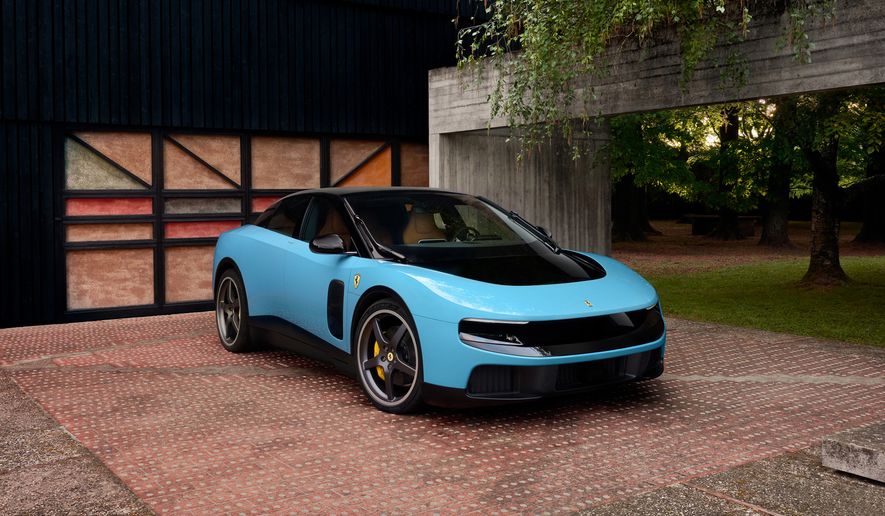

Ferrari shares fell sharply Tuesday after the Italian sports car manufacturer unveiled the Luce, its first fully electric vehicle, at a ceremony in Rome, triggering a wave of investor anxiety over the brand’s pivot away from the combustion engines that made it famous.
Milan-listed shares of Ferrari dropped more than 6%, while U.S.-listed shares on the New York Stock Exchange fell roughly 4%.
The Maranello-based automaker unveiled the Luce — Italian for “light,” a name the company said “evokes clarity and direction” — at the Vela di Calatrava venue in Rome. The model marks a significant departure from Ferrari’s traditional aesthetic and arrives even as rival luxury automakers Porsche and Lamborghini have scaled back their own electric vehicle ambitions amid weak demand.
People were interested in these podcasts
Chief Executive Officer Benedetto Vigna called the launch a “very, very important day” for the company and described it as the opening of “a new chapter” in Ferrari’s history. Addressing concerns about whether the electric model could satisfy both longtime customers and new buyers, Mr. Vigna told CNBC, “Look, when you do a new technology, you need always to keep in mind a word that is called respect.”
“Respect of the technology, because when you have a new technology, you need to make sure that that technology is properly represented in the design, so the design must be different,” he added.
The Luce is also Ferrari’s first production car homologated for five occupants — prior models including the Purosangue and GTC4Lusso seat four — and can accelerate from zero to 60 mph in approximately 2.5 seconds, reaching a top speed of roughly 192 mph. It is powered by a quad-motor all-wheel-drive system producing more than 1,000 horsepower and carries a starting price of approximately 550,000 euros, or roughly $640,000. Ferrari’s CEO has confirmed customer deliveries are scheduled to begin in October.
The exterior design — conceived in collaboration with LoveFrom, the agency founded by former Apple chief design officer Jony Ive — drew polarized reactions, with some reviewers and social media commentators comparing it unfavorably to mass-market electric vehicles.
Analysts attributed the stock’s decline to a mixture of what they called “design hate” and the classic market dynamic of “buy the rumor, sell the news,” noting that Ferrari’s share price had risen significantly in the days ahead of the launch.
“Ultimately many fans are disappointed that Ferrari is embracing the EV concept, believing it dilutes the supercar brand, which has modelled itself around classic design and raw, combustion-engine power,” Michael Field, chief equity strategist at Morningstar, told CNBC by email.
Mr. Field also noted that investors had feared the development of an electric model because of the high research and development costs, which could pressure the brand to recoup the investment and potentially weigh on returns.
Anthony Dick, an auto analyst at Oddo BHF, said the sell-off was “by far the sharpest reaction we’ve seen for a car design — the market has spoken.”
Despite the backlash, Mr. Vigna pushed back on the notion that the Luce would fail to deliver the emotional experience Ferrari is known for. He said the car would give drivers “the same sensation” as a traditional model, arguing that the electric engine’s sound is simply different — “each engine has its own sound” — and that what ultimately matters is “the emotion that is [being given] to the driver.”
Ferrari has committed approximately 4.7 billion euros to electrification through 2030, with battery electric vehicles expected to account for roughly one-fifth of sales by the end of the decade. The company’s order book currently extends through the end of 2027.
This article was constructed with the assistance of artificial intelligence and published by a member of The Washington Times' AI News Desk team. The contents of this report are based solely on The Washington Times' original reporting, wire services, and/or other sources cited within the report. For more information, please read our AI policy or contact Steve Fink, Director of Artificial Intelligence, at sfink@washingtontimes.com
The Washington Times AI Ethics Newsroom Committee can be reached at aispotlight@washingtontimes.com.

Please read our comment policy before commenting.