


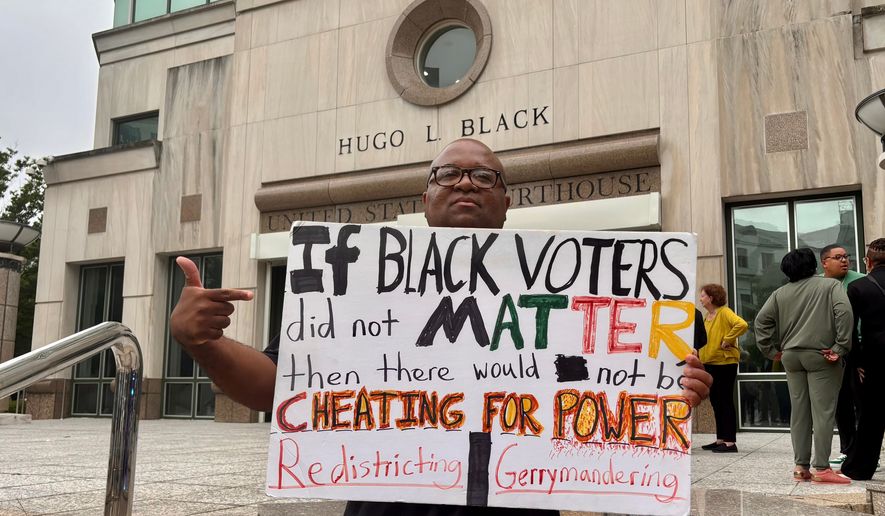

Republicans’ redistricting offensive suffered a series of setbacks Tuesday when South Carolina’s GOP-run legislature rejected a new map and federal judges tossed out Alabama’s redrawn congressional districts.
The South Carolina state Senate blocked a redistricting measure that would have eliminated the state’s only Democrat-held seat. A handful of Republicans sided with Democrats to kill the redrawn map recently passed by the House.
The state’s upper chamber also rejected a plan to schedule a new primary with the revised map that could have ousted longtime Democratic Rep. James E. Clyburn, essentially making Tuesday’s early in-person voting in the state moot. Because early voting already began for the previously scheduled June primary, some Republicans said it was too late to reschedule.
People were interested in these podcasts
While Mr. Clyburn’s seat is relatively safe this year, his district — the state’s only majority-Black district — could be redrawn before 2028.
Meanwhile, new Republican-drawn maps in Tennessee and Florida survived separate court challenges on Tuesday.
The Tennessee Supreme Court upheld the GOP map against a challenge by the NAACP. In Florida, a state judge allowed the implementation of the new Republican-friendly map while three lawsuits against it proceed through the courts.
These are the latest twists in a mid-decade redistricting frenzy that came at President Trump’s behest. He pushed it in GOP states to help Republicans hold the House majority. Democrats responded in kind to help their quest to flip the House.
Texas kicked off the nationwide battle to redraw districts.
Mr. Trump had urged South Carolina lawmakers to redraw the map to evict Mr. Clyburn from his district, prompting Republican Gov. Henry McMaster to call a special session to redraw it. State Senate Majority Leader Shane Massey, however, has long opposed gerrymandering, believing that “Republicans are stronger when the Democrat Party is vibrant and viable.”
Hours before the South Carolina vote, federal judges blocked Alabama Republicans’ gerrymandered plan.
A three-judge panel found that the map unconstitutionally discriminates against Black voters and that their ruling is not affected by the Supreme Court’s recent decision narrowing the Voting Rights Act.
“Ultimately, we cannot see our way clear to requiring Alabamians to cast their votes in the 2026 elections under a districting plan tainted by intentional race-based discrimination,” the judges ruled.
A preliminary injunction requires continued use of the old court-drawn congressional districts, including a second majority-Black district. The court found that the proposed map cannot be interpreted as “anything other than intentionally discriminatory.”
State officials asked the court to scrap the previous order that required the map to be used until after the 2030 census, seeking to revert to a court-blocked map from 2023 that had just one Democratic-leaning district.
Alabama Attorney General Steve Marshall said that the state would appeal to the Supreme Court.
The seat at the core of the issue — one that Republicans want — is held by Democratic Rep. Shomari Figures.
“This is a significant step in the right direction, but there is still a long way to go before this fight is settled,” Mr. Figures said on social media. “This case is still not over.”
Lawyers representing Black voters argued that the same judicial panel previously ruled the state’s map was intentionally discriminatory against Black voters, pointing to illegal dilution of their political power.
The ruling bucks the Supreme Court’s decision last month that struck down Louisiana’s court-ordered majority-Black district as an unconstitutional racial gerrymander, narrowing how states can use race in redistricting. This prompted several Republican-led Southern states — Florida, Mississippi, South Carolina and Tennessee — to pass new, heavily redrawn maps that could eliminate minority electoral districts that have favored Democrats.
Alabama’s redistricting battle stretches back to 2023, when the blocked map was found intentionally discriminatory by this same court.
Contact the author


Please read our comment policy before commenting.