



A version of this story appeared in the daily Threat Status newsletter from The Washington Times. Click here to receive Threat Status delivered directly to your inbox each weekday.
NEWS AND ANALYSIS:
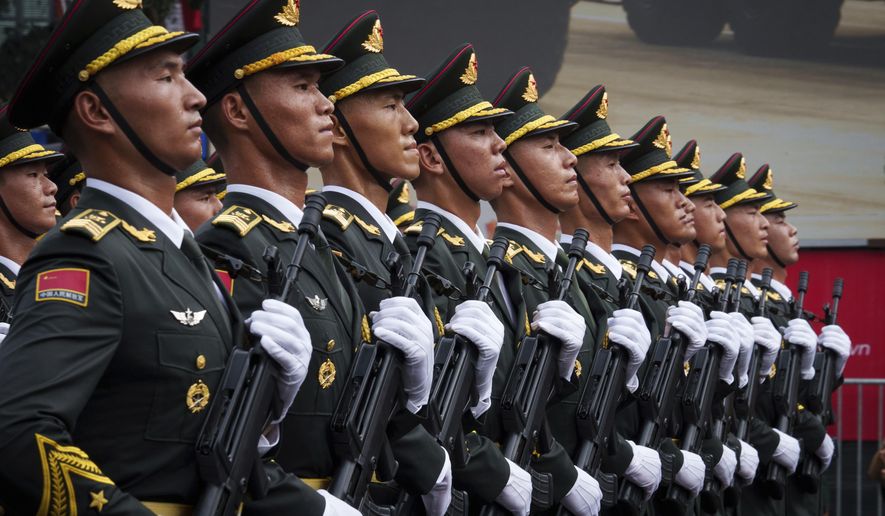
China’s People’s Liberation Army increased its army, navy, air force and rocket force structures along with increasing military specialties for waging of space conflict, information warfare and cyberwar in the past year, according to a new report by an Air Force think tank.
“This restructuring is explicitly intended to improve the PLA’s ability to conduct joint, all‑domain operations and informationized warfare in contingencies ranging from Taiwan to the western Pacific and Indian Oceans,” the report by the China Aerospace Studies Institute warns.
PLA military reforms have also refined and improved the command structure for the relatively new five theater commands, the report said.
People were interested in these podcasts
The 113-page report, “PLA Aerospace Power: A Primer on Trends in China’s Military Air, Space, and Missile Forces,” was made public on Tuesday.
The creation of the new PLA aerospace force after dissolving the strategic support force in 2024 also bolstered space warfare capabilities.
The growing PLA power is described in Chinese military writings as air, missile, naval aviation, and space capabilities that are “mutually reinforcing tools for deterrence, coercion, and, if necessary, high‑intensity regional conflict,” the report states.
CASI Director Brendan S. Mulvaney said the latest report is a main source for understanding China’s drive for waging advanced warfare.
“It explains how the People’s Liberation Army air forces, space capabilities, and the CCP directed aerospace industrial base, are rapidly progressing and modernizing its aerospace force; rivaling, and in the case of hypersonic weapons even surpassing, those of the U.S.,” he said.
A troubling advance for the PLA air force in the past year was evident in long-range nuclear deterrence and strategic signaling with H-6 nuclear bomber patrols and joint flights with Russian Tu-95 strategic bombers near Japan and South Korea, the report said.
Chinese nuclear bombers also conducted patrols near Taiwan along with large numbers of warship operations that, the report said, “have become routine and are explicitly framed by Chinese sources as warnings against ‘Taiwan independence’ and external interference.”
The past year also saw major increases in the development of Chinese aircraft carrier power projection, which the report said is “extending China’s naval aviation reach beyond the first island chain and narrowing qualitative gaps with U.S. carrier strike groups.”
The carrier operations are bolstering power projection capabilities into the western Pacific and Indian Ocean and “indicate that China is on the cusp of fielding a more capable carrier aviation force able to support sustained blue‑water operations,” the report said.
PLA missile power is also advancing significantly, with large numbers of missiles of all ranges and types that threaten U.S. and allied bases, ports and naval forces in the region.
The missiles complement air forces and navy aviation by providing “rapid, long‑range precision strike options against regional targets, complicating U.S. and partner operational planning in a crisis,” the report said.
The increase in missile power happened despite a purge within the missile force and defense industry that may have disrupted some procurement and timelines for advanced missile and space weaponry.
“We nonetheless judge that despite short‑term disruptions, sustained growth in China’s defense budget and political commitment to modernization mean that PLA [Rocket Force’s] long‑term trajectory remains upward, albeit with greater central oversight and potential delays in selected high‑end systems,” the report said.
Space warfare capabilities also increased in the past year, the report said.
Foreign joint exercises and military sales also stepped up in the past 12 months, with close defense and military ties to Russia, Iran, Pakistan, Egypt, Saudi Arabia, and some European and Latin American states, the report said.
Taken together, PLA military developments over the past year confirm that China is steadily improving its capacity to project power and impose costs on adversaries across multiple domains, the report concluded.
“At the same time, the anti‑corruption campaign in the defense sector, the technical complexity of advanced carrier aviation and space systems, and the possibility of miscalculation during increasingly frequent joint drills and close air and maritime encounters all underscore that China’s rise as an air and space‑power is neither linear nor without risk.”
Space Force urged to deploy troops on Moon
The Space Force must plan to deploy troops on orbiting space stations and at bases on the Moon to prevent China from winning the new space race and controlling outer space, according to a report by an aerospace think tank.
The report by the Mitchell Institute for Aerospace Studies warns that a sustained human military presence in space is needed to counter China’s growing space efforts that are run by the People’s Liberation Army, including plans for a Moon base by 2030.
“China is poised to achieve positional advantage in setting norms, standards, and legal frameworks for lunar habitation and lunar economy,” states the report, made public May 22. “This condition is unacceptable for U.S. national security.”
Military troop deployments in space are needed to defend American interests over the long term and to prevent Chinese dominance in the region of low-Earth orbit to the Moon in the 21st century, the report states.
Using unmanned drones for military operations or limiting space presence to civilians under the direction of the National Aeronautics and Space Administration poses national security risks, based on China’s current designs on space, the report said.
A human military space presence is imperative because of the growing likelihood of a high-stakes competition for control of lunar access and resources.
“China’s own aggressive disposition on Earth and in space and the militarization of their human spaceflight programs make it clear that Guardians, under the purview of the U.S. Space Force, must seek to understand and cultivate its own spaceflight operations,” the report said, noting Beijing’s history of belligerent maritime and territorial assertion.
“With a potential ‘in person’ lunar conflict with China as the contextual touchstone, the U.S. must begin a pragmatic multi-decade effort, leveraging its Space Test Course (STC), as well as partnerships with NASA and commercial space companies, to deliver the skills, tools, and concepts needed for future Title 10 activities to enforce U.S. space power-enabling norms and standards,” the report said.
Title 10 is the U.S. code guiding all military operations.
China’s plans for a Moon space station could violate the 1967 Outer Space Treaty space program run by the PLA because the treaty prohibits claims of lunar sovereignty and militarizing the Moon.
The U.S. should seek to uphold the treaty, but pragmatically, preparations for a U.S. military base on the Moon are needed despite the pact, the report said.
“China has consistently sought control of territory with belligerent force on the ground, sea, and air, and they are building the means to do so in space,” the report said.
Beijing’s leaders understand the future importance of space power and have underpinned their system with military hard power.
“Should China establish its space silk-road, built and sustained by the PLA, the influence and relative control the United States currently enjoys in space will become obsolete in the eyes of the world,” the report states.
“The United States must act now to achieve a space power vision that embraces human spaceflight. Only Guardians can ensure human spaceflight dominance…”
The report was written by retired Space Force Col. Kyle Pumroy, now a senior Fellow for space studies at the Mitchell Institute.
Congressional report reveals China’s continuing nuclear, missile proliferation
Chinese companies are continuing to sell nuclear weapons and missile-related systems and goods to Russia, North Korea and Iran, according to a Congressional Research Service report.
The Chinese government halted direct involvement in nuclear-related proliferation and transfers of complete missile systems, the report said.
“However, Chinese entities have continued to engage in proliferation, according to the U.S. government, which also has repeatedly expressed concerns with regard to weaknesses in China’s export control system,” the May 19 report stated.
A 2019 State Department report on arms control agreement compliance stated that China supplied missile systems and items to Iran, North Korea, Syria and Pakistan, and in 2023, U.S. requests for China to halt the missile transfers remained unresolved.
The 2024 and 2025 arms compliance reports dropped all mention of the Chinese missile proliferation activities.
The CRS report said separate State Department reports from 2024 and 2025, however, declared that Chinese companies and arms dealers “worked to supply technology and equipment that could be used to develop weapons of mass destruction (WMD) and their missile delivery systems to programs of concern” to North Korea, Iran, and Pakistan.
The State Department stated in April that Chinese companies are a major source of equipment, goods and technology for Iran’s ballistic missile program, which has been degraded sharply during the recent U.S. war.
Since 2024, the U.S. government has imposed sanctions on numerous Chinese companies and people for nuclear weapons and missile proliferation activities.
The sanctions include Treasury measures aimed at China’s missile support to Iran, and Commerce sanctions on a Chinese company linked to Pakistan’s nuclear programs.
China was notorious for its provision of nuclear weapons equipment and design support in the 1980s and 1990s, which led to Pakistan emerging as a nuclear missile power.
The CRS report quoted former Deputy Assistant Secretary of State Vann Van Diepen as saying that even if the Chinese nuclear and missiles transfers are not directly state-sponsored, “China hasn’t devoted the priority, effort, or resources to thwart” the arms proliferation.
Mr. Van Diepen also said that “when that continues to be the case over 20 years … over time it becomes a choice.”
China is also helping Saudi Arabia develop uranium production, the report said.
In addition to equipment and systems, China’s proliferation activities include money laundering, the provision of illicit financial services, and entities in China that are engaged in illegitimate procurement.
Chinese entities and individuals have engaged in proliferation financing activities “for the benefit of” Iranian and North Korean weapons of mass destruction programs, according to a Treasury report mentioned by CRS.
China is also building five nuclear reactors in Pakistan that are prohibited under Beijing’s commitment to an agreement called the Nuclear Suppliers Group.
The NSG prohibits building nuclear reactors in Pakistan that lack International Atomic Energy Agency safeguards.
Contact the author


Please read our comment policy before commenting.