


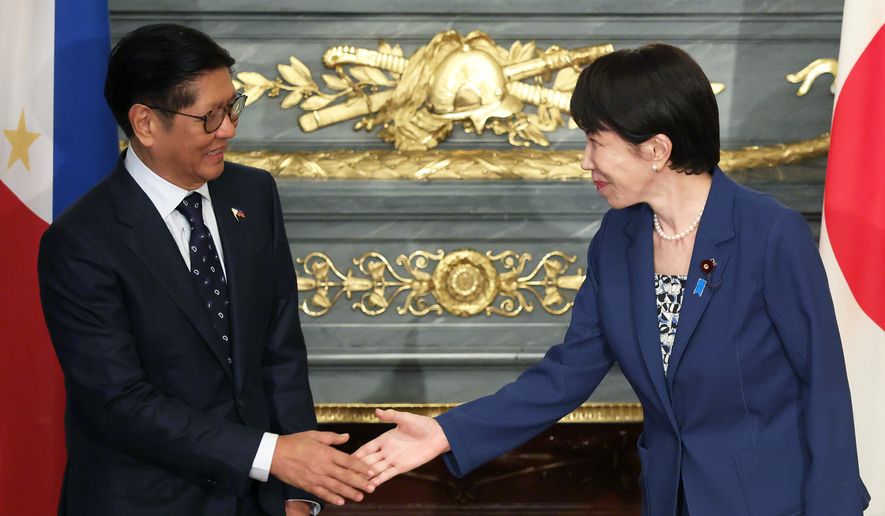

TOKYO — Japan and the Philippines on Thursday agreed to strengthen their defense cooperation by accelerating talks on Japanese weapons sales and intelligence sharing at a time of fears over China’s military activity in Asia.
The two countries also upgraded their ties to the highest-tier diplomatic framework of a Comprehensive Strategic Partnership, meaning that they will cooperate on a broader range of areas, not just on a strategic priorities.
Japan treated Philippine President Ferdinand Marcos Jr. with highest levels of hospitality, including a meeting with Emperor Naruhito, a palace banquet and one of Japan’s most prestigious decorations, the Grand Cordon of the Supreme Order of the Chrysanthemum, on Wednesday.
The message was clear: Japan sees the Philippines as a key defense partner and major arms customer in a region where tensions are rising.
Marcos, at a joint news conference after Thursday’s talks with Japanese Prime Minister Sanae Takaichi, called the partnership upgrade a “milestone” and that it “will be built on a foundation of friendship and shared values for peace, diplomacy and adherence to international law.”
Both nations have China firmly in mind as they tighten a military relationship that the United States hopes will act as a bulwark against Beijing’s ambitions in the East and South China Seas and its designs on Taiwan, the self-governing island China claims as its own.
PHOTOS: Japan woos Philippine leader during state visit with arms sales and China in mind
Red carpet for a big weapons customer
Philippines is the first potential major customer for Japanese arms since Takaichi’s government scrapped a ban on lethal weapons exports. The change in April was a break from Japan’s postwar pacifist policy as the nation accelerates its military and arms industry buildup.
The two leaders on Thursday agreed to pursue negotiations on a sale of multiple Abukuma-class destroyers and Japanese navy TC-90 training aircraft. Philippine Defense Minister Gilberto Teodoro Jr., who observed joint live-fire exercises with his Japanese counterpart earlier this month, also expressed interest in Type-88 surface-to-ship missiles.
Japanese officials say Marcos’ state visit also is linked to the 70th anniversary of diplomatic ties between the two countries and to the Philippines this year holding the rotating presidency of the Association of Southeast Asian Nations.
Military intelligence sharing
Marcos and Takaichi also agreed to formally start talks meant to achieve a military intelligence sharing pact.
“Japan will continue to further strengthen cooperation with the Philippines as we respond to the increasingly severe strategic environment in the region,” Takaichi said.
An intelligence sharing pact would enable closer communication and help tighten trilateral military cooperation with the U.S., their mutual ally, Japanese officials said.
Japan has provided a set of five coastal surveillance radars to the Philippines as part of official security assistance and intelligence-sharing would enhance reconnaissance cooperation.
Japan wants strong ties beyond Marcos
Takaichi said that their top-tier partnership “underscores commitments by the two countries to strengthen their partnership in a sustainable and multi-layered manner without being swayed by the changes of global environment.”
Japan wants to enhance its partnership with the Philippines beyond Marcos’ presidency, which ends in 2028, as Tokyo looks to avoid what is considered flip-flopping on China policy by some previous Philippine governments.
Marcos has taken a hard-line stance against China over maritime disputes in the South China Sea. During his presidency, the Philippines and Japan have bolstered their security ties bilaterally and trilaterally with the U.S.
Japan and the Philippines signed a pact in 2024 allowing their forces to smoothly visit each other’s country for joint military drills. This paved the way for Japan to deploy 1,400 military personnel as regular participants in joint military exercises.
The two countries signed a separate defense pact this year that would allow the tax-free provision of ammunition, fuel, food and other necessities when their forces stage joint training.
Energy security and oil reserves
During the state visit, Marcos and Takaichi also agreed to advance cooperation in trade, energy security, supply chain resiliency, including through a Japan-initiated multinational funding framework announced in April, the leaders said.
That framework is designed to help Southeast Asian countries, including the Philippines, stabilize oil reserves through financial assistance to build necessary infrastructure as they struggle from the fallout of the Iran war that has halted oil transports through the Strait of Hormuz.

Please read our comment policy before commenting.