



The Justice Department announced lawsuits Thursday against four Democrat-led states that have policies blocking ICE from obtaining registrations for vehicles used in undercover work.
Maine, Washington, Oregon and Massachusetts restrict access to confidential license plates. The Justice Department says their policies are unconstitutional and dangerous to federal agents at Homeland Security.
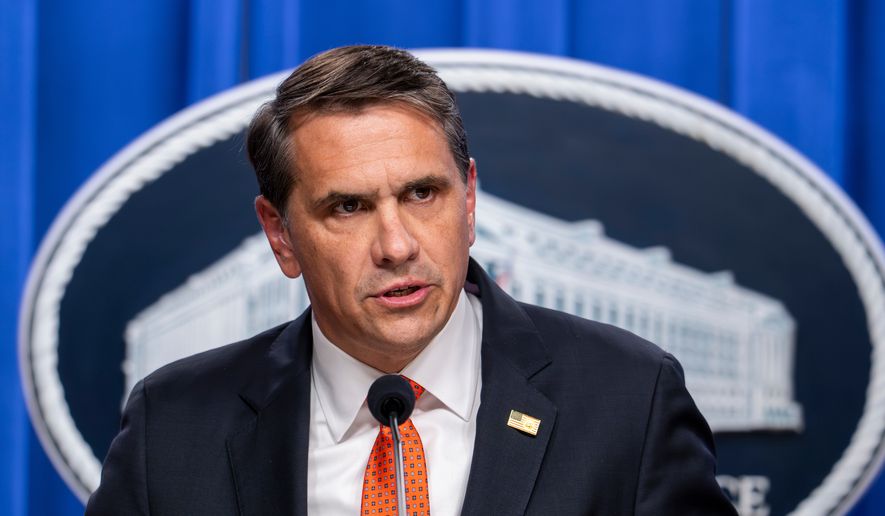
“By denying undercover license plates to DHS components, including ICE, while issuing them to their own state agencies, these governors are pursuing discriminatory and obstructionist policies against federal law enforcement,” acting Attorney General Todd Blanche said.
People were interested in these podcasts
Undercover plates are standard in law enforcement work, allowing agents and officers to blend in with regular traffic and conduct operations with less visibility. The Justice Department said it can also prevent U.S. Immigration and Customs Enforcement officers from being tracked and harassed.
As recently as last year, all four states allowed ICE and other federal agencies to obtain confidential plates.
But they have now changed.
Oregon, as of April, denies plates to all federal law enforcement agencies, citing a review of compliance. It makes federal agencies use “U.S. Government” plates instead.
Maine’s new process only grants plates to agencies that attest that the vehicles will “not be utilized for federal civil immigration law enforcement.”
Washington will still issue to the FBI, U.S. Marshals and U.S. Secret Service but, according to the lawsuit, it began refusing plates for ICE and Customs and Border Protection, DHS’s other immigration law enforcement agency, in October.
And Massachusetts says it won’t issue plates for civil enforcement, which is what most immigration arrests are, but will still issue them for criminal investigations.
“In Massachusetts, we support law enforcement doing legitimate criminal investigative work, and agencies doing that work can request confidential plates. But that’s not what we are seeing from ICE and its unconstitutional tactics,” Gov. Maura Healey said in response to the new lawsuit.
The state argues that its rules about civil investigations apply not just to federal immigration enforcement but also to civil enforcement at the IRS, and to Massachusetts’ own Department of Revenue.
The Justice Department, in its complaint, disputed that, saying the actual application doesn’t make the civil-criminal distinction.
Besides, the Justice Department said, Homeland Security can prove the plates are necessary to “protect the physical safety of law enforcement personnel using the vehicle,” which the state lists as a reason to issue plates despite the other rules.
Washington’s licensing agency declined to comment for this story.
The Washington Times has sought comment from Maine and Oregon.
Federal officials said each state is trying to use its own rules to regulate federal law enforcement. The Justice Department said that it tramples on the Constitution’s Supremacy Clause, which makes state laws subordinate to national ones.
The lawsuits are the latest in a string of legal cases the Trump administration has brought challenging sanctuary policies.
So far, the Justice Department has been mostly unsuccessful. Federal judges have blocked attempts to withhold money from sanctuaries.
And lawsuits aimed at overturning laws, such as New York’s limit on arrests at state courthouses, have been rebuffed by judges.
The Justice Department has seen success in challenging anti-masking and forced identification laws. California had both — and both have been blocked by federal courts that ruled they trampled on federal power.
California’s anti-masking law, in particular, was blocked because courts found it discriminated by singling out the federal government. The state had no similar law for its own personnel.
The Justice Department suggested that the same logic could apply to the license plate restrictions.
Contact the author


Please read our comment policy before commenting.