



OPINION:
Artificial intelligence is already changing warfare.
There’s no doubt AI can help our service members process enormous amounts of information, identify threats faster, improve logistics, strengthen cyber defenses and make better decisions under pressure. China and Russia are investing heavily in AI and autonomous systems because they know these technologies could determine who holds the advantage in the next conflict.
The United States cannot afford to fall behind.
People were interested in these podcasts
But after 25 years in the Navy as a combat and test pilot and 15 years as an astronaut, I know having the most advanced technology doesn’t guarantee success. Technology is a tool. What matters is whether our people know how to use it, understand its limitations and can still accomplish the mission when it fails.
Used well, AI can process information faster than any human and help commanders make sense of a complex battlefield. But in a conflict with a capable military like China’s, we should expect attempts to jam our communications, corrupt our data and try to disable the systems on which our forces depend.
That leaves our military with a lot of challenges to solve with AI. While we need to have the most capable systems, we can’t lose sight of these two principles: our service members must be able to fight when technology fails, and human judgment and responsibility must be at the center of decisions about the use of force.
So first, we need the Department of Defense to assess how reliance on AI affects readiness, identify the skills most impacted by AI and determine how service members keep the judgment they need when those systems are unavailable or compromised. That’s the idea behind my bipartisan Warfighter AI Readiness and Preparedness (WARP) Act, that I introduced with Sen. Tom Cotton, R-Ark.
This isn’t an argument against AI. It’s an argument for using it correctly as a tool, not a replacement. A pilot still needs to be able to complete the mission when the automation fails. Tomorrow’s warfighters must be able to recognize when an AI system is giving them bad information and know how to continue the mission without it.
Because while AI can assist human judgment, it cannot replace human responsibility, including for the use of force.
For that reason, we also need a permanent requirement for human judgment and accountability when autonomous weapons and AI systems are involved in the use of force, which is part of my Ultimate Human Responsibility in Defense Systems Act.
That doesn’t mean a human has to manually perform every function of an advanced weapon system. But it does mean there must ultimately be a human being responsible for how force is used.
Commanders and operators need to understand the systems they employ. They need the ability to supervise their operation and, when necessary, be able to intervene. And those systems must be developed and used consistent with U.S. law, the law of armed conflict, and the rules of engagement that govern our military.
These requirements aren’t obstacles to innovation. They are part of building military technology we can trust in the highest-stakes moments of a conflict.
My legislation would also require the Pentagon to keep learning and improving how we use this technology. Aviation became extraordinarily safe in part because the military and commercial aviation communities study accidents, near misses, mechanical failures and human error, and use those lessons to improve training and technology.
We should bring that same discipline to AI generally and to AI use in the military.
When an AI recommendation conflicts with a commander’s intent, or when a use of AI contributes to an error, the Defense Department should learn from it.
The faster AI develops, the more important it becomes to get ahead of it, capture these lessons and feed them back into how these systems are developed and used.
America has enormous advantages in this competition. We have some of the world’s best technology, research universities, engineers and entrepreneurs. More importantly, we have the most professional military in the world.
Our goal should be a military in which AI allows a service member to understand the battlefield faster, make better decisions and accomplish missions that would otherwise be impossible while still possessing the training, experience and judgment to recognize when technology is wrong and take control.
The countries that figure out that balance will have a major advantage. That edge is ours for the taking.
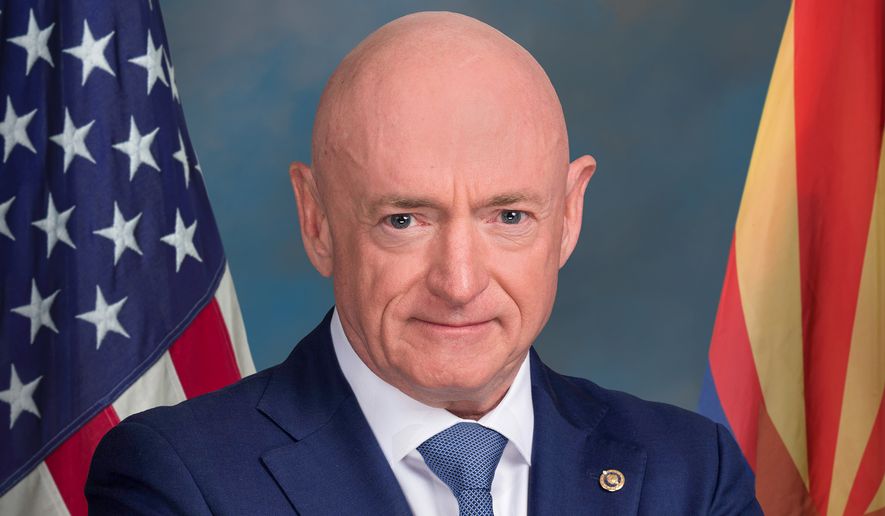
• Sen. Mark Kelly has served his country as a U.S. Navy combat pilot, a NASA astronaut, and now as a U.S. Senator for Arizona. He serves on the Armed Services, Environment and Public Works, Intelligence, Aging, and Joint Economic Committees. He is Ranking Member of the Senate Armed Services Airland Subcommittee.

Please read our comment policy before commenting.