


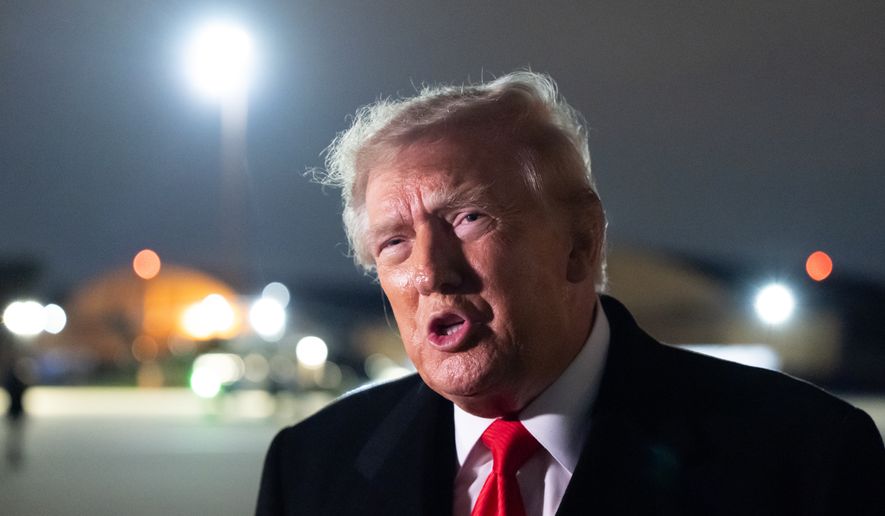


After winning tariff relief for Scotch and Irish whiskey, the U.S. spirits industry’s top trade group now wants President Trump to finish the job and drop the remaining 10% levy on European cognac and liqueurs.
The U.S. Distilled Spirits Council said the administration’s trade-deficit logic does not fit products that can only be made in one place.
People were interested in these podcasts
To put it simply: Americans may drink far more cognac than France drinks bourbon, but that is no reason to tax the brandy.
The Council said it has taken that message to the White House, the Commerce Department and the U.S. Trade Representative to steer the administration away from tariffs that it says turned the industry into “a leverage point” in trade disputes.
“We’ve tried to help educate the administration who is zoned in on trade deficits, that trade deficits shouldn’t really apply for our industry,” Chris Swonger, president and CEO of the Distilled Spirits Council, told The Advocates. “We’re not widgets. We’re distinctive products. You can only make American whiskey in the United States.”
Within the last year, Mr. Trump removed a 10% tariff on Scotch whisky, and Mr. Swonger said this happened after King Charles “came in and talked to him about it.”
Mr. Swonger noted that about two weeks ago, when Mr. Trump was in Ireland, he removed the 10% tariff off Irish whiskey coming in, but there still is more work that needs to be done.
“That is awesome. And we applaud that. … We’re still imposing a 10% tariff on European spirits products like cognac and liqueurs. And we hope the administration will consider removing that 10% tariff.”
Cheers for Senate prescribed burn bill
The National Association of Manufacturers applauded the Senate’s recent passage of bipartisan legislation that exempted prescribed burns from the Clean Air Act.
Prescribed burns are a state forest management practice in which agencies intentionally set fires under certain weather conditions to prevent larger, out-of-control fires.
“The Wildfire Emissions Prevention Act provides commonsense amendments to the Clean Air Act that will streamline permitting and provide regulatory relief to states and manufacturers all while helping prevent unnecessary loss of life, property and productivity from catastrophic wildfires,” said NAM Vice President of Domestic Policy Chris Phalen.
The legislation by Sens. John Curtis, Utah Republican, and Jeff Merkley, Oregon Democrat, defines prescribed burns as an “exceptional event” that can be excluded from a state’s air quality data.
Under the Clean Air Act, which the measure amends, states are required to meet particulate matter requirements and prescribed or controlled burns can potentially elevate emissions.
“States that proactively use prescribed burns can face regulatory consequences for the temporary emissions created by the very work that prevents far greater emissions,” Mr. Curtis said. “Our bill provides states greater certainty.”
Negotiations over the summer brought the act to a point of agreement by both Republican and Democratic lawmakers in the upper chamber.
Push for proactive fraud prevention
Citizens Against Government Waste’s Grigory Menshikov wants the feds to catch fraud before money goes out the door instead of the current “pay-and-chase” method.
Improper payments rose 15% ($24.3 billion), from $161.5 billion in FY 2024 to $185.8 billion in FY 2025.
Despite the Government Accountability Office first identifying improper payments as a systemic government-wide issue in 1997 and the enactment of the Improper Payments Act of 2002 and three related bills through 2019, the rip-offs keep mushrooming, Mr. Menshikov said.
The GAO’s Oct. 16, 2016, report found agencies only used do-not-pay authority “in limited ways.”
Mr. Menshikov pointed to an April 27, 2026, GAO improper payments report, which revealed that such payments totaled “about $3 trillion” since 2003,
“The lack of efficiency in the ‘pay and chase’ approach led Congress to pass the Improper Payments Elimination and Recovery Improvement Act of 2012,” Mr. Menshikov wrote.
“Since the legislation established the Do Not Pay system (DNP) to allow (but not require) agencies to verify recipient eligibility before making payments, the DNP process was strengthened by legislation that was enacted into law in 2015 and 2019.”
Mr. Trump in March 2025 ordered agencies to route more of their payments through the Treasury Department, which would screen them for fraud and improper payments before money is sent out.
He also pushed agencies toward shared financial systems and fewer independent pay-out offices.
The Treasury recently announced progress on preventing fraud and improper payments, which included the streamlining of the DNP onboarding process and interagency data sharing.
Mr. Menshikov said: “Expanding the availability and requiring the use of the DNP system is a significant improvement in the efforts to prevent taxpayer dollars from being wasted.”
He added, “If the government continues to focus on preventing fraud upfront instead of ‘paying and chasing,’ more money will get to the people who are eligible to receive those funds; and taxpayers will benefit from less of this type of waste, fraud, abuse, and mismanagement.”
• The Advocates column is a weekly look at the political action players who drive the debate and shape policy outcomes in Washington. Send tips to theadvocates@washingtontimes.com. Click here to receive The Advocates in your inbox each week.
Contact the author


Please read our comment policy before commenting.