


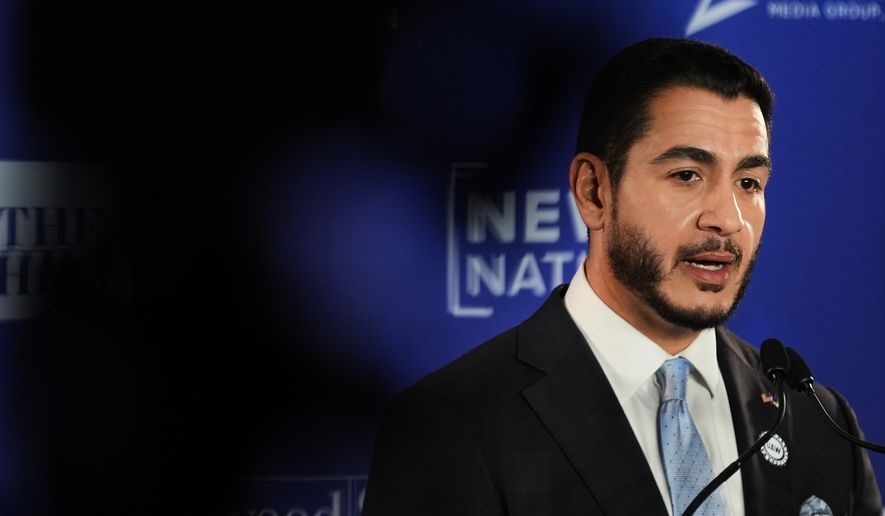

Former Rep. Mike Rogers, Michigan’s Republican Senate nominee, repeatedly invoked the Muslim Brotherhood during his first debate with Democratic nominee Abdul El-Sayed, mentioning the group five times and accusing his opponent of taking money from people who “openly support Hamas, Hezbollah, al Qaeda.”
He is hardly alone.
President Trump recently called Mr. El-Sayed a “jihadist,” nicknaming him “Mohammed Abdul El-Sayed” and insisting he is “a Muslim Brotherhood guy, 100%.”
People were interested in these podcasts
The Senate Leadership Fund, a Republican super PAC, is airing an ad that says “six radical extremist groups” have spent more than $1 million to boost his campaign, while Sen. John Kennedy of Louisiana recently told reporters that Mr. El-Sayed sleeps “in a Bin Laden jersey.”
The attacks come as Republicans raise the stakes in a race that will help determine control of the Senate, arguing that Mr. El-Sayed’s alleged ties to Hamas and other extremists, combined with his sharp criticism of Israel, raise questions about his judgment and loyalty to the United States.
Mr. El-Sayed, the son of Egyptian immigrants, has forcefully rejected the accusations. He said he has no ties to the Muslim Brotherhood, Hamas or other Islamist groups. He said Republicans are relying on dog-whistle politics to stoke suspicion about his faith and are deliberately conflating criticism of Israeli government policies with support for extremism.
At the center of the dispute is the Muslim Brotherhood, a Sunni Islamist movement founded in Egypt in 1928 that has affiliates and supporters across the Middle East. The U.S. has not designated it as a terrorist organization, although Hamas emerged from the movement’s Palestinian branch and is designated by the U.S. government as a terrorist organization.
Republicans say public statements from Mr. El-Sayed’s family members and other evidence undermine his denials.
This week, they pointed to a series of social media posts from Mr. El-Sayed’s half-sister, Eman Abdelhadi, with whom he shares a mother, Fatten Elkomy. Writing after Mohamed Morsi was elected Egypt’s president in 2012, Ms. Abdelhadi said their mother had been active in the Muslim Brotherhood while in college.
“Had an amazing talk with my mom about her activism in the Muslim Brotherhood during the early 70s while she was in college #respect,” Ms. Abdelhadi wrote.
In another post, she added: “My family has long been MB, but I’ve always felt that it has navigated the political sphere poorly/destructively.”
After Mr. Morsi was ousted in 2013, Ms. Abdelhadi, now an assistant professor at the University of Chicago, wrote that members of her family had been jailed because of their ties to the organization.
Asked about the posts, Mr. El-Sayed said that neither he nor his family had ties to the Muslim Brotherhood.
“I have never had these conversations with my mother. I wasn’t raised by my mother,” he told NBC News. “You’re using hearsay evidence from a tweet. It’s just not serious.”
Among the other connections cited:
• A Washington Free Beacon report identifying a “Dr. Abdul Rahman El-Sayed” as one of 46 signatories to a 2012 statement backing Egyptian President Mohamed Morsi’s government. The statement urged Mr. Morsi to “purge the media and the police as quickly as possible” and criticized efforts to seek Western opposition to the Egyptian regime.
• His mother’s employment with the Islamic American Relief Agency, a Missouri-based humanitarian nonprofit. The Treasury Department froze the group’s U.S. assets in 2004 after designating its Sudan-based parent organization a global terrorist entity, saying affiliated offices had provided support to Osama bin Laden, al Qaeda and the Taliban. Five officials were later indicted for violating sanctions and sending money to Iraq, leading to guilty pleas by the charity and its executive director. Mr. El-Sayed’s mother was not among those charged.
• Mr. El-Sayed’s father-in-law, Jukaku S. Tayeb, a kidney doctor, held leadership roles with the Michigan chapter of the Council on American-Islamic Relations, or CAIR, and the Islamic Society of North America. Federal prosecutors identified both organizations as unindicted co-conspirators in the 2007 Holy Land Foundation terror-financing case, which resulted in convictions against the charity and five former officials for funneling roughly $12.4 million to Hamas-controlled organizations between 1995 and 2001. Neither ISNA nor CAIR was charged, and federal courts later agreed that prosecutors erred in publicly disclosing the list.
• Mr. Tayed contributed $300,000 to the pro-El-Sayed Fighting for Michigan super PAC, making him one of the group’s largest individual donors.
• In Mr. El-Sayed’s keynote address at a CAIR Oklahoma event in October 2022, he said the same forces that displaced Native Americans, destroyed Black Wall Street and bombed the Oklahoma City federal building also helped drive a 2010 Oklahoma referendum banning Shariah law, which was later struck down in federal court.
Some critics describe CAIR as a terrorist-linked organization and point to Mr. El-Sayed’s praise for the group, which he has credited with defending the civil liberties and civil rights of Muslim Americans.
The El-Sayed campaign did not respond to requests for comment on the specific allegations.
“Michiganders deserve answers from Abdul over his connection to anti-American extremist groups who are bankrolling his campaign,” said Chris Gustafson, a spokesman for the Senate Leadership Fund.
Republicans are not letting up.
Sen. Ted Cruz of Texas devoted an entire 37-minute podcast on Oct. 14 to challenging Mr. El-Sayed’s denials, calling them a “flat-out provable lie” and warning that, if elected, the Democrat could “pass on classified materials to terrorists who want to murder us.”
At a recent Rogers’s campaign barn party, David Beamer, the father of Flight 93 hero Todd Beamer, questioned whether Mr. El-Sayed’s values align with America.
“Abdul’s belief system, his outlook, his plan for America, proves that it takes more than a birth certificate to be a Michigan man,” Mr. Beamer said. “He is not a Michigan man. He’s a citizen, but that does not make him an American. He’s not an American.”
The Muslim Brotherhood questions are unfolding against a complicated political backdrop in Michigan, where Mr. El-Sayed was born and raised by his Egyptian father and stepmother, a Michigan native, and where he was valedictorian of his class at the University of Michigan.
The dynamics date back to 2024, when anger over the Biden administration’s support for Israel’s war in Gaza pushed many Arab American voters away from Democrats. Mr. Trump capitalized by promising to avoid new foreign entanglements and bring peace to the Middle East, helping him carry Dearborn and Dearborn Heights and narrowly win the state.
Two years later, some of those same voters have grown frustrated with lingering economic concerns and the administration’s handling of conflicts in the Middle East, creating an opening for Mr. El-Sayed, who is running to become the nation’s first Muslim senator.
Mr. El-Sayed has called Israel’s military campaign in Gaza a “genocide,” urged an end to unconditional U.S. assistance and opposed the Trump administration’s decision to join Israel in striking Iran. He also makes criticism of the American Israel Public Affairs Committee, or AIPAC, a centerpiece of his Democratic primary campaign, where he overcame more than $30 million in spending by AIPAC-affiliated groups to defeat him.
He now holds a narrow lead in recent polls.
His message has resonated with many Arab American and college-educated voters, while alienating others, including Jewish voters.
Republicans have intensified their efforts to tie him to extremist groups, betting the issue can both energize their base and raise doubts among swing voters.
Republicans acknowledge they are unlikely to win back many Muslim voters. Instead, the strategy is aimed at offsetting those losses elsewhere.
“How do we balance off the 100,000 votes you’re going to lose in the Muslim community?” said Steve Mitchell, a Michigan-based Republican pollster, describing the party’s thinking.
Mr. El-Sayed handed his critics additional ammunition during the campaign’s first debate, when he declined to say whether Israel or Iran posed the greater threat to the United States.
The steady drumbeat of attacks, however, has sparked accusations of Islamophobia and xenophobia from some of the same Arab American voters who helped fuel Mr. Trump’s 2024 victory and now accuse Republicans of exploiting fears about Muslims for political gain.
Bishara Bahbah, founder of Arab Americans for Trump, which has since rebranded as Arabs for Peace, has warned Republicans that their support could evaporate if they remain firmly aligned with Israel as the war in Gaza drags on.
“The time of reckoning is going to come for those Republicans because elections are coming up,” he told TRT World.
Some Arab American leaders say the attacks on Mr. El-Sayed are more likely to alienate voters than persuade them.
Faye Nemer, founder of the Middle East and North Africa American Chamber of Commerce in Dearborn, voted for Mr. Trump in 2024 and helped organize a Trump visit to the city that year. She said she decided to back Mr. El-Sayed after the U.S. joined Israel’s strikes on Iran.
“They’re trying to paint him as an extremist candidate or a radical candidate simply because of his ethnic background or the way he prays,” she said. “That’s really a disservice to voters.”
Ms. Nemer dismissed the allegations of extremist ties.
“If there was any validity to that, the FBI would be involved, and there would be a full-fledged investigation, and he would be prevented from even seeking public office,” she said.

Please read our comment policy before commenting.