


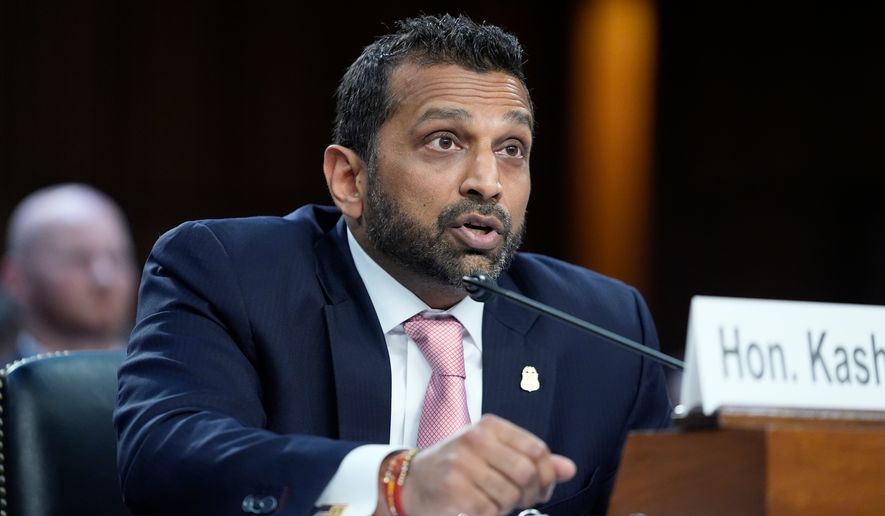

FBI counterintelligence agents are not doing enough to confront and thwart technology theft and other threats carried out by unofficial spies, mainly from China, according to a new report by Congress’ Government Accountability Office.
The report called on FBI Director Kash Patel to implement a plan to strengthen FBI partnerships with academic institutions to improve information sharing that can help defeat threats from what the report calls nontraditional intelligence collectors, or NTCs.
The congressional watchdog said greater FBI effort to mitigate threats from nontraditional spies targeting academia would bolster the broader mission of protecting American national security and economic interests.
People were interested in these podcasts
“Further, without better engagement with academic institutions, the FBI is missing opportunities to enhance research security and prevent NTCs from sharing valuable information with foreign entities,” the report stated.
The report, “National Security: FBI Should Strengthen Partnerships to Combat Non-Traditional Intelligence Collectors,” was made public Thursday.
Recent federal prosecutions and counterespionage cases have revealed that China’s Ministry of State Security intelligence service has been using such unofficial spies for decades, including government-directed efforts to suborn American scientists and academics as part of “talent recruitment” programs. The operations have also included infiltrating U.S. companies through unofficial agents who then steal advanced technology that is supplied to China.
The report mentions the July 2025 guilty plea by San Jose, California, engineer Gong Chenguang, a dual U.S.-China national, who stole trade secrets from a defense contractor used by the U.S. government to detect nuclear missile launches, track ballistic and hypersonic missiles, and allow U.S. fighter planes to detect and evade heat-seeking missiles.
Chinese intelligence also relies on its unofficial intelligence agents to conduct influence operations targeting the American public to support Beijing’s policies.
Large-scale cyber theft operations are also conducted by Chinese hackers in the pay of Beijing’s intelligence service and often posing as cybersecurity companies, according to a review of recent federal prosecutions.
Despite the FBI’s broad powers to investigate nontraditional spy threats through its outreach and security partnerships with American industry and academic institutes, problems remain, the report said.
“The challenges the FBI faces in mitigating threats posed by NTCs, specifically the cultural differences between the FBI and academia, may impede the agency’s ability to fully address NTCs,” the report concluded.
A better program of FBI outreach to universities is needed to mitigate the threat, the GAO said.
The report stated that most cases of nontraditional spying “are tied to China” but also are conducted by other nations.
The unofficial spies often conduct operations based on national-level directives and appeals to nationalism and “use their academic or business positions to gain access to data, intellectual property, technology and expertise.”
The FBI launched a special counterspy program in November 2018 called the China Initiative to combat Beijing’s economic espionage and intellectual property theft. But that program was shut down in the first year of the Biden administration over its concerns it was racist against Asian Americans.
China’s intelligence operations in the U.S. remain large-scale and aggressive, ranging from traditional targeting of government secrets to large-scale technology and intellectual property theft.
An FBI spokesman did not immediately respond to a request for comment on the GAO report.
The FBI website, however, identified what it calls “the China threat” as the bureau’s top counterintelligence priority.
“The counterintelligence and economic espionage efforts emanating from the government of China and the Chinese Communist Party are a grave threat to the economic well-being and democratic values of the United States,” the website stated.
According to the FBI, China is using tactics aimed at influencing lawmakers and public opinion to produce policies supportive of Beijing.
“China’s efforts target businesses, academic institutions, researchers, lawmakers and the general public and will require a whole-of-society response,” the FBI said. “The government and the private sector must commit to working together to better understand and counter the threat.”
China also is seeking to become the world’s dominant superpower “through predatory lending and business practices, systematic theft of intellectual property, and brazen cyber intrusions,” the FBI said.
In August, President Trump appeared to minimize China’s spying operations.
“Somebody was saying about China, ’What about China? We hear they’re spying.’ We spy on them too. So it goes,” Mr. Trump said Aug. 27 during an Oval Office meeting with reporters.
Contact the author


Please read our comment policy before commenting.