


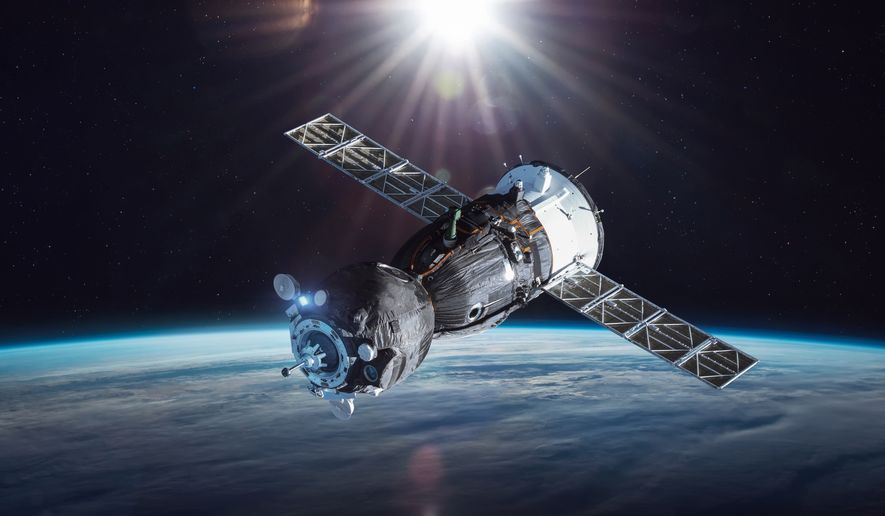

A mysterious Russian satellite is closing in on a U.S.-Finnish radar satellite that supports the Ukrainian military, according to a new analysis, raising fears that Moscow may be poised to launch an attack in orbit and kick off an era of kinetic space warfare.
A report from the leading Washington think tank Center for Strategic and International Studies details the trajectory of the Russian satellite Cosmos 2612, which will soon be close to a commercial synthetic aperture radar satellite operated by the Finnish-based company ICEYE.
The ICEYE satellite is registered and licensed in the U.S., according to the CSIS paper, and is believed to provide high-resolution space intelligence to the Ukrainian military.
People were interested in these podcasts
Aerospace and national security insiders are increasingly concerned that the Russian satellite could seek to disable the ICEYE asset, perhaps by deploying a space weapon.
“Given Russia’s history of testing on-orbit weapons, policymakers should assume Cosmos 2612 could take an action that threatens the commercial satellite,” wrote Clayton Swope and Chantal Li, deputy director and research assistant, respectively, with CSIS’ Aerospace Security Project.
“But the risk extends beyond just one satellite,” they wrote. “A Russian counterspace activity in the vicinity of Western satellites should be assessed within the context of aggressive Russian gray zone activities targeting U.S. and European interests. To date, neither the United States nor Europe has been able to deter Russia from expanding the scope and frequency of these gray zone actions.”
In 2024, Russia launched a counter-space weapon capable of attacking U.S. satellites in low-earth orbit, the Pentagon said at the time. In 2021, Russia conducted a “hit-to-kill” test that destroyed one of its own satellites, smashing it into what the Pentagon described as “more than 1,500 pieces of trackable orbital debris.”
Those instances, national security sources told The Washington Times, suggest that Russia is laying the groundwork for potential military action in space.
ICEYE did not immediately respond to a request for comment. The Russian Embassy in Washington and Roscosmos, Russia’s official state-run space agency, also did not immediately respond to a request for comment.
Using an orbital weapon would be an extraordinary step by Russia and would immediately raise questions about how the U.S. and its allies should respond to actual space combat.
America now has assets in place to respond with its own attacks, if it chooses.
Last month, Air Force Secretary Troy Meink revealed for the first time that the U.S. has its own weapon in orbit. He suggested that the weapon is designed to counter attacks by other adversaries targeting satellites or other space-based assets.
“The United States now has on-orbit space-control weapons capable of defending the joint force against hostile adversary action,” Mr. Meink said during an address at the Air, Space and Cyber Conference just outside Washington last month.
Mr. Meink’s announcement appeared designed to signal to China and Russia that the United States is now openly engaged, at a potentially kinetic level, in the growing great-power military competition in space.
Both adversaries have made major strides in their own space capabilities in recent years, including Moscow’s pursuit of anti-satellite weapons and Beijing’s investment in space weapons that U.S. defense analysts say are designed to destroy or disrupt American satellites.
Questions about the purpose of the Cosmos 2612 satellite come amid broader uncertainty about the space-based assets aiding Ukraine in its fight against Russia.
Earlier this week, Ukrainian drone operators lost some of their connection speed after restrictions were imposed on battlefield use of the country’s U.S.-made Starshield communication terminals, officials said Wednesday as Kyiv endured a second straight night of missile attacks.
Lawmakers of both parties have questioned whether the Trump administration ordered those restrictions following public criticism by Ukrainian President Volodymyr Zelenskyy and others of a U.S.-Russia deal to relax sanctions on Russian diesel exports.
Against that backdrop, specialists say the Russian satellite has maneuvered in ways that suggest it could potentially take action against the ICEYE commercial satellite.
“Over two weeks beginning on Sept. 30, 2026, Cosmos 2612 executed a series of new maneuvers that brought it back into coplanar alignment and placed it at nearly the same altitude as the commercial satellite,” the CSIS researchers wrote.
They also said that previous Russian Cosmos satellites have released objects while in orbit, with some U.S. officials describing those released objects as having “exhibited the characteristics of a weapon system.”
The analysis by Mr. Swope and Ms. Li explains in great technical detail why Cosmos 2612’s actions are unusual.
“Maneuvering a satellite in LEO into a coplanar orbit is unusual because it requires a large expenditure of fuel — a limited resource on a satellite — and is not part of the standard mission profile for most satellite missions, including broadband and remote sensing,” they wrote. “A satellite in an orbit coplanar to another satellite is positioned to quickly move, with little additional fuel expenditure, into place for conducting close-proximity operations.”
Contact the author


Please read our comment policy before commenting.