


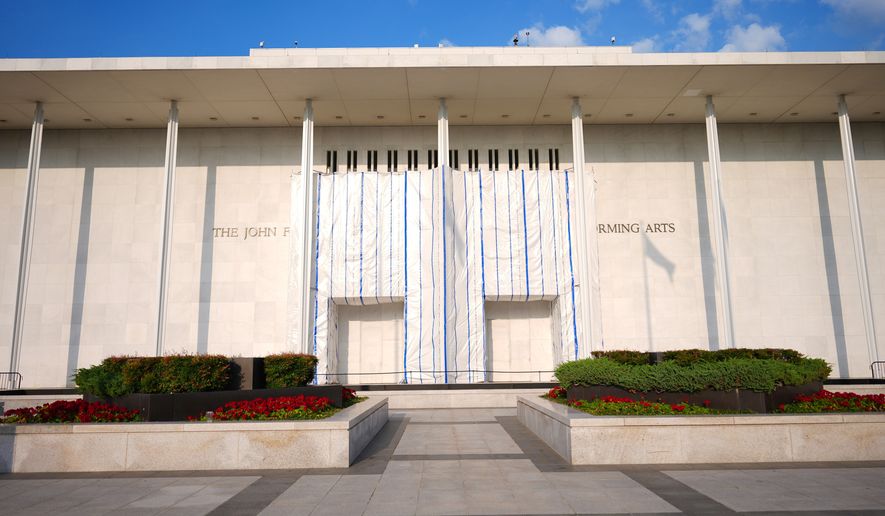

The White House has invoked executive privilege to shield certain records of President Trump’s communications from being shared with Rep. Joyce Beatty as part of her legal challenge against plans to close the John F. Kennedy Center for the Performing Arts for two years.
The Ohio Democrat, a Kennedy Center board member, has been challenging the Trump administration’s plans to shutter the center for renovations and add the president’s name to the building.
She’s seeking documents or communications concerning Mr. Trump’s involvement in the center.
People were interested in these podcasts
In a court filing late Wednesday, White House deputy counsel Joshua Hoyt said he was “formally invoking the presidential communications privilege with respect to information, documents, and communications requested” by the plaintiff in the case, Ms. Beatty.
Mr. Hoyt said the presidential communications privilege, a form of executive privilege, covers communications among Mr. Trump, his advisers and Kennedy Center employees about the president’s “duties and the effective functioning” of the District’s historic performing arts institution.
“These communications were intended to be confidential and have remained confidential,” Mr. Hoyt wrote.
Mr. Trump named himself to the board and was voted chairman by his handpicked board members.
In December, the board voted to add his name to the building’s facade, a move that has since been reversed by the courts.
Meanwhile, the center has been closed since mid-September after a ceiling collapse.
President Trump had floated plans to shut down the center for two years in order to complete renovations.
Mr. Hoyt said that because the president appoints members to the board and the Advisory Committee on the Arts, he must “familiarize himself” with management, operations, and current and planned activities.
“I believe that, without the protection of the presidential communications privilege over the communications described above, presidential advisors and their staff members would be chilled from gathering relevant information, exploring alternatives, and providing fully informed recommendations regarding the performance of the President’s duties,” Mr. Hoyt concluded.
Ms. Beatty’s lawyers argue that Mr. Trump’s communications are not covered by executive privilege because he’s being sued in his capacity as chair of the board, not as president, adding that invoking such privilege would be “unprecedented.”
In a response to Ms. Beatty’s motion, Justice Department lawyers saidshe was conducting a “fishing expedition.”
They argued that her “pursuit of irrelevant evidence does not justify her extraordinary request” for additional communications.
The lawyers added, “Even though the President’s statutory duties and the Chairman’s trust duties overlap, what matters for the purpose of executive privilege is that Plaintiff seeks information, documents, and communications concerning the President’s actions in his official capacity.”
The DOJ asked the judge to deny Ms. Beatty’s motion to compel additional information, documents and communications.
Ms. Beatty’s attorneys previously argued that the Kennedy Center is not part of the executive branch and “does not exercise executive power.”
They said this “kind of cover-up is a direct assault on the rule of law.”
They added in their statement, “The Supreme Court has stressed that the government should not invoke executive privilege lightly, but that is precisely what the Department of Justice is doing here.”
Mr. Trump, they said, is “trying to shield his management by improperly invoking executive privilege.”
The Justice Department had said that it was withholding material on executive privilege grounds, pending a decision by the president or his designee. Mr. Hoyt’s declaration is that formal invocation.
Contact the author


Please read our comment policy before commenting.