



Be wary of hurricanes that start with the letter “I.”
The ninth letter of the alphabet leads all others in the number of named Atlantic storms that have been retired over the decades due to their destruction or high death tolls.
Next up is Isaias, which became the first hurricane of the Atlantic season on Wednesday night. Whether it lives up to the misery of others whose first letter it shares remains to be seen. The latest forecast appeared to be less dramatic than those of other scarier storms.
People were interested in these podcasts
Isaias was expected to make landfall on the northern Gulf Coast late Friday or early Saturday, according to the National Hurricane Center in Miami.
“We just have to be prepared for the worst,” said Jeff Collier, mayor of Dauphin Island, Alabama, a 15-mile (24-kilometer) long barrier island at the mouth of Mobile Bay. “We take all of the storms seriously, once they get into the Gulf.”
Atlantic hurricanes have been given names since 1953, and 100 of them are no longer used. There have been 14 storms with “I” names retired, including 12 this century. When eastern and central Pacific hurricanes are considered, that retired “I” list grows to 20.
Ten Atlantic storm names starting with “F” have been retired, followed by “C” with nine, and “D” and “M” with eight apiece, according to a list compiled by the hurricane center.
Why I is such a foreboding letter
Hurricanes starting with “I” typically occur in the middle of the June 1-Nov. 30 season, when warming ocean waters can supercharge a storm’s energy.
The timing of Isaias is an exception to this trend, due to the current super El Niño weather pattern, which stunted Atlantic hurricane formations through September while cranking out storms throughout the Pacific region.
Isaias came one day shy of tying a 121-year-old record for the latest-forming initial hurricane of the Atlantic season.
‘I’ storms prove to be costly
Of the 55 costliest hurricanes to hit the United States, a dozen began with the letter “I”, including four in the top 10.
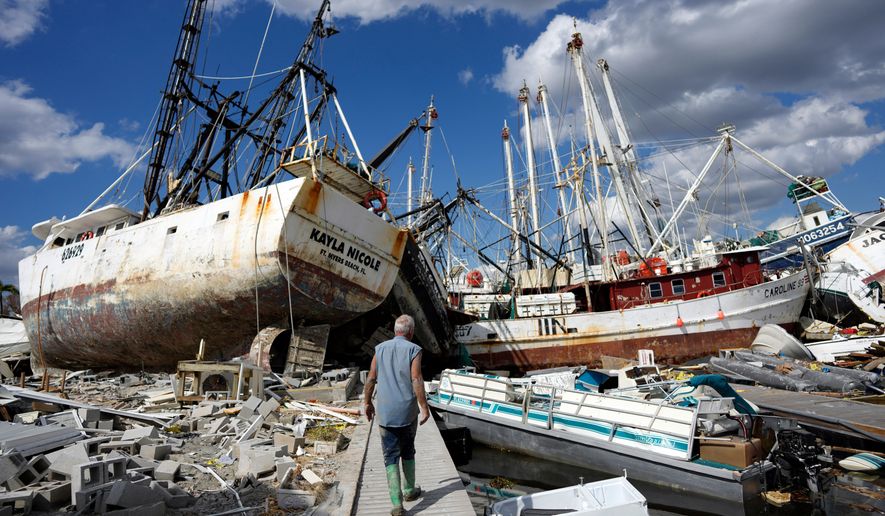
Category 4 Ian in 2022 came in at No. 3 with $119.6 billion in damage. Ian hammered Florida with such ferocity that it wiped out whole neighborhoods, tossed boats onto highways, swept away beaches and swamped homes in roof-deep waters.
Category 4 Ida, devastating parts of Louisiana in 2021, was the sixth-costliest hurricane at $84.6 billion. Category 4 Irma tore through the Florida Keys in 2017 for No. 8 at a cost of $64 billion. Category 2 Ike made landfall near Galveston, Texas, in 2008 for No. 10 at $43.2 billion. The National Oceanic and Atmospheric Administration said it based these figures on the 2024 Consumer Price Index adjusted cost.
In 2020, they ran out of names. Then came Iota
The 2020 hurricane season exhausted that year’s alphabetical list of storm names by mid-September, so later storms were identified using Greek letters, including Iota, the 30th named storm of that record-breaking year.
Category 4 Iota decimated Nicaragua and Honduras in November 2020 only two weeks after another hurricane had passed through the region.
The World Meteorological Organization, which oversees storm naming, later decided not to use the Greek alphabet for future storms, citing potential confusion when translated into other languages. Instead, a supplemental list of names will be used when the standard list is exhausted in a particular season.
Ivan spawned 118 tornadoes in a destructive loop
Ivan tore through Grand Cayman island in 2004, damaging or destroying an estimated 95 percent of the buildings there, the National Weather Service said. Then it slammed into the United States, spawning 118 tornadoes from Florida to Pennsylvania, more than any other tropical system since modern-day records have been kept starting in 1950, the weather service said. The storm was blamed for 124 deaths, including 57 in the United States.
Ivan formed during an El Niño, and churned a loopy path. After coming ashore near Gulf Shores, Alabama, it went up to Virginia, then back down through southeast Florida, returning into the U.S. Gulf and to Texas.
Irene was among the costliest in its category
In 2011, Hurricane Irene sent cars bobbing down rivers, swept away covered bridges, put millions in the dark and killed dozens of people. It made landfall along the North Carolina coast, then veered north along a densely populated corridor. New York City took a direct hit, but the heaviest rains were further inland.
In Vermont, the storm killed six people, washed homes off their foundations and damaged or destroyed more than 200 bridges and 500 miles (805 kilometers) of highway. It was the costliest Category 1 U.S. hurricane on record since at least 1980, with estimated total damage of $18.8 billion.
___
Associated Press writer Kim Chandler in Montgomery, Alabama, contributed to this report.

Please read our comment policy before commenting.