


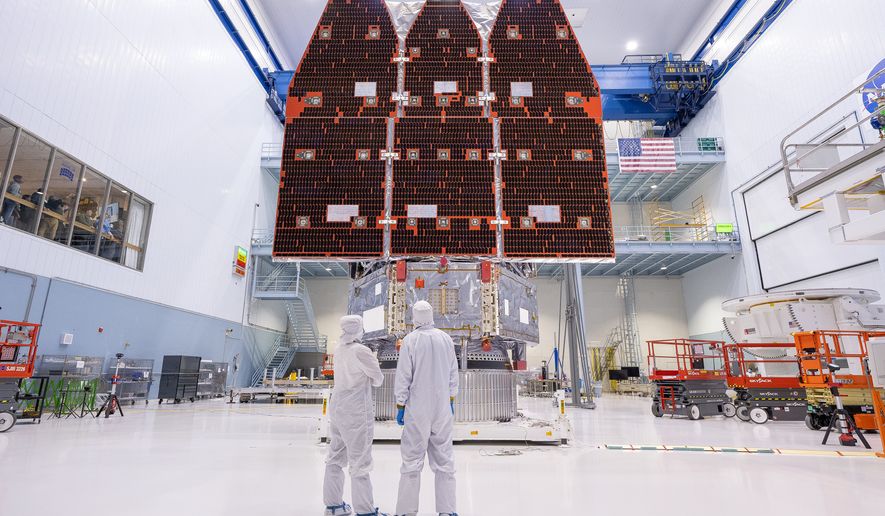

NASA’s Nancy Grace Roman Space Telescope launched Sunday at 7:26 a.m. EDT aboard a SpaceX Falcon Heavy rocket from Launch Complex 39A at Kennedy Space Center in Florida, beginning a three-month, million-mile journey to its final orbit, according to NASA.
The observatory pairs a wide field of view with sharp infrared imaging to study dark matter, dark energy and exoplanets, NASA said. Officials said the mission’s surveys will also support research beyond its core science goals.
“Roman is exactly the kind of success story we want to see across NASA,” NASA Administrator Jared Isaacman said in a statement, adding that the telescope was delivered ahead of schedule and on budget after more than a decade of work by NASA and industry partners.
People were interested in these podcasts
Ground controllers at NASA’s Goddard Space Flight Center in Greenbelt, Maryland, began receiving telemetry seven minutes after liftoff, according to NASA. The Falcon Heavy separated from the observatory 31 minutes into flight, and its boosters returned safely to the launch site for refurbishment, the agency said.
Nicky Fox, associate administrator for NASA’s Science Mission Directorate, said in a statement that Roman “will usher us into a new era of discovery” and help lay the groundwork for the search for life beyond the solar system.
NASA said Roman will rely on the Near Space Network before handing off communications to the Deep Space Network about 70 minutes after launch. The Deep Space Network will guide Roman toward the second Sun-Earth Lagrange point, roughly one million miles from Earth. The agency confirmed that the observatory’s solar panels and lower instrument sun shade deployed successfully about an hour and 23 minutes after launch.
In the coming days, according to NASA, teams will deploy Roman’s high-gain antenna and aperture cover, initiate the first of two mid-course corrections and power on its Coronagraph Instrument. The instrument will photograph Jupiter-like planets while demonstrating technology that future missions could use to image Earth-like planets.
A few weeks later, NASA said, the telescope’s primary Wide Field Instrument — a 300-megapixel infrared camera — will activate. Roman is designed to survey the universe a thousand times faster than the Hubble Space Telescope.
Scientists will calibrate and test Roman’s instruments during the remainder of its three-month commissioning period. NASA anticipates releasing the telescope’s first images by early 2027.
Roman is expected to transmit 1.4 terabytes of data daily, the highest data rate of any NASA astrophysics mission to date, with machine learning, artificial intelligence and citizen scientists helping process it, according to NASA.
Roman is the fourth primary NASA mission launched on a Falcon Heavy rocket, the agency said. It is managed at NASA Goddard, with participation from the Jet Propulsion Laboratory, Caltech/IPAC, the Space Telescope Science Institute and scientists from various research institutions. ESA, JAXA, the French space agency CNES and Germany’s Max Planck Institute for Astronomy also contributed to the mission.
This article was constructed with the assistance of artificial intelligence and published by a member of The Washington Times' AI News Desk team. The contents of this report are based solely on The Washington Times' original reporting, wire services, and/or other sources cited within the report. For more information, please read our AI policy or contact Steve Fink, Director of Artificial Intelligence, at sfink@washingtontimes.com
The Washington Times AI Ethics Newsroom Committee can be reached at aispotlight@washingtontimes.com.

Please read our comment policy before commenting.