



President Trump’s attempt to rope the U.S. Postal Service into policing which ballots can and can’t be mailed suffered another setback after a second federal judge issued a ruling halting the idea.
U.S. District Judge Carl Nichols, a Trump appointee to the court in Washington, said it’s up to Congress, not the president, to set such rules on the post office.
“Nothing in the Postal Reorganization Act authorizes the Postal Service to impose new election procedures on state election officials, to create a data collection system for mail-in and absentee voters, or to refuse the transmission of lawful mail because it fails to meet these data collection requirements,” he wrote in his decision late Sunday.
Mr. Trump had ordered the postal service to get lists from the states of all persons they intended to send ballots through the mail. The states would then have to send out those ballots in envelopes approved by the post office, and with bar codes so postal officials could identify and track them.
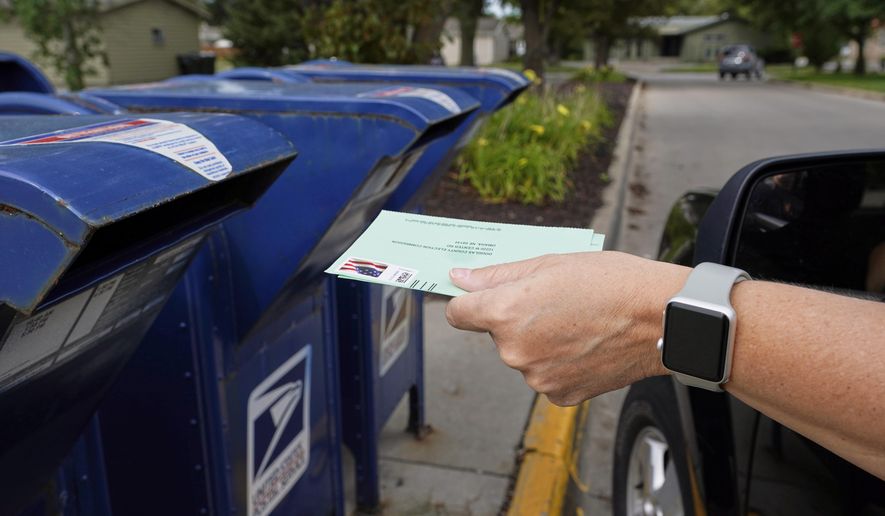
The service said it would refuse to deliver ballots that didn’t comply.
Judge Nichols said the service may have the authority to specify the types of envelopes to be used, but that doesn’t extend to the new intrusive registration list Mr. Trump envisions.
His injunction joins with that of another federal judge in Massachusetts. That case is now pending before the Supreme Court, where the Justice Department has asked the justices to allow Mr. Trump to proceed anyway.
Some states have already begun to send out ballots, making the administration’s case even more complicated.
Judge Nichols, in his ruling, said the Postal Service only finalized its plans on Aug. 21, or about two weeks before the first ballots were due to be sent.
He said that was another factor in favor of halting the postal service.
“If anything, the extremely short timeframe between issuance of the final rule and the midterm elections cuts strongly in favor of preliminary injunctive relief,” he wrote.
The postal service counted nearly 55 million ballots sent through the mail in 2022, the previous midterm congressional election.
Government lawyers have compared the post office ballot rules to restrictions on mailing cremated remains or replica explosives, which are allowed but regulated.
Judge Nichols said those restrictions address packaging and making sure the packages are tracked as they wind through the postal system. The ballot proposal, he said, was more about vetting the sending.
Solicitor General D. John Sauer, in asking the Supreme Court to intervene, has tried to minimize that part of the plans.
“The Postal Service will not perform any verification of voter eligibility; its role is limited to ensuring that envelopes comply with the rule’s design and informational requirements,” he wrote in his petition.
In Mr. Trump’s original vision, the post office rules were supposed to be coupled with a separate system from Homeland Security, which would vet the states’ registration lists and try to flag noncitizens.
That part of the plan has not been finalized, and is also facing its own court challenges.
Judge Nichols was ruling on three cases separately challenging the postal service. The cases were led by the League of Women Voters, the Democratic Senatorial Campaign Committee and the National Association for the Advancement of Colored People.
Judge Nichols had declined earlier to issue an injunction in the case. At that point the postal service hadn’t finalized its plans.
He said Sunday that the issue is ripe now, given the post office’s final regulation.
Contact the author


Please read our comment policy before commenting.