


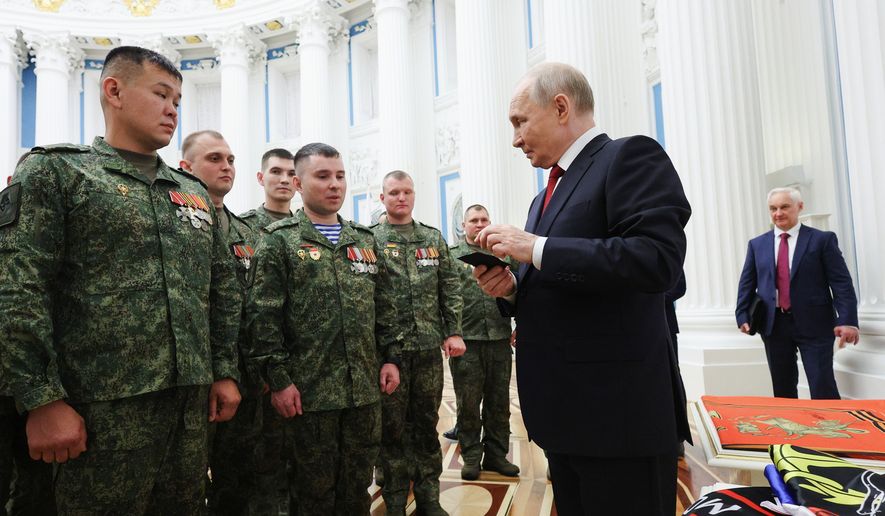

All eyes are on President Trump after Congress on Wednesday passed a long-awaited economic sanctions bill targeting Russia and the countries financing its war against Ukraine.
The bill is headed to Mr. Trump’s desk, and the White House signaled he will sign it. Yet it remains to be seen whether, or how, he will use the powerful sanctions and tariff authority Congress has just given him.
Supporters of the sanctions bill — named after its main champion, the late Sen. Lindsey Graham, South Carolina Republican — hope Mr. Trump will use it to issue sweeping secondary tariffs of up to 100% on the top purchasers of Russian oil. China and India top that list.
In theory, those nations would reconsider purchasing Russian fuel, putting more pressure on Russian President Vladimir Putin to genuinely come to the negotiating table and end the largest land war in Eastern Europe since World War II.
“Putin has chosen to continue this war regardless of the cost in Russian lives. Russia can only continue fighting because of those who choose to fund Putin’s war machine by buying cheap Russian energy,” said Rep. Mike Turner, Ohio Republican.
“This legislation gives us the opportunity to strike at those networks and impose real consequences on Russia and those who continue financing Putin’s war,” he said.
Opponents, primarily Democrats, fear the president will abuse his new tariff authority to impose higher levies in his long-running trade war, a move they say risks further strain on U.S. relations with allied nations.
“We can stand with Ukraine without giving President Trump another weapon to raise prices on American families,” said Rep. Gabe Amo, Rhode Island Democrat. “We don’t need to cede more power to ruin alliances.”
Mr. Trump, who promised to end the conflict shortly after taking office in January 2025 but has struggled to negotiate a peace deal, has not said how he plans to use the bill’s authority.
The measure passed the House on Wednesday on a 262-159 vote. The Senate passed it in August on an 86-11 vote.
“The bill supports President Trump’s efforts to achieve peace in the Russia-Ukraine war by strengthening the authorities he can use to encourage Russia to accept terms for peace,” the White House said in a statement ahead of the Senate vote.
The centerpiece of that strategy is a provision allowing Mr. Trump to issue tariffs of up to 100% on the top five purchasers of Russian oil and natural gas, though it includes exceptions to protect European nations still heavily reliant on Russian energy supplies.
The bill also authorizes new sanctions on wide swaths of the Russian economy, including its energy, financial and defense industries, as well as Russian oligarchs, businesses and even Mr. Putin himself.
Proponents hope it will send a message to other nations considering similar military aggression in pursuit of territorial ambitions.
“Evil is on the march. History is calling, and now is the time to act,” said Rep. Michael McCaul, Texas Republican, who worked with Graham on the bipartisan bill.
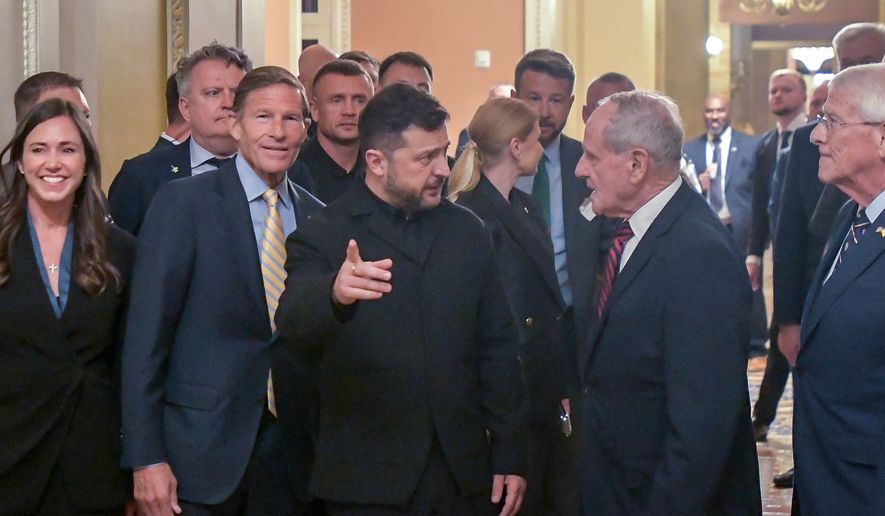
Ukrainian President Volodymyr Zelenskyy told lawmakers during a visit to Washington this summer for Graham’s funeral that the sanctions bill would do more to help end the war than anything his troops could do on the battlefield.
Understanding the impact
If Mr. Trump fully exercises the power given to him, it could help squeeze a Russian economy already battered by years of U.S. and European penalties.
Russia already faces one of the most aggressive and sweeping sanctions regimes in history. More than 13,000 people, including political leaders and Russian oligarchs, have been hit with sanctions aimed at preventing them from conducting business in the global financial system.
Since Russia invaded Ukraine in February 2022, Russian banks, businesses and individuals have been hit with 23,960 sanctions, according to the online tracking platform Castellum.AI.
The U.S., the European Union and European nations account for most of those, but nations such as Japan and Australia have also each issued more than 1,000 sanctions of their own targeting Russian businesses, individuals or ships, Castellum data shows.
Despite the already unprecedented level of sanctions targeting Russia, the Kremlin can still sell energy to customers around the world. Those energy sales are the lifeblood keeping its otherwise stagnant economy afloat.
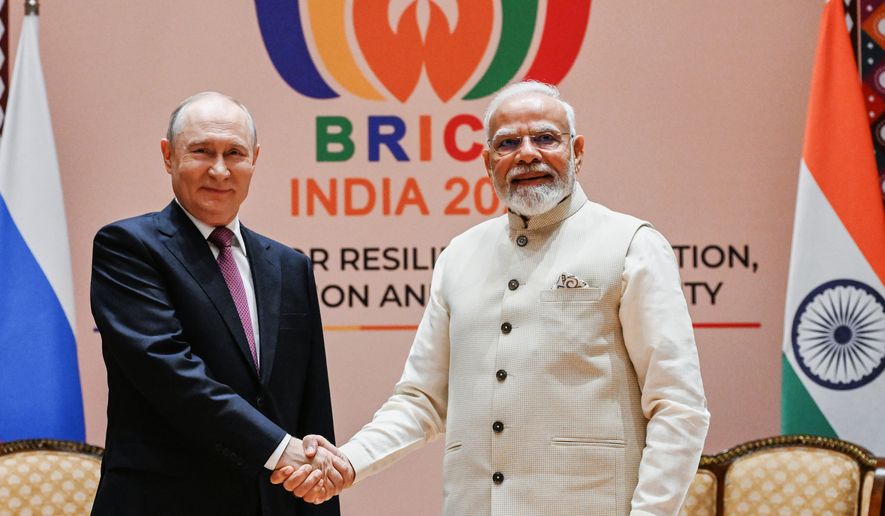
From December 2022 through July 2026, China bought roughly 50% of Russian crude oil exports, according to data from the Helsinki-based Center for Research on Energy and Clean Air. India accounted for about 37%, followed by Turkey at 5%.
Europe still buys nearly half of all Russia’s natural gas exports, underscoring the power Russia still holds over global energy markets.
Since December 2022, the U.S. and Europe have enforced a price cap on Russian energy.
That cap has been set at $60 per barrel of Russian crude oil. Western companies providing maritime services — such as insurance and shipping — for transporting that oil do so only if the oil is sold at or below the $60-per-barrel cap.
It has been somewhat successful, though Russia is still reaping huge profits. It received about $192 billion in revenue from oil and gas exports in 2024, according to data from the International Energy Agency.
The Oxford Institute for Energy Studies estimated in a 2024 study that Russia gets 30% to 50% of its total federal budget revenue from the oil and gas industry. Much of that money is then funneled into the Russian military.
Analysts say Russia also has a complex array of schemes to evade Western sanctions.
The sanctions bill targets one of those schemes, Russia’s use of a “shadow fleet,” ships without proper insurance or identification transporting illicit oil at prices outside of the cap.
Russia also relies on shell and front companies to obscure its financial activities worldwide, according to the global analytics firm Kharon.
To get a sense of how Russia still reaps profits from selling other products, consider this: Russia made $1.2 billion from sunflower oil exports to India in just the first six months of this year, according to Russia’s Interfax News Agency. That was up more than 34% from the same period in 2025.
Russian energy exports have slowed in recent months, however, as Ukrainian drone attacks on Russian energy infrastructure have become more effective.
Tribute to Graham
Graham was a fierce critic of Mr. Putin and a relentless supporter of Ukraine. He told colleagues before his death that the sanctions bill, if enacted, would be his proudest achievement.
He first introduced the bill in April 2025 with Sen. Richard Blumenthal, Connecticut Democrat, and a large group of bipartisan cosponsors.
Senate Republicans declined to bring it to the floor until Mr. Trump gave them the green light, which did not come until more than a year later.
Graham announced this July, during one of his many visits to Ukraine, that after months of arduous negotiations, he had reached a deal with the White House on an updated version of the sanctions bill and expected a quick Senate vote.
The next day, hours after Graham returned to the U.S., he died of an aortic dissection, according to a preliminary medical examiner’s report, after emergency responders had initially responded to a cardiac arrest call. His sister, Darline Graham, was appointed to fill his Senate seat and worked with Mr. Blumenthal and other co-sponsors to get it across the finish line.
Senators added a renewal of Iran sanctions set to expire in December, per a last-minute request from Mr. Trump.
Contact the author


Please read our comment policy before commenting.