


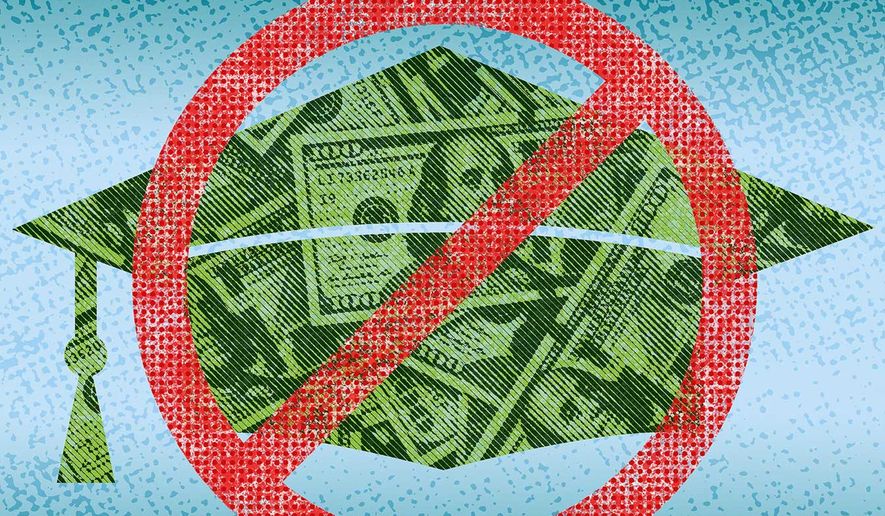

When the first cohort of Public Service Loan Forgiveness applicants became eligible in October 2017, a full decade after Congress created the program, the Department of Education approved 96 of them. That was a strikingly small number against the tens of thousands who had spent ten years making payments in government and nonprofit jobs on the promise that their remaining student debt would eventually be erased. The rejection rate that year topped 99 percent, and for years afterward, PSLF became shorthand in Washington for a federal promise that mostly wasn’t kept.
A 10-year promise Congress wrote loosely
Congress created PSLF in 2007 as part of the College Cost Reduction and Access Act, a bill President George W. Bush signed after it passed the Senate 79 to 12 and the House 292 to 97. The design was simple on its face: borrowers who make 120 qualifying monthly payments, 10 years’ worth, while working full time for a government agency or a 501(c)(3) nonprofit have their remaining federal student loan balance forgiven, tax-free. Eligibility is broad by design, covering roughly a quarter of the college-educated workforce rather than singling out specific professions like teaching or nursing.
What Congress left vague was how a borrower proves, 10 years later, that every one of those 120 payments actually counted. The paperwork built to answer that question did not exist for years after the program launched.
3 small mistakes that have sunk most applications
The overwhelming majority of early denials trace back to three technical requirements. The first is loan type: only direct loans qualify. At the time PSLF launched, however, only about a fifth of new federal loans were direct loans, meaning most borrowers from that era first had to consolidate older Federal Family Education Loans, a step many never knew was necessary.
The second is repayment plan: only payments made under an income-driven plan count in practice, since the standard ten-year plan pays off a loan in exactly ten years, leaving nothing left to forgive. For years, payments made under graduated or extended plans did not count at all.
The third is employer certification, which requires documented proof that each job actually qualified, using a form the department did not introduce until years into the program and, until 2023, required physical signatures mailed or faxed in. According to Education Department figures reported by the National Association of Student Financial Aid Administrators, more than half of early denials were for too few qualifying payments, about a quarter were for missing information, and 15 percent were for ineligible loans, the three categories mapping almost exactly onto those three requirements.
The reforms that finally moved the numbers
Congress’s first fix, the Temporary Expanded PSLF program passed in 2018, retroactively allowed payments made under graduated or extended plans to count, but it ran on a limited, first-come-first-served fund. Ultimately, it helped fewer than 8,000 borrowers.
The more consequential change came in October 2021, when the Education Department issued a limited PSLF waiver giving borrowers retroactive credit across all three problem areas at once: payments made on FFEL loans before consolidation, payments made under non-income-driven plans, and late, partial or forbearance-period payments, so long as the borrower’s employer qualified. About 60 percent of everyone who has ever received PSLF forgiveness came through that waiver.
By January 2026, more than 1.2 million borrowers had received a combined $90.6 billion in forgiveness, an average of nearly $75,000 each, according to an analysis by the Brookings Institution, a reversal almost unrecognizable from the program’s first decade.
What borrowers should verify now
The list of things to check has changed again this year. In March 2025, President Trump signed an executive order directing the Education Department to exclude employers found to have a “substantial illegal purpose.” The department finalized a rule built around that standard in October 2025, set to take effect July 1, 2026.
“President Trump has given the Department a historic mandate to restore the Public Service Loan Forgiveness program,” said Under Secretary of Education Nicholas Kent when the rule was proposed, arguing it would stop taxpayer subsidies for employers breaking the law.
A federal district court struck the rule down on June 30, 2026, finding the Higher Education Act gives the secretary no authority to pick and choose among nonprofits, according to the National College Attainment Network, a nonprofit that tracks the program. For now, any government job or 501(c)(3) nonprofit still counts as before.
Borrowers pursuing forgiveness should confirm their loans are direct loans, confirm they are enrolled in an income-driven repayment plan rather than a graduated or extended one, file an employer certification form every year rather than waiting until the end, and keep personal records of payments and certifications regardless of how the litigation or the department’s new repayment plan eventually settles.
None of this makes PSLF simple. A program built to reward a decade of public service still asks borrowers to get three separate, easy-to-miss technical details right for ten straight years, and now to track a legal fight over who counts as a qualifying employer in the meantime. The paperwork, not the public service, remains the hard part.
This article was constructed with the assistance of artificial intelligence and published by a member of The Washington Times' AI News Desk team. The contents of this report are based solely on The Washington Times' original reporting, wire services, and/or other sources cited within the report. For more information, please read our AI policy or contact Steve Fink, Director of Artificial Intelligence, at sfink@washingtontimes.com
The Washington Times AI Ethics Newsroom Committee can be reached at aispotlight@washingtontimes.com.

Please read our comment policy before commenting.