



President Trump said Sunday he’s deciding whether to launch a catastrophic military attack on Iran.
“My question is, if and when do I blow the entire nation up? They better behave,” Mr. Trump told Fox News correspondent Trey Yingst in a phone interview Sunday morning.
The president’s threat followed his sudden return Saturday to the White House from Camp David, which cut short a weekend getaway.
Mr. Trump said he’s in “deciding mode” on Iran and “very big things [will happen] in the not too distant future.”

Saudi Arabia confirmed on Saturday that Houthi rebel groups from Yemen tried to attack its capital with ballistic missiles.
Coalition forces spokesperson Major-General Turki al-Maliki wrote in an English statement on Saturday that Royal Saudi Air Defense Forces “successfully intercepted and destroyed a ballistic missile” launched by the Houthis. He went on to say that the attempted strike was part of “persistent, deliberate and systematic targeting of civilians and civilian objects” by the rebel group.
The Houthis earlier claimed, without evidence, that they had targeted “sensitive sites” in Riyadh and oil facilities to disrupt production by the world’s largest oil company, Aramco. Saudi leadership shut down a major pipeline after drone attacks by the Iranian-backed Houthis last week amid new gains by the rebel group. The Saudi Ministry of Energy called the shutdown “a precautionary measure.”
Aligned with Tehran, the Houthis have used the coast of Yemen as a strongpoint to advance down the Bab al-Mandab Strait, another critical choke point for shipping traffic coming from the Red Sea. The combination of the Strait of Hormuz and the Bab al-Mandab constitutes the main shipping lanes Saudi Arabia uses for petroleum products to enter the Arabian Sea before moving on to the rest of the world.
The Houthis captured a strategic island at the southern portion of the Red Sea, officials said, opening a new front in the Iran war that will impact oil and gas transportation. The capture of Mayun Island and the advance by the Houthis could skyrocket oil and gas prices as Saudi Arabia, the world’s largest oil exporter, increasingly relies on the Red Sea and Bab el-Mandeb strait.
Mr. Trump is under increasing pressure to end the Iran war, now in its eighth month. The fighting has constricted the world’s oil supply, spiking prices for gasoline and diesel.
The president said the choices he’s weighing include wiping Iran out through military strikes, letting the regime “rot” economically, or making a deal to end the war, which Tehran has refused to join.
On Friday, the House voted a third time to require Mr. Trump to seek congressional approval to conduct military action in Iran.
Seven Republicans voted for the measure.
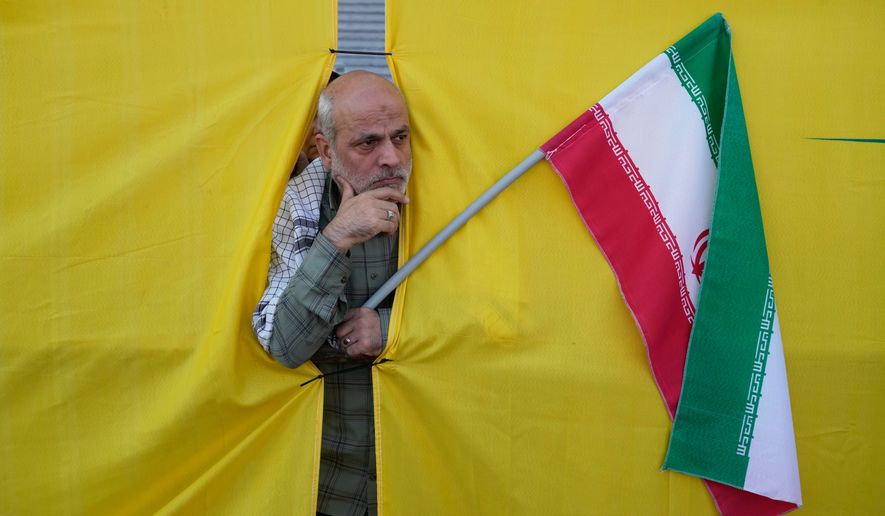
Meanwhile in Iran, hundreds of thousands of Iranians filed into the streets to rally for a government-organized show of defiance after months of war. The Iranian government looked for people to pledge a willingness to take up arms against the U.S. and others as the economic situation in the country worsens. Citizens marched through downtown Tehran in combat uniform, carrying flags, as onlookers cheered.
The Friday rally had varied estimates, with little reliable statistics coming out of the country. Local state-run media encouraged its citizens to join the campaign for days before the event, saying that volunteers would receive basic military training with an assault rifle.
This new layer of minimally trained citizens adds to the security offered by the Revolutionary Guard and the Basij militia, both military arms of the Iranian government and system that have played key roles in anti-government protests in the past.
Mr. Trump returned Saturday to the White House as the State Department issued an alert to U.S. citizens across the Middle East, citing “the potential for unforeseen escalation.”
Contact the author


Please read our comment policy before commenting.