



The cryptocurrency industry is opening up its war chest in an important Senate race after Democrats blocked legislation favorable to digital assets.
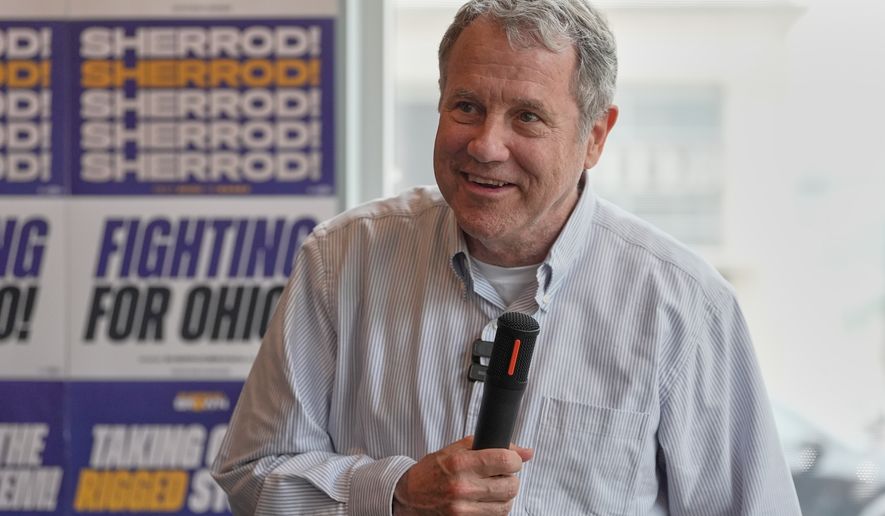
Fairshake, a PAC funded by crypto companies, announced plans Monday to spend $30 million on ads to oppose former Sen. Sherrod Brown, a Democrat trying to unseat incumbent Republican Sen. Jon Husted of Ohio.
“We’re still paying for Sen. Sherrod Brown’s failed liberal legacy,” says the narrator in one of the first Ohio Senate ads from Defend American Jobs, a group in Fairshake’s network. The ad accuses Mr. Brown of “welcoming Social Security benefits to illegals.”
Another ad backs Mr. Husted, saying he is “laser-focused on affordability, delivering the biggest tax cut in Ohio history.”
The spots do not mention cryptocurrency.
The group’s spending adds to Republicans’ money advantage in the Buckeye State’s Senate race, which election forecasters rate a toss-up.
Senate Democrats recently blocked the Digital Asset Market Clarity Act — legislation designed to clarify how federal regulators share oversight of cryptocurrency.
After months of bipartisan negotiations, no Democrats voted to advance the bill.
Democrats demanded additional restrictions on President Trump and his family’s ability to profit from cryptocurrency investments.
Additionally, Sen. Elizabeth Warren, Massachusetts Democrat, said its regulations were too friendly to crypto and could destabilize the economy.
Big crypto, which has taken on Mr. Brown before, has waited relatively late to help out Republicans in the general election.
At the same point in the 2024 election cycle, Defend American Jobs had spent $40 million to support Republican Bernie Moreno’s ultimately successful bid to unseat Mr. Brown.
It was by far the crypto industry’s biggest area of spending.
The Democrat’s campaign has criticized the spending.
“Jon Husted’s for sale and the billionaires and corporations pouring millions into this race know it,” Patrick Eisenhauer, Mr. Brown’s campaign manager, said in a statement. “They know Sherrod will fight the rigged system they’re feasting on.”
Still, the crypto industry’s entry into the midterms is likely bad news for Democrats, who are already dealing with funding disadvantages.
Last cycle, crypto groups adopted a bipartisan approach, backing successful Democratic Senate nominees such as Ruben Gallego of Arizona and Elissa Slotkin of Michigan.
Mr. Husted’s campaign did not respond to a request for comment on the spending.
Mr. Brown’s campaign has focused on the impact of technology in the race, attempting to connect Mr. Husted to unpopular data center construction.
Mr. Husted recently attempted to pass the Ratepayer Protection Act, legislation requiring state public utility regulators to consider ways to make data center companies cover their own energy costs.
Sen. Martin Heinrich, New Mexico Democrat, blocked the attempt to pass the bill by unanimous agreement, saying the measure had no teeth.

Please read our comment policy before commenting.