



SEOUL, South Korea — South Korean Defense Minister Kang Shin-chul confirmed to the National Assembly on Tuesday that a North Korean land mine that wounded three South Korean soldiers had been planted — not displaced by weather — suggesting a deliberate cross-border operation.
That raises the stakes: It indicates a deliberate cross-border operation by North Korean forces, rather than an accident.
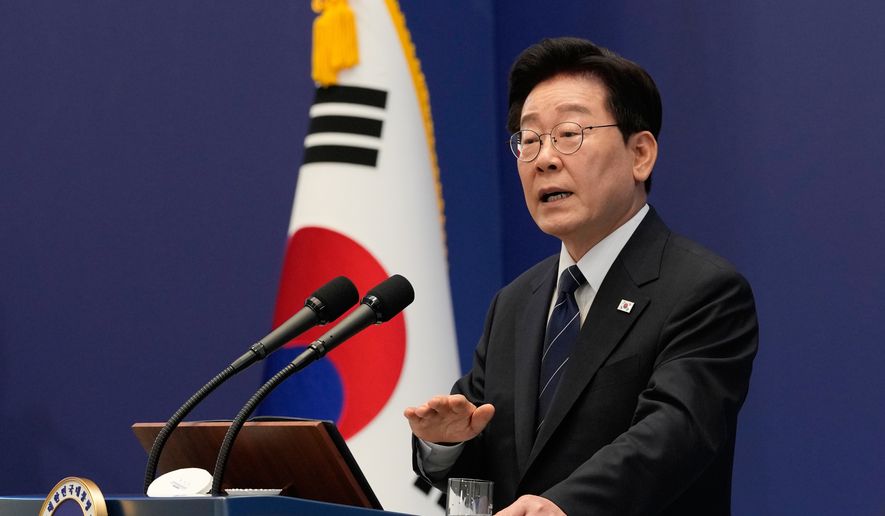
The disclosure is yet another blow to South Korean President Lee Jae-myung’s hopes of a thaw in relations with North Korea. In his Sept. 22 speech at the United Nations General Assembly in New York, Mr. Lee offered his latest prescription to initiate inter-Korean talks.
People were interested in these podcasts
Since taking office in 2025, Mr. Lee has consistently reached out to Pyongyang, but the North has not reciprocated. The speech to the United Nations on Monday by North Korean Vice Minister of Foreign Affairs Kim Son-gyong did not reference Mr. Lee’s remarks and made clear that Pyongyang will never denuclearize.
Similarly, President Trump’s public outreach to North Korean leader Kim Jong-un has been ignored.
Kim Yo Jong, the North Korean dictator’s sister and a key foreign policy advisor, dismissed the South Korean findings as a “conspiratorial farce” and accused Seoul of making groundless claims to create a pretext for military provocation against the North.
Meanwhile, Mr. Lee has engaged in a surprisingly high-profile spat with Ukrainian President Volodymyr Zelenskyy over the fate of two North Korean troops captured by Kyiv.
North accused of DMZ blast
The latest information on a Sept. 21 explosion in the Demilitarized Zone, which severely wounded two South Korean officers and lightly wounded a third, was released Tuesday.
Mr. Kang made clear that the mine that was detonated had been buried in a pattern with others, suggesting a small minefield.
On Monday, Gen. Kwon Dae-won, vice chairman of South Korea’s Joint Chiefs of Staff, told reporters that the explosion was “very likely caused by a North Korean military land mine.”
“Witness accounts note that a brown North Korean resin antipersonnel mine was spotted approximately 1 meter from the primary explosion site,” Gen. Kwon said, according to Yonhap News Agency.
Plastic resin is a feature of North Korean mines. The crater shape and traces of TNT-based explosives found were also consistent with North Korean mines, the Joint Chiefs of Staff said.
“If the final investigation concludes that the cause of the damage to our military was a land mine planted by North Korean forces … our military will take appropriate and corresponding measures,” Gen. Kwon warned.
What that means, now that Mr. Kang has confirmed the mine’s planting, is unclear.
The explosion took place south of the Military Demarcation Line, or MDL, the de facto border that runs through the middle of the DMZ. Military sources had acknowledged that the mine could have been carried south of the MDL by a landslide or mudslide caused by seasonal rains.
Mr. Kang’s statements eliminate that possibility.
The last remaining piece of the puzzle is whether North Korean forces buried their mines south of the MDL because of navigational error or because of deliberate tactical intent.
North Korea has made no comment on the matter.
Although massive firepower is stationed north and south of it, the 2½-mile-wide DMZ is prowled only by small foot patrols from both Koreas who operate on their respective sides of the MDL.
Problematically, the MDL is poorly demarcated in places, and much of the DMZ is heavily overgrown, with rugged terrain, compelling troops to stick to well-known patrol routes.
Lee courts North Korea
Earlier, Mr. Lee had accepted the harsh reality that North Korea is determined to retain nuclear arms, regardless of any outside influences.
In his speech to the United Nations, Mr. Lee did not mention the customary demand for complete, verifiable, irreversible denuclearization but shifted to a phased process.
“It is time to seek realistic and rational solutions based on a coolheaded perception that denuclearization cannot be achieved in the short term,” he said.
He called instead for “a pragmatic and phased solution beginning with a ‘stop’ in the sophistication of nuclear and missile capabilities, going through a ‘reduction’ process and reaching ‘dismantlement.’”
Mr. Kim, speaking to the United Nations on Monday, offered no indication of any agreement with Seoul’s stance, instead stating the threats it faced.
A trilateral grouping comprising South Korea, Japan and the U.S. that is “unmistakably aimed” at North Korea is “being evolved by the United States into a more offensive and aggressive military bloc with a nuclear element,” he said.
He credited the fact that no military crisis had broken out on the peninsula to the possession by North Korea of “a war deterrent in place, powerful enough to break anyone’s will to start a war of aggression.”
Hammering home an oft-made point by Pyongyang officialdom, Mr. Kim reiterated “the official position of North Korea,” as “a nuclear weapons state, that has been uncompromisingly and permanently fixed both physically and legally with absolutely no turning back, can never be reversed in any circumstances or by any means.”
Pyongyang’s disinterest in talking to South Korea or the U.S., experts say, stems from North Korea being more comfortable and secure than it was in 2018 and 2019.
For those two years, Mr. Kim held talks with South Korean and U.S. presidents. Engagement broke down over denuclearization, initiating an ongoing period of near-total noncommunication.
North Korea has renewed political and diplomatic backing from China. It is also receiving massive supplies of economic and technical support, as well as work access for its laborers, from Russia, in return for Pyongyang’s assistance in the Kremlin’s war against Ukraine.
North Korea is the only nation openly supporting Russia in the conflict. It has supplied millions of rounds of artillery ammunition and tactical missiles and has deployed ground troops.
It is unclear whether Seoul or Washington can realistically offer Mr. Kim the incentives he may seek to bring him to the table: acceptance of nuclear status, sanctions relief and pathways toward diplomatic normalization and entry into the U.S.-led global trade bloc.
Separately, Mr. Lee engaged in a diplomatic spat with Mr. Zelenskyy, who revealed during his Sept. 23 address to the United Nations that he had transferred two North Korean prisoners of war, captured by his forces last year, to South Korea.
Calling the matter “deeply regrettable” and “highly sensitive,” Mr. Lee said Mr. Zelenskyy had agreed not to disclose the personnel transfer.
Mr. Lee’s office said he aimed to shield the families of the two from judicial retaliation by Pyongyang authorities. However, Seoul’s conservative opposition has accused him of wanting to appease Pyongyang.
Before becoming president, Mr. Lee blamed NATO expansion for the Russia-Ukraine war, and Kyiv has long been frustrated that Seoul, despite North Korea’s clear support for Russia, has declined to offer Ukraine military aid.
Mr. Zelenskyy shot back that the two sides had no nondisclosure agreement.
The spat continued Monday as the South Korean Foreign Ministry summoned Kyiv’s ambassador for a dressing-down.
Contact the author


Please read our comment policy before commenting.