



A version of this story appeared in the daily Threat Status newsletter from The Washington Times. Click here to receive Threat Status delivered directly to your inbox each weekday.
The Pentagon is leveraging its most powerful authorities to put missile production on “wartime footing” now that the U.S. war against Iran has burned through a significant amount of munitions.
Major players in the defense industry have been freed up by legal openings in the Defense Production Act — a Cold War-era law that President Trump invoked in June — to produce missiles faster through collaboration that previously would have triggered antitrust violations.
At the same time, several U.S. defense contractors are pouring a nearly unprecedented level of money and resources into building more missiles, while the Pentagon pushes to accelerate new multicompany supply chain mechanics.
People were interested in these podcasts
During the months since Mr. Trump cited the Defense Production Act in a June 11 memo to the Pentagon, the law has been embraced behind the scenes by critical munitions providers — most notably those who produce assets for depleted Patriot and Terminal High Altitude Area Defense (THAAD) missile defense systems — to share best practices and even investment strategies without violating antitrust laws.

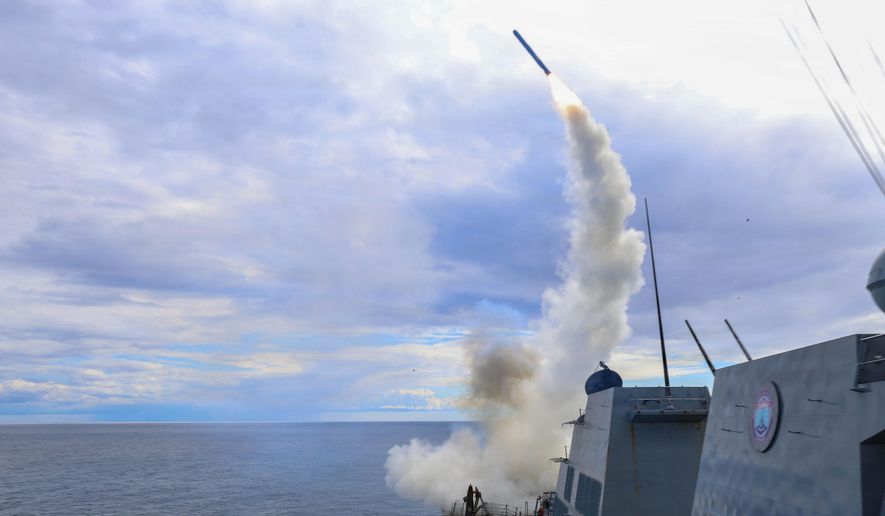
Patriot missile interceptor stockpiles have dropped by two-thirds and THAAD interceptors by half since the start of the Iran conflict in February, according to the Center for Strategic & International Studies. The Washington think tank has said U.S. forces have also fired roughly 1,000 offensive Tomahawk cruise missiles at Iranian targets — more than any previous conflict, including the Iraq war.
Before now, defense industry prime contractors, including Lockheed Martin, RTX Raytheon and Northrop Grumman, and the slew of smaller companies that supply them had become “optimized for peacetime performance,” one Pentagon official told The Washington Times.
“We’re moving to a wartime footing in the department,” said the official, who spoke on the condition of anonymity because of the sensitive and strategic nature of missile production. “That’s where a lot of our investment has been going because we want second supplies, but we also need the folks we already have to actually be making them right now.”
At the center of the push is an effort to accelerate production of solid rocket motors (SRMs) that are needed to make American missiles fly and are in high demand around the world.
Many of the air defense systems used in Ukraine rely on similar supply chains for the missiles being used by U.S. forces against Iran, and SRMs are the critical heart of the most complex munitions.
U.S. officials say the situation opened the way for the Pentagon to leverage the Defense Production Act — a post-World War II law that a sitting president can tap to mobilize industry for war — if only to establish a “voluntary agreement” with contractors to produce faster and more collaboratively.
“We brought all of the solid rocket motor companies in … for discussions around our goals and how to achieve this and how we can drive better coordination,” Michael Cadenazzi, assistant secretary of defense for industrial base policy, told The Times in an exclusive interview.
“The ultimate goal is a more robust and resilient rocket motor industrial base over the course of the next few years. That’s really the goal here,” he said. “We’ve been fragile for a long time.”
Mr. Cadenazzi outlined how the Pentagon is attempting to “qualify the new people, new companies, quickly” to produce more munitions, while also emphasizing the level of investment that the government expects from individual companies to make their own supply chains more resilient.
“It’s tip to tail for munitions,” he said.
Inside the Pentagon’s L3Harris deal
Demand isn’t waiting for the supply chain to be fixed. Patriot and Tomahawk missiles use a similar SRM engine that has only a single supplier, Florida-based L3Harris Technologies.
That makes for a fragile, single-thread supply chain amid urgent demand.
Prior to invoking the Defense Production Act, the Trump administration created a group inside the Pentagon in 2025 called the Munitions Acceleration Council (MAC) to better coordinate domestic arms production.
The council is the brainchild of Trump-appointed Deputy Secretary of Defense Stephen Feinberg, a billionaire former businessman and private equity executive.
Eight of 11 critical munitions that have since been identified by the MAC rely on single suppliers, according to Pentagon officials.
It’s a reality that helps explain why U.S. officials in January announced an investment of $1 billion in L3Harris’ Missile Solutions business unit, an unprecedented move that gave the Pentagon a direct public stake in the company.
Part of the deal promised that the government’s investment would convert into common equity upon an initial public offering. L3Harris’ announcement of the deal said the public stock would be introduced “in the second half of 2026, pending market conditions.” That offering has yet to materialize.
In a statement to The Times, an L3Harris spokesperson said the company is “working closely across the missile ecosystem to expand the nation’s propulsion capacity.”
L3Harris had begun investing billions of dollars into its own internal capacity to build SRMs before the start of the U.S.-Iran war.
“L3Harris is making more than $1 billion in targeted investments. In turn, our suppliers are stepping up with their own investments as the Department of War provides clear multiyear demand and long‑term opportunities,” the spokesperson said, referring to the Trump administration’s unofficial name for the Department of Defense.
Mr. Cadenazzi said there is “no easy unlock” to the notoriously slow and bureaucratic process of certifying and qualifying new suppliers to supplement the work L3Harris and other companies are now doing.
There is also a bottleneck in the supply chain for critical chemical ingredients that SRMs require.
Nick Doucette, vice president of strategic operations and co-founder of Colorado-based aerospace and defense company Ursa Major, told The Times in a July interview that many lower-level suppliers were feeling the pressure of exceptionally high demand.
“The ingredients to make that SRM cake still rely on one supplier of ammonium perchlorate. So now all we’ve done is add new pressure,” Mr. Doucette said. “We haven’t really increased any throughput.”
Ursa Major is positioning itself to produce multiple sizes of SRMs on a single production line, rather than follow the traditional “one line, one motor” model that other major defense companies have done in the past.
The company is also a participant in the government’s attempt to pull companies together for more efficient, collaborative production, rather than competition.
Putting missile production ’on steroids’
U.S. Chief of Naval Operations Adm. Daryl Caudle has described the Pentagon’s approach as a “risk-sharing venture” designed not only to generate faster productivity, but also to create longer-term sustainability for the companies making the munitions.
“This is business. We want them to have a good [return on investment],” Adm. Caudle told reporters during a lunch he hosted recently at U.S. Naval Station Norfolk in Virginia. “We want to share that risk by giving them longer contracts.”
Suppliers, he said, have suffered when the government has asked for “1,000 units and then next year we pull the rug out from under them.”
“They’ve retooled an entire facility to go build these units,” he said, adding that “Secretary Feinberg is working really hard to give at least seven-year contracts to these companies for these preferred munitions.”
Several of those contracts have come to fruition during recent months.
The Pentagon in June announced a seven-year contract with Lockheed Martin for up to $35 billion to quadruple production of THAAD interceptors.
Jamin Brown, vice president of missile defense programs at Lockheed Martin, said during a recent Threat Status exclusive video interview that collaboration among private contractors is essential.
“Once a contract gets awarded,” said Mr. Brown, the thought immediately becomes, “Who do we need? What expertise does this small business have? What expertise does this new entrant have? And can we bring that together and deliver for the war fighter?”
“We don’t see each other as competition,” he said. “We see the threat as competition.”
The Pentagon also has announced contracts aimed at tripling Patriot missile production through an agreement with General Dynamics.
RTX, formerly known as Raytheon, has been awarded a framework “multiyear” deal to ramp up production of Tomahawk cruise missiles — a deal the company has described as “an unprecedented $22.9 billion contract.”
Adm. Caudle reflected on the developments during his recent lunch with reporters. “A lot of my portfolio in the Navy comes from RTX, Raytheon,” he said, listing off numerous missiles and torpedoes the company supplies. “That’s a lot of my kit with one company.”
He added that the effort to provide longer-term contracts has put munitions production “on steroids.”
“You can’t win a war without bombs,” Adm. Caudle said. “You need missiles, you need ammunition, and that’s got to be a part of this.”
Correction: A previous version of this story misspelled Nick Doucette’s last name.
Contact the author


Please read our comment policy before commenting.