



For nearly a decade now, news outlets ranging from The Atlantic to the Forward and The Free Press have reported on the increasing number of Jewish students attending college in the South.
This shift is not unique to American Jews. The five states with the fastest-growing number of applicants are all in the South or Southwest. Most American students attend schools in their own state, but Southern institutions have also seen a surge of out-of-state applications, especially from the Northeast.
Although the uptick began before Hamas’ Oct. 7, 2023, attack and the Israel-Hamas war, observers have argued that campus politics now plays a role – particularly for Jewish students, some of whom are avoiding campuses with reputations as hotbeds of activism.
People were interested in these podcasts
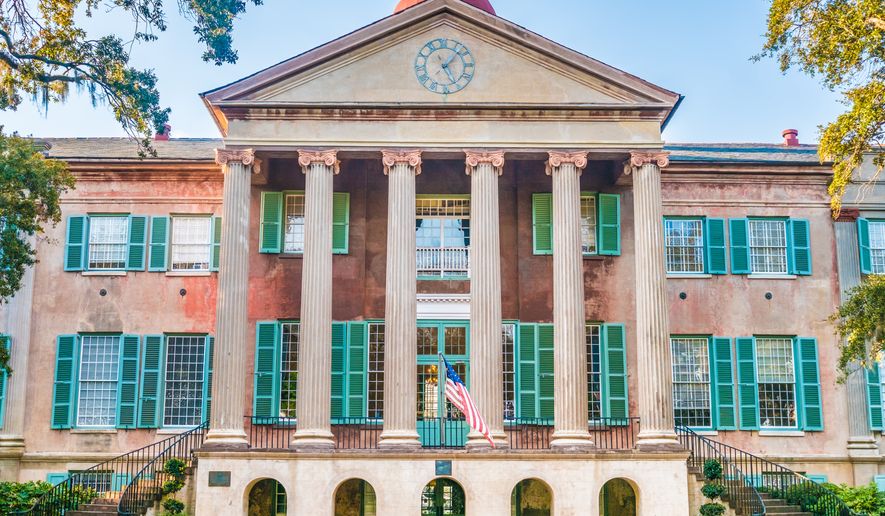
Many Americans seem surprised by the idea of Jewish students drifting south. I direct the Pearlstine/Lipov Center for Southern Jewish Culture at the College of Charleston and am co-authoring a book about the city’s history of East European Jewish migration. If I had a nickel for every time someone responded to my professional title with shock – “There’s Jews in the South!?!” – I could buy a Charleston-priced cappuccino with the proceeds.
Jews have called the South home for centuries. Yet many people struggle to reconcile popular images of the Christian Bible Belt and white supremacist violence with their understanding of who American Jews are and under what conditions they are most likely to thrive.
Jewish hub
I like to let the numbers speak for themselves. By the 1820s, approximately 800 Jews resided in Charleston, compared to 550 or so in New York City at the time.
Later on, when Charleston’s economy was in decline, Jews increasingly tried their luck in cities such as New Orleans, New York or Philadelphia. More than 2 million East European Jews immigrated to the United States from 1881-1924, and most opted to settle down in the Northeast.
But in the early 1800s, Charleston was a bustling commercial hub, and Jewish merchants from a variety of backgrounds gravitated there in search of security and new opportunities. The Southern economy was underpinned by ports that traded in cotton, rice, sugar, tobacco – and enslaved people. Charleston’s Jewish community was quite possibly the wealthiest in the United States at the time. Commerce facilitated Jewish integration into white, Protestant society.
The Jews of early 19th-century Charleston were a diverse lot, hailing from different corners of the globe and speaking a variety of languages. From early on, there were divisions between Ladino-speaking Sephardic Jews, with ancestral ties to medieval Spain and Portugal, and Yiddish-speaking Ashkenazi Jews, who traced their heritage to central and eastern Europe. Generational, educational and class differences further exacerbated internal conflict.
Start of a movement
Tensions came to a head in late 1824, when 47 male congregants petitioned leaders at their synagogue, Kahal Kadosh Beth Elohim, to change the liturgy. Inspired by a new style of worship introduced in the Hamburg Temple in Germany, the petitioners in Charleston asked for several reforms, such as shortening Sabbath services, using English translations of Hebrew prayers, and adding an English-language sermon about the weekly Torah portion.
These young men feared that worshipping in Hebrew, which many congregants did not understand, was driving away the next generation of Jews. They also believed the traditional style of worship was outdated and sought a spiritual practice that reflected their sense of themselves as modern Americans.
The conflict over Sabbath services in Charleston is widely regarded, although somewhat controversially, as the origins of Reform Judaism in the United States. Reform is one of the three major denominations of Judaism in the U.S. today, alongside Conservative Judaism and Orthodox Judaism, and its American roots are distinctly Southern.
Rabbi and historian Gary Zola explains that of the six earliest Jewish congregations in the United States, the three Southern congregations in Savannah, Charleston and Richmond were the first to introduce reforms. Congregations in New York City, Philadelphia and Newport, Rhode Island maintained traditional liturgies for longer.
The color line
As in Germany, historians contend that Southern Jews who wanted reforms, which wound up making worship more similar to a Protestant service, were responding to the overwhelmingly Christian makeup of the society around them. The pressures confronting Jews certainly included the existence of antisemitism, although it was not nearly as pronounced then as it was during the trial and lynching of Leo Frank in 1915 and the interwar period.
Proximity to white Protestants also played out in terms of racial divisions. In slaveholding societies divided between Black and white, Jews were perceived as white and enjoyed the benefits of whiteness – including participation in the slave economy.
In wealthy Charleston, an estimated 83% of Jewish households owned enslaved people in 1830, as did 87% of the general white population. At the outset of the Civil War, most Southern Jews supported the Confederacy, and approximately 2,000 to 3,000 Jewish men enlisted in its army.
A plaque installed in 2021 now sits in front of Kahal Kadosh Beth Elohim, memorializing enslaved people’s role in constructing the current building. While many laud the placement of the plaque, the decision to acknowledge the congregation’s troubled history did not happen without considerable debate.
Next chapter
Today, 25% of American Jews live in the South, as do almost 40% of all Americans.
Students in my history courses often describe feeling defensive when people make blanket statements about the region, dismissing it as backward – a bastion of racism, Christian extremism and far-right politics. The South is not a monolith. Nor is it alone in its need to confront racial, class, gender and sexual inequalities, past and present.
In an attempt to move beyond generalizations, I challenge students to consider which regional aspects of the United States have proven conducive to Jewish life. Like other communities, Jews have historically gravitated to places where they feel welcome and see opportunities for success.
I suspect that some Jewish students’ interest in Southern schools reflects that pattern. Over the past couple of decades, many universities and colleges have supported programs for Jewish students, including kosher dining options, campus Hillels and Jewish Greek life, Jewish studies classes, and rabbis in residence.
The prevailing narrative of Southern Jewish life during the second half of the 20th century is one of decline. This decline is often captured sentimentally in memoirs about the Jewish Southof a bygone era or photographs of Jewish cemeteries in various states of disrepair.
Against this backdrop, the increasing numbers of Jewish students attending Southern institutions are sure to leave their mark on the Jewish South. That chapter, I believe, remains to be written.
The Conversation is an independent and nonprofit source of news, analysis and commentary from academic experts. The Conversation is wholly responsible for the content.

Please read our comment policy before commenting.