


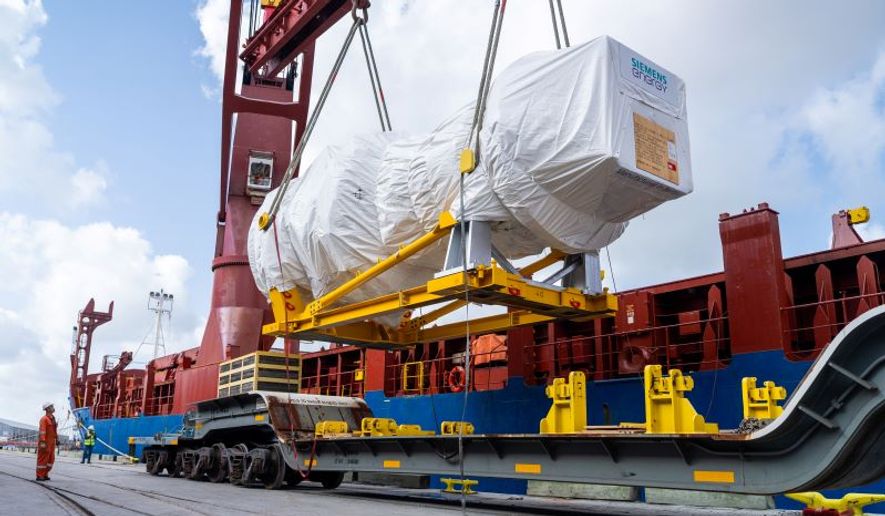

The machine at the center of the AI buildout is not a chip. It is a heavy-duty gas turbine, the engine that burns natural gas to generate hundreds of megawatts. And it is effectively sold out.
Three manufacturers, GE Vernova, Siemens Energy and Mitsubishi Heavy Industries, dominate the market for the large frames that power modern plants. Together they account for nearly two-thirds of global gas turbine capacity under construction, according to Global Energy Monitor data from 2024, and all three report deliveries booked years out. The gas turbine shortage is already working its way toward ratepayers.
Why turbines are carrying the load
People were interested in these podcasts
Data centers need firm, around-the-clock power on a construction schedule of one to three years, according to The International Energy Agency. Solar and wind can be built in one to five years, the IEA says, but they need storage to run a constant load. New nuclear will not arrive in time, and the reactor restarts, plus the small modular reactor deals signed by Microsoft, Google, Amazon and others, are mostly early-2030s propositions.

That leaves combined-cycle gas as the default bridge, which is why the amount of gas-fired power in development in the United States has nearly tripled in a year to a record 252 gigawatts, according to Global Energy Monitor, and why utilities such as Entergy are planning 5.2 gigawatts of new gas generation for a single Meta data center campus in Louisiana.
Three factories for the whole world
The numbers describe a seller’s market. GE Vernova’s gas turbine backlog and slot reservation agreements reached 116 gigawatts in the second quarter, and CEO Scott Strazik told investors the company expects to be mostly sold out through 2030 by the end of the year.
Siemens Energy closed its fiscal third quarter with a 69-gigawatt gas turbine backlog inside a total company backlog of €162 billion.
Mitsubishi reported 35 gigawatts of large-frame turbines in its backlog, up from 23 a year earlier, with orders booked in its latest quarter scheduled for delivery between 2028 and 2030. The figures are not directly comparable, OilPrice.com notes: GE’s total includes 63 gigawatts of paid slot reservations, and Mitsubishi’s covers large frames only.
Capacity is expanding, but slowly. GE Vernova is investing more than $160 million in Greenville, South Carolina, to lift heavy-duty output from 55 units a year toward 70 to 80. Siemens is expanding blade production in Florida, and Mitsubishi is reported to be planning to double its capacity.
A key constraint is not floor space. It is the hot section: single-crystal superalloy blades that must survive gas hotter than the metal’s own melting point, with the help of internal cooling, cast by a limited set of specialized foundries. Wood Mackenzie cites hot-section component bottlenecks and specialized labor shortages as limits on production.
What operators actually face
Lead times for new combined-cycle plants have gone from about 3.5 years in 2023 to roughly five now, and up to seven for some heavy-duty frames, OilPrice.com reports. Wood Mackenzie projects turbine prices will reach $600 per kilowatt by the end of 2027, nearly triple their 2019 level.
Manufacturers now sell slot reservation agreements, non-refundable deposits for a place in line, and GE Vernova’s second-quarter cash flow got a $6.4 billion working-capital lift from those down payments, according to the same report.
GE Vernova CEO Scott Strazik has said that in many cases turbines are not the gating item, pointing to construction, permitting and fuel availability as parallel constraints. But a developer who does not already hold a slot is, in practice, planning a power plant for the 2030s.
The bill lands on ratepayers
Scarcity is already priced into electricity markets. Goldman Sachs projects U.S. data center power demand rising from 31 gigawatts in 2025 to 41 in 2026 and 66 in 2027, with 36.3 gigawatts of data center capacity scheduled to come online in 2027 alone, up from 13.6 gigawatts in 2026.
The regions absorbing the demand see it first. The PJM Interconnection grid operator’s capacity auction for 2028-29 cleared at its $325-per-megawatt-day price cap for a third straight year, drew only 525 megawatts of new generation, and still fell 6,831 megawatts short of its reliability requirement. Tight conditions in parts of Texas point the same way. Higher equipment costs feed utility rate cases, which is how a queue at three factories becomes a line item on a household electric bill.
This article was constructed with the assistance of artificial intelligence and published by a member of The Washington Times' AI News Desk team. The contents of this report are based solely on The Washington Times' original reporting, wire services, and/or other sources cited within the report. For more information, please read our AI policy or contact Steve Fink, Director of Artificial Intelligence, at sfink@washingtontimes.com
The Washington Times AI Ethics Newsroom Committee can be reached at aispotlight@washingtontimes.com.

Please read our comment policy before commenting.