


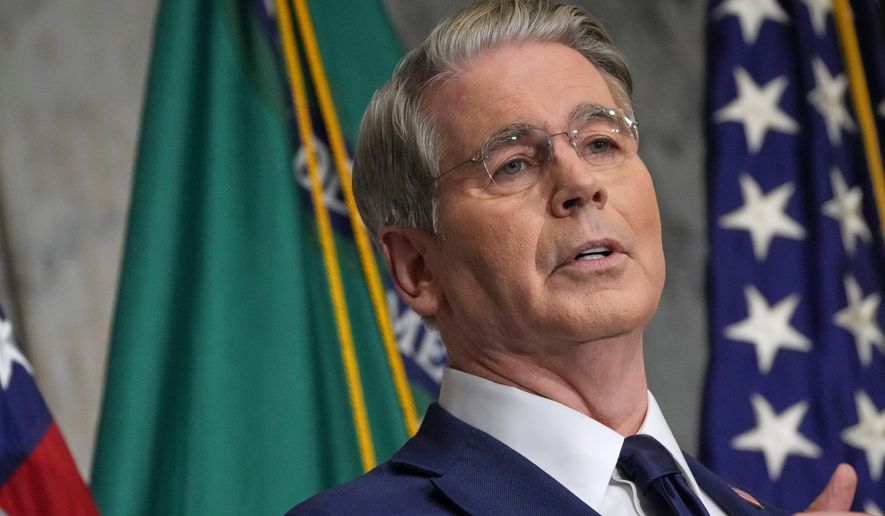

Treasury Secretary Scott Bessent estimated Sunday that Iran has only a smattering of crude oil left to sell to China, its main customer, pointing to Tehran’s lack of reserves as evidence that the U.S. pressure campaign is working.
Addressing concerns that China’s purchase of Iranian oil will continue to prop up the government in Tehran, Mr. Bessent insisted that it is a moot issue because of the few barrels Iran has left to sell.
“There’s probably only about 30 million barrels of Iranian crude oil left that China hasn’t bought,” Mr. Bessent said in an interview with Fox News’ “My View with Lara Trump.” “So that will run out soon, and there will be no problem with China buying because they have no product.”
He added that the U.S. blockade of Iran’s ports has made it increasingly difficult for Tehran to export anything, let alone millions of barrels of crude oil. Washington’s sanctions regime targeting Iran has also helped cripple the Islamic Republic’s economy, Mr. Bessent said.
He repeated President Trump’s assertion that the U.S. has complete control over the Strait of Hormuz, despite Iran repeatedly attacking commercial ships in the waterway over the past month.
“The Iranian chokehold, to the extent they have one — and I can tell you, they do not have one — we are in control of the strait,” the Treasury secretary said.
In recent days, Mr. Bessent has oscillated between insisting that Iran does not control the strait, a narrow water route connecting the Gulf of Oman and the Persian Gulf, and asserting that the waterway will become irrelevant in a matter of years.
He repeated his arguments Sunday, saying that Gulf powers are working on “alternative pipeline” projects that would make it possible to safely export oil without going through the Strait of Hormuz.
Experts have said that oil pipelines cannot fully replace the Strait of Hormuz as a primary export route in the near term. Projects would need to cover vast territories, pass through multiple nations and could cost billions of dollars.
Pipelines are also massive targets for regional militias, and the projects would require major security investment.
Mr. Bessent’s comments come as the Treasury Department works to expand Operation Economic Outcast, the latest sanctions campaign targeting Iran’s financial partners.
The operation has targeted dozens of individuals and entities with ties to Tehran and sanctioned the United Arab Emirates branch of the Egyptian state-owned Banque Misr and the Golden Global Bank in Turkey.
In response, Iran on Sunday established an “economic war command center” to coordinate responses to the U.S. pressure campaign.
Contact the author


Please read our comment policy before commenting.