


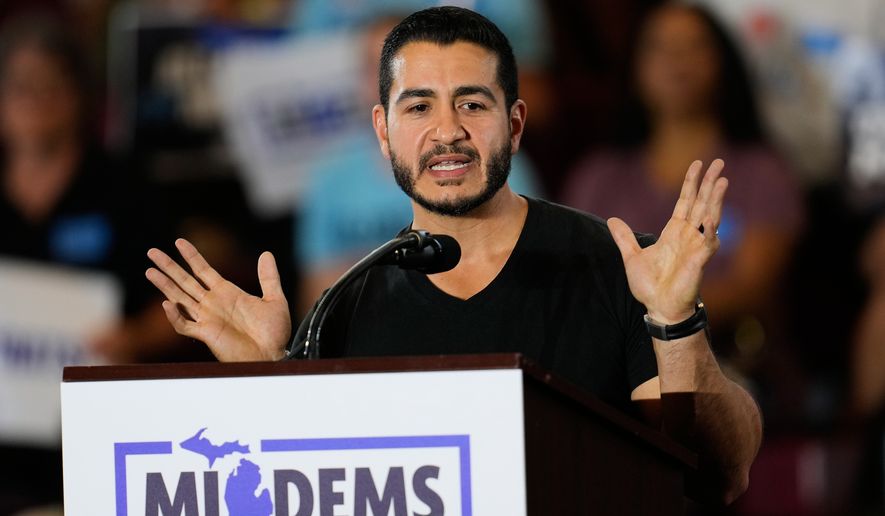

DETROIT — Four-term Michigan state Rep. Tyrone Carter says friction between Arab and Black communities in metro Detroit is “always simmering,” and now Democrat Abdul El-Sayed’s U.S. Senate run could get burned.
Mr. Carter, a Black man who formerly served as an executive lieutenant in the Wayne County sheriff’s office, said the tension between the two communities can, at times, feel combustible, and “the wick is getting shorter and shorter.”
So when some Democratic voters are urged to back Mr. El-Sayed, the response is blunt: Absolutely not.
People were interested in these podcasts
With less than four weeks to go before the Nov. 3 election, that is a big problem for Mr. El-Sayed, a far-left Democrat who is one of the most outspoken pro-Palestinian candidates running for Senate this year.
He is trying to knit together Democratic constituencies with competing demands: Arab American voters who helped power his primary win, Black voters who preferred his opponent and Jewish voters who remain wary of his views on Israel.
To bridge these divides, he has touted the endorsement of the Congressional Black Caucus and appeared with former Vice President Kamala Harris, who praised his work on Black maternal health. He is set to campaign with former President Barack Obama on Oct. 24, the first day of in-person early voting in Michigan.
Mr. El-Sayed has also apologized to Jewish leaders for his remarks after the March attack on Temple Israel in suburban Detroit, during which he condemned the attack but said “hurt people hurt people” and “violence always begets violence.”
He has said he is as committed to Jewish safety as he is to the safety of his daughters.
Whether that is enough is unclear.
He is in a tight race against Republican Mike Rogers, a former congressman who says disaffected Black and Jewish voters are swinging his way.
Mr. El-Sayed’s ability to solve that puzzle could decide who succeeds retiring Democratic Sen. Gary Peters and which party controls the Senate during President Trump’s final two years in office.
“What seems like a marginal difference could end up being the difference,” said David Dulio, a political science professor at Oakland University. “Michigan is infamous for sort of weird, fitting puzzles when it comes to winning coalitions.”
Strengths, weaknesses, warning signs
The August primary clarified Mr. El-Sayed’s strengths and vulnerabilities. He ran up the score in college towns and among highly educated voters. He dominated Dearborn, home to the nation’s largest Arab community, and Dearborn Heights, another Arab American stronghold.
His primary rival, former Rep. Haley Stevens, performed better in Wayne and Genesee counties, both of which are home to large Black populations. She also finished first across suburban Detroit, including Oakland County — home to a sizable Black and Jewish community and Temple Israel, the target of the Hezbollah-inspired terrorist attack in March.
Ms. Stevens was boosted by more than $30 million in spending by the American Israeli Public Affairs Committee.
The results underscored a split over Mr. El-Sayed among key Democratic constituencies.
Mr. El-Sayed, the son of Egyptian immigrants, would be the first Muslim elected to the U.S. Senate. That history, along with his far-left views, including on Israel, endeared him to Arab American voters and younger liberals.
Indeed, Arab Americans overwhelmingly view Israel unfavorably and oppose U.S. support for military action in the Gaza Strip and Lebanon.
Those same attributes unsettle traditional Democratic blocs.
Although American Jews are increasingly critical of Israel’s current leaders, they overwhelmingly support Israel’s right to exist.
With Black voters, the backlash is different. Some believe Mr. El-Sayed’s support for the pro-Palestinian “uncommitted” protest in the 2024 primary weakened Ms. Harris’ historic bid and boosted President Trump in the Arab American community.
Mr. Carter said women, in particular, still feel burned by those who undercut support for Ms. Harris — a sentiment he hears often as: “They did our girl bad.”
That wound has not healed, he said, and now the “vote blue no matter who” slogan that some El-Sayed supporters are rallying behind comes off as hypocritical.
Jewish challenge
Jewish concerns cut just as deep.
Mr. El-Sayed has been a vocal critic of Israel’s response to the Oct. 7, 2023, Hamas attack, calling the war in Gaza a “genocide.”
After the attempted truck attack at Temple Israel, he initially said “hurt people hurt people,” linking the violence to an Israeli strike in Lebanon that reportedly killed members of the assailant’s family, including the attacker’s brother, whom Israel identified as a Hezbollah commander.
Mr. El-Sayed apologized to the Jewish Democratic Caucus on Aug. 29, but doubts persisted.
Michigan rabbis and Jewish leaders say they are still waiting for him to shift his rhetoric or clarify his stance. On Sept. 8, they launched a Nonnegotiable petition demanding Jewish safety, including for Zionist Jews, and the right to define their own identity. It also calls for Jewish self-determination in Israel and full participation in American civic life.
“American Jews now feel forced to fight for the party they long claimed as their political home,” the petition reads, urging urgency and moral clarity.
Weeks later, Jewish advocates noted that Mr. El-Sayed did not issue a statement marking the anniversary of the Oct. 7 Hamas terrorist attack on Israel that killed about 1,200 people.
That same day, Rabbi Aaron Starr, president of the Michigan Board of Rabbis and a leader of the Nonnegotiable effort, had lost hope in the Democrat, writing in a Detroit News op-ed: “I will not vote for U.S. Senate candidate Abdul El-Sayed.”
Rabbi Starr said Mr. El-Sayed’s rhetoric echoes antisemitic tropes, frames U.S. support for Israel in ways that resemble conspiracy theories and questions whether Jewish statehood is compatible with liberal values. He also pointed to Mr. El-Sayed’s appearances alongside Hasan Piker, the streamer known for antisemitic rhetoric.
“Some Jewish Democrats will abstain … others will vote for the Republican nominee, Mike Rogers,” Rabbi Starr said. “Still others are listening to every word El-Sayed states, hoping … he might offer real reflection.”
Simmering tension in Detroit
Late last month, an 18-year-old woman of Arab descent reportedly ran a red light and crashed her car into a 49-year-old Black woman. The woman said a crowd of mostly Arab men surrounded her and hurled racial slurs — an incident activists say reflects deep-seated anti-Black racism inside parts of the Arab American community.
Nasser Beydoun, a longtime Arab American civic leader who ran for the 2024 Democratic Senate nomination, said those tensions have existed for years and stem partly from ownership patterns — with Arab American families running many gas stations, liquor stores and small groceries in Black neighborhoods. “There’s very little Black ownership in those sectors,” he said.
Mr. Beydoun has also been a sharp critic of the Democratic Party and the pro-Israel lobby. Weeks before the 2024 election, he derided Mr. Trump and Ms. Harris as “Zionists” and told an Arab American conference, “F—- them both.”
Now he says Republicans are exaggerating the latest tensions between Arab Americans and Black voters for political reasons.
“They are going to try everything in their power to defeat Abdul El-Sayed because he scares the hell out of them,” he said, adding that the Arab American community is firmly behind Mr. El-Sayed and working to help him build trust in the Black community.
Mr. El-Sayed has tried to meet that moment by stressing his record in Detroit, reminding voters that he left his job as an assistant professor of epidemiology at Columbia University to take on the challenges facing Black and underserved communities as the city’s public health director.
He has promised to push for more investment in healthcare and affordable housing, change how schools are funded so Black communities receive the resources needed for a good education, expand lending to minority-owned businesses, increase low-income housing tax credits and pass the John Lewis Voting Rights Act.
“My commitment has always been to work with the community to try and bring whatever I could to address challenges systematically and directly facing Black communities,” he said.
He has also reminded voters that he is Arab, but also African, given his Egyptian roots — and that Arab and Black communities should be natural allies.
“When your back’s against the wall,” he said, “the question is who’s got their back against the wall with you, and how do you lock arms to be stronger against the folks putting your back to the wall?”
Rogers rolls out the welcome mat
Mr. Rogers, who fell about 20,000 votes short in the 2024 Senate race, is working the seams, saying he needs to win just over 5% of Ms. Stevens’ primary supporters to win the Senate seat.
He said he is making inroads with Jewish voters turned off by what he called Mr. El-Sayed’s “toxic language” that contributed to a hostile environment for Jews.
He also points to their first debate, when Mr. El-Sayed declined to say whether Iran or Israel posed a greater threat. Mr. Rogers said Iran’s Islamic Revolutionary Guard Corps “has American blood on its hands.”
Mr. Rogers and his allies are also playing on the divide among Black voters.
Sen. John Kennedy, Louisiana Republican, said Mr. Obama’s upcoming visit speaks volumes.
“President Obama doesn’t want to be anywhere near this mess,” Mr. Kennedy told reporters during a campaign swing with Mr. Rogers. “In his heart of hearts, I don’t think that he believes a lot of what Dr. El-Sayed stands for.”
Mr. Rogers said he is reaching out to Black voters who feel Democrats have drifted toward socialism and “left them behind.”
He is also making forays into communities Republicans rarely visit. When he recently attended a service at St. Paul Church of God in Detroit, Mr. Rogers said the pastor told him, “There hasn’t been a Republican in this church for 76 years.”
Mr. Rogers added, “You drive down some pretty rough neighborhoods in Detroit, and you will see Mike Rogers signs because we’ve been down there.”
At a roundtable last month with Black leaders, Mr. El-Sayed heard something similar about Mr. Rogers making inroads.
Kimberly Fisher, a House candidate, said she saw more Rogers signs while canvassing her Detroit district and heard voters say, “Why would I vote for an Arab? Arabs don’t like us.”

Please read our comment policy before commenting.