


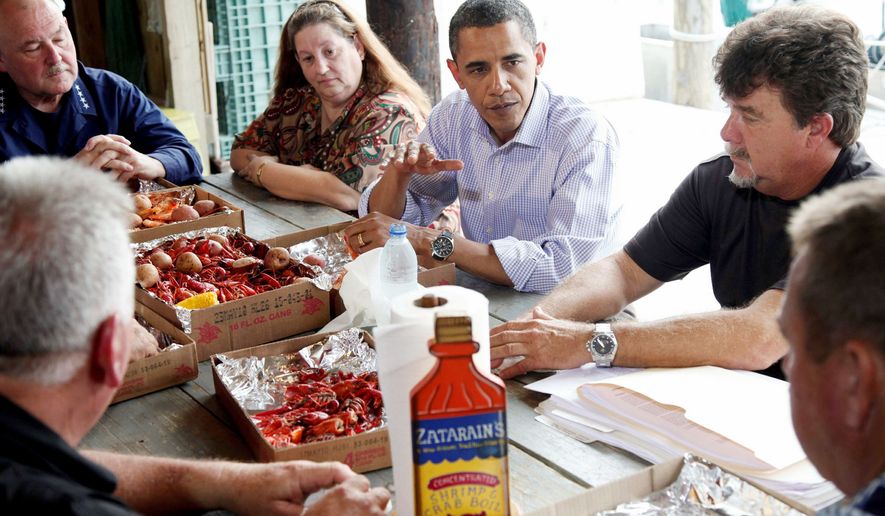

GULFPORT, Miss. | It’s not clear whether President Obama’s stomach can save an entire industry, but he’s making a real go of it when it comes to seafood from the Gulf of Mexico.
From his two-day trip in June, when he put away as much crawfish and shrimp as possible, to the Gulf shrimp he had served at his birthday barbecue last weekend, Mr. Obama is doing what could best be described as stomach stimulus in the wake of the catastrophic BP oil spill.
And the president will go for third helpings this weekend during a two-day vacation in Panama City, Fla.
“Americans can confidently and safely enjoy Gulf seafood once again. We’re certainly going to enjoy it here at the White House. In fact, we had some yesterday,” Mr. Obama said Monday as he welcomed the Super Bowl champion New Orleans Saints, and the shrimp and oyster fixings for a 30-foot po’boy sandwich they brought with them, to the White House.
The results from Mr. Obama’s first Gulf trip are mixed: Most restaurants are still down, and seafood distributors report gigantic losses as they struggle to find suppliers that can get them seafood, and customers willing to pay for Gulf shrimp, oysters, crab and fish even as national press reports warn of continued dangers.
Still, for most folks down here, in Mr. Obama’s stomach they trust.
“After he came down here and said our beaches are clean, our seafood is safe, it helped tremendously. There’s no doubt about it,” said Scott Weinberg, owner of the Blow-Fly Inn in Gulfport, who shared a lunch of fried shrimp, mini-crabcakes and shrimp salad sandwiches with Mr. Obama and other business owners.
More than a third of Mississippi coast restaurants report seeing a drop of more than 20 percent since the spill, according to a survey Mr. Weinberg, president of the Mississippi Hospitality & Restaurant Association, took of Mississippi coast restaurants.
He said his menu at Blow-Fly Inn hasn’t changed, but the food behind it has. He’s paying 30 percent to 40 percent more for oysters - and they’re smaller and coming from the coast of Florida rather than the rich oyster beds just off the Mississippi coast that used to produce the big oysters for his po’boy sandwiches.
“There’s a terrible stigma out there about our product, and it’s not true,” said Peter Nord, who runs Chimneys restaurant in Gulfport, and who supplied the food for the Obama get-together with business owners.
Restaurants, though, can change their menus. Mr. Nord said he has added lobster to fill out his menu since the oil spill. That’s not the case for the seafood distributors, such as Sean Desporte, whose family has been in the business for 110 years and five generations.
Business at his Biloxi shop was great the first two weeks as customers made a run, buying up all his inventory. But since then he’s down 40 percent in his retail business, and his wholesale business is taking a beating as the big Biloxi casinos cancel orders. He said his shop used to have the contract for oysters at all the local Hooters restaurants as well, but they’ve been taken off the menu, so that order has dried up.
“We’ve never been this slow before, and it’s killing us,” he said.
He said he’s able to get enough supply to sell, though he’s gone from four oyster suppliers down to one.
He urged customers across the country to consider placing mail orders for Gulf seafood. With overnight shipping, he said, it can be at customers’ doors, fresh, the next day.
Obama’s every bite
Scientists - and Mr. Obama - say the seafood is safe. Restaurant owners, seafood distributors and environmental officials say the food is probably the most-tested seafood in the world at this point. Besides, the government closed fishing grounds that might be contaminated, making it unlikely that any bad seafood would get to market.
But with 4.9 million barrels of oil spilled and the government unable to account for much of it at this point, business owners say, consumers aren’t convinced.
Business owners blame the press, saying overblown stories caused the scare in the first place, but those owners say that national coverage of folks eating the food is the solution.
That’s where Mr. Obama and his stomach come in. Few things can cut through the clutter of news like the president, and the horde of reporters who hang on his every word, or in this case his every bite.
Some of the seafood distributors in Mississippi want to ship a bunch of seafood to the White House and host a big cookout on the executive mansion’s lawn for the president and his staff.
That idea has not taken off, but last weekend Mr. Obama featured Gulf seafood at his birthday barbecue, and on Monday, as he hosted the New Orleans Saints, a team of Washington chefs built and served the 30-foot po’boy made with Louisiana oysters, shrimp and bread from New Orleans-based Leidenheimer Baking Co.
The presidential palate is powerful. During the 2008 campaign, Mr. Obama’s seal of approval helped sell pizza in St. Louis and cookies in Des Moines, Iowa, while in the days since he’s taken office he’s boosted Washington-area burger joints with his occasional visits.
So it’s no surprise seafood folks say he can help them overcome their troubles along the Gulf.
They’ll get another test this weekend when Mr. Obama brings his family to Florida for a quick two-day vacation this weekend.
Mr. Obama’s not the only one trying to use a trip to the region to stir up business.
Dennis Gorg, who runs a coffee shop in St. Louis, organized a busload of folks from Missouri to travel the coast this week with the sole purpose of spending money and garnering attention for the region’s businesses.
“What do business owners need more than anything? They need customers. I thought, let’s take them customers,” Mr. Gorg said just before he and his group tucked into an afternoon lunch at Blow-Fly Inn, Mr. Weinberg’s restaurant.
He said he appreciates Mr. Obama’s efforts but that he thinks his group’s visit could make even more difference when it comes to convincing average Americans that the food is safe.
“He’s got a Secret Service agent in the kitchen. I don’t think he’s going to have a bad fish experience,” Mr. Gorg said, wondering whether the image of the president eating seafood translates. “Of course it’s safe for him; he travels in a bubble.”
Short-lived bump?
On Mr. Obama’s June trip, he bought lemon-lime ices with Mississippi Gov. Haley Barbour at Cyndi’s Sno De-Lites on the beach in Gulfport. Business at the beach-front kiosk boomed that day, according to local press reports.
But the effect was apparently short-lived. On Monday and Tuesday this week, the white shutters at Cyndi’s were shut, the parking lot at Combs Pier, where Mr. Obama ate lunch that day, was all but empty, and a row of lonely personal watercraft bobbed 50 yards off shore.
One local said Cyndi’s is still open on weekends, but with the number of beachgoers down by half there probably wasn’t enough traffic to keep it open the rest of the time.
Still, the suffering is not shared by all, and one place that’s weathering better than most is Tacky Jacks tavern in Orange Beach, Ala., where the president ate dinner in June, sharing crawfish tails, a gigantic plateful of loaded nachos that the restaurant calls “Mexican Garbage,” and sweet royal red shrimp, pulled from 4,000 feet deep in the Gulf.
David Evans, vice president of operations and development for Tacky Jacks, said the restaurant did see a price spike in their seafood supply in July but has managed just fine - possibly because it’s a bigger operation with higher purchasing power and a steady customer base.
“We have been able to maintain our traditional menu of seafood. We have had very little to no difficulties truly with any seafood products,” Mr. Evans said. “Oysters have been a bit touch-and-go for just a short period of time, but really we’ve just not had much of a problem.”
Shucking paradise lost
For Paul Johnson, a sixth-generation fisherman who works the Gulf and runs an oyster-shucking business along with his father and brother, the spill has been a personal disaster. They’ve collected checks from BP PLC and have spent some time working on the BP cleanup crews out in the Gulf, but they haven’t shucked an oyster since June 1.
“I’m a little scared to get back into it too quick. I don’t want somebody coming back and saying I found a little oil in this,” said Jeff Johnson, the father.
Both men said they’d like to go back to work on the BP cleaning crews, where there’s good money to be made. But some seafood distributors here worry that the money is too good.
Richard Gollott, who runs a seafood-processing plant and is on the Mississippi Commission on Marine Resources, said he was shocked earlier this week when he was watching a national news broadcast where scientists declared the seafood safe, then a few minutes later a local fisherman argued that the situation was still bad and the things he was pulling up were oil-infested.
Mr. Gollott said the prospect of a guaranteed, good check from BP is so attractive that some fishermen are bad-mouthing local seafood in order to keep BP on the line longer.
“To people down here it’s clear what’s going on,” Mr. Gollott said. He said he doesn’t blame the fishermen, just the economics that are so skewed that it makes more sense to take the guaranteed check over running the risk of fishing all day with the possibility of coming up empty.
Contact the author


Please read our comment policy before commenting.