


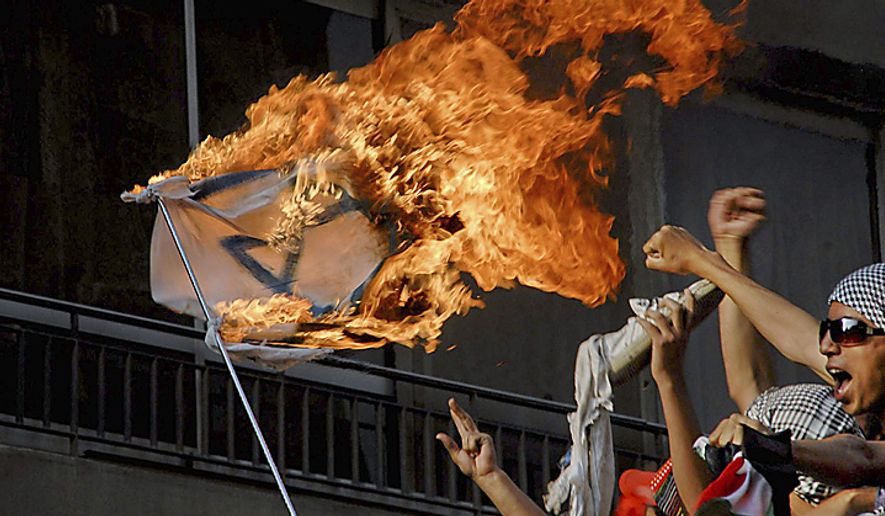

Thousands of Palestinian demonstrators clashed with Israeli security forces on three hostile borders Sunday in an unprecedented wave of protests marking an annual ritual against the founding of the Jewish state in 1948.
Israeli soldiers opened fire, leaving at least 15 dead and many more injured, as rioting Palestinians poured across the borders with Syria, Lebanon and the Palestinian territories.
Israeli officials said 13 troops were wounded and blamed Syria and Iran for orchestrating the clashes.
The protests mark the first time that the demonstrations, which have swept the Arab world this year, have been directed at Israel.
The riots erupted as U.S. efforts to promote Israeli-Palestinian peace talks appeared close to collapse with the sudden resignation Friday of U.S. special Middle East envoy George Mitchell.
The resignation leaves already stalled U.S. peace efforts in tatters, a circumstance that President Obama is expected to address this week in a major speech on the Middle East.
“We hope calm and quiet will quickly return, but nobody should be mistaken. We are determined to defend our borders and sovereignty,” Israeli Prime Minister Benjamin Netanyahu said in brief remarks broadcast live on Israeli TV stations.
Mr. Netanyahu said he ordered the military to act with “maximum restraint” but vowed a tough response to any further incursions. The Israeli leader is due in Washington for talks with Mr. Obama this week.
Despite the upcoming visit, observers said recent events in the region — the fall of several Arab autocracies and a deal between the Palestinian factions Fatah, which controls the West Bank, and Hamas, which controls Gaza — have effectively paralyzed U.S. efforts.
“Everything is on hold right now because so many variables are unreadable,” Hussein Ibish of the American Task Force on Palestine told The Washington Times.
“What is the relationship between the Israeli-Palestinian issue and the broader Arab Spring? It’s still unclear. … What will Egypt’s foreign policy be?
“No one knows what the Palestinian agreement [between Fatah and Hamas] means.
“It’s also unclear what the Israelis want. Do they favor a two-states solution [with a sovereign Palestine alongside Israel] or not? … The Israeli Cabinet is divided just as the Palestinians are.”
Mr. Ibish said Mr. Obama deserved credit for his efforts but said it was difficult to see how there could be progress now.
The unprecedented breakthrough by Palestinian demonstrators on the Syrian border in the disputed Golan Heights area — tightly controlled by the Syrian military — brought allegations that Damascus had encouraged the protests as a way of distracting attention from the two-month-long uprising against the regime of President Bashar Assad.
The clashes sparked demonstrations in Egypt, where police fired tear gas at demonstrators trying to storm the Israeli Embassy in Cairo.
The demonstrations were part of annual protests by Palestinians marking the foundation in 1948 of Israel — an event they call “al-Naqbah,” or “the Catastrophe.” Hundreds of thousands of Palestinians fled when Arab nations attacked Israel. They became refugees in the West Bank and Gaza and in neighboring countries, where many remain in camps.
Crowds were larger than expected because activists used Facebook and other social networking websites to mobilize Palestinians and their supporters in neighboring Arab countries to march on the border with Israel, including its disputed border with Syria in the Golan Heights
Israel captured the Golan from Syria in the 1967 war, and Syria demands the area back as part of any peace deal. Israel has annexed the territory.
Despite hostility between the two countries, Syria has carefully kept the border quiet since the 1973 war, and the breakthrough by demonstrators was unprecedented.
About midday, thousands of people approached the border, hoisting Palestinian flags, shouting slogans and throwing rocks and bottles at Israeli forces.
When hundreds of people burst across the border fence into the Israeli-controlled town of Majdal Shams, Syrian forces did not intervene, and surprised Israeli soldiers opened fire.
Israeli defense officials, speaking on the condition of anonymity because of the sensitive nature of the information, acknowledged the military was caught off guard by the violent marches.
Officials also said there were strong signs that Syria and its Iranian-backed Lebanese ally, Hezbollah, orchestrated the unrest.
“The Syrian regime is intentionally attempting to divert international attention away from the brutal crackdown of their own citizens to incite against Israel,” said Lt. Col. Avital Leibovich, an Israeli military spokeswoman.
Israel’s military spokesman, Brig. Gen. Yoav Mordechai, told Channel 2 TV he also saw “fingerprints of Iranian provocation and an attempt to use ’Naqbah day’ to create conflict.”
Hezbollah’s al-Manar TV was in place to film much of the day’s clashes, and the Israeli officials said the activists were bused in from Palestinian refugee camps throughout Syria.
In a television interview Sunday, Iranian President Mahmoud Ahmadinejad said the day’s events proved again the character of the Jewish state and reiterated his calls for its destruction.
“On the anniversary of this regime, people demonstrated in various places, but there were dead and wounded and this regime once again showed its real nature,” he said. “Like a cancer cell that spreads through the body, this regime infects any region. It must be removed from the body.”
• This article is based in part on wire service reports.

Please read our comment policy before commenting.