



PHOENIX (AP) - Gov. Doug Ducey says officials need to ensure the state’s Election Day fiasco isn’t repeated after some Phoenix-area voters waited five hours and into the night to cast ballots.
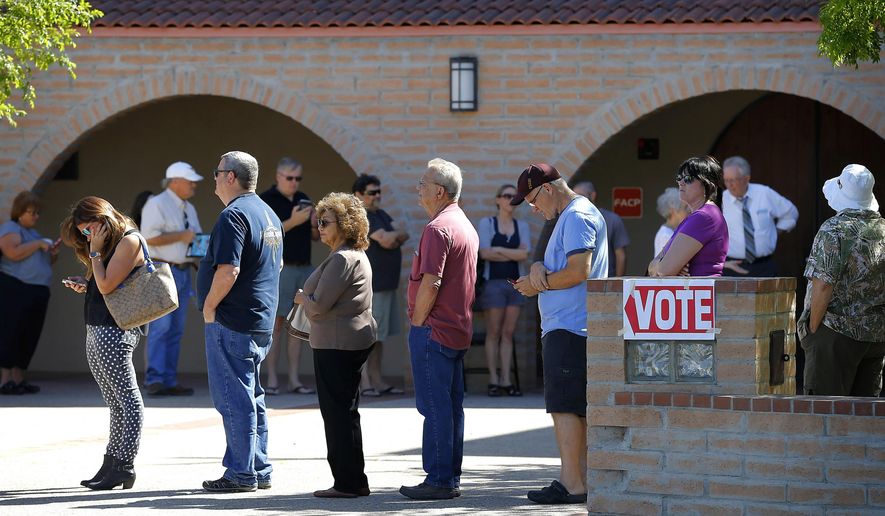
The primary Tuesday produced easy victories for Republican Donald Trump and Democrat Hillary Clinton, but long lines were the norm at the 60 polling sites in a county with 2 million registered voters. That compares with 200 sites in the 2012 White House primary and 700 in the 2014 general election.
Maricopa County officials drastically cut the number of polling sites to save money, and the decision backfired the minute the polls opened and long lines began to form. They grew worse throughout the day, and police had to be called to direct traffic at some locations. At least one spot ran out of Democratic ballots. A downtown Phoenix location that saw especially large turnout still had people in line hours after polls closed and the races were called.
People were interested in these podcasts
“I’m glad to see so many Arizonans step up to make their voice heard for the candidate of their choice. However, it’s unacceptable that many of them had to battle incredibly long lines,” Ducey said Wednesday in a statement. “Our election officials must evaluate what went wrong and how they make sure it doesn’t happen again. “
Some voters wore wide-brimmed hats or carried umbrellas for shade. Others sat in lawn chairs they brought from home. In one downtown location, a woman passed out animal crackers to weary voters.
Keith Clausen waited nearly five hours to vote at a Presbyterian church in Phoenix and witnessed people who spent long stretches in the line walk away without voting. They either had to return to work or be somewhere else.
The frustration was especially palpable in a year when many voters turned out to express their dissatisfaction with the status quo, only to become more frustrated with the government’s ability to run an election.
“Just the amount of people waiting in line is absurd,” Clausen said. “I feel that whoever made this cut (of polling places) deserves to hear from voters who had to wait in line.”
Trump won on the Republican side, capitalizing on his harsh border rhetoric and endorsement of immigration hard-liners to secure the state’s rich delegate prize. On the Democratic side, Clinton fended off an aggressive challenge by Bernie Sanders, who went all out to turn around his campaign in Arizona after getting swept a week ago by the former first lady and secretary of state.
Trump held a comfortable double-digit margin over Sen. Ted Cruz, far too much for any shift among late voters to make up. Clinton also opened up an insurmountable double-digit lead. Sen. Marco Rubio was in third place despite dropping out a week ago, leading Ohio Gov. John Kasich. The first batch of vote tallies were from mail-in ballots, many from before Rubio quitting the race.
The move was designed to save money and in response to the popularity of early mail-in ballots. In addition, independents who can’t vote in the primaries make up more than a third of the electorate. Ducey called for that to be changed.
Trump’s victory was fueled by three campaign appearances before raucous crowds in Arizona, where GOP primaries have long been dominated by the immigration debate. The debate peaked in 2010 with the state’s passage of the anti-immigration law known as SB1070 but waned in recent years after business leaders tired of the backlash and series of legal challenges.
Trump revived the debate nationally after declaring he would build a wall on the U.S.-Mexico border and make Mexico pay for it. He called Mexican immigrants rapists and drug dealers and vowed to forcibly deport the 11 million people living in the country illegally. He sought the endorsement of Sheriff Joe Arpaio, who made a name for himself as an immigration fighter but was forced by a federal judge to quit enforcing immigration laws after being found to have violated people’s constitutional rights.
Gov. Jan Brewer also endorsed Trump.
Supporters gravitated to the New York businessman.
“Just the way, you know, you think you could have a beer with him,” voter Don Rock said outside a Phoenix polling place. “Of course, I wouldn’t mind going on one of his yachts partying with him, but he just talks normal. All the other ones, politicians, they just say what they want you to hear, and they just don’t do anything.”
In the Democratic race, Sanders courted Latinos, tribal members and young voters in a series of Arizona appearances and drew 7,000 supporters to a Phoenix event.
But Clinton had the strong backing of the Democratic political establishment and aired TV ads touting the support of former Rep. Gabby Giffords, who was shot in the head five years ago at a Tucson political event.
Marie Howard, 57, of Tonalea, Arizona, keeps postcards, an autographed photo and newspaper clippings that remind her of when Clinton visited the Navajo Nation and the Grand Canyon long before she became a presidential contender. She backed Clinton in Tuesday’s election.
“She’s the only one who’s been out here trying to make a difference,” Howard said.
Trump lands 58 delegates for his win. The Democratic contest yielded 75 delegates. Ten Democratic superdelegates can vote for the candidate of their choice.
___
Associated Press reporters Adam Kealoha Causey contributed in Phoenix, Astrid Galvan contributed from Tucson and Felicia Fonseca from Cameron.

Please read our comment policy before commenting.