The Washington Times

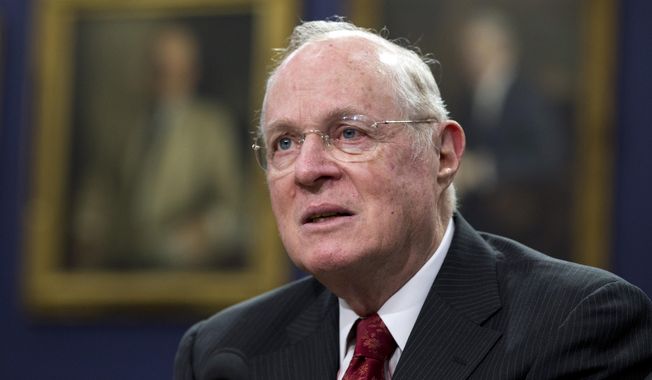
Topic - Anthony Kennedy

Subscribe to this topic via RSS or ATOM
Related Stories
  • LETTER TO THE EDITOR: Memo to Justice Kennedy

    Someone ought to point out to Supreme Court Justice Anthony M. Kennedy that the Defense of Marriage Act (DOMA) in no way restricts an individual state's laws concerning who in that state may marry, nor does it restrict laws having to do with receipt of state benefits attendant to persons married in that state ("Supreme Court questions DOMA's legitimacy," Web, March 28).

  • Matt and Melanie Capobianco's adoptive daughter, Veronica, goes trick-or-treating in Charleston, S.C., in October 2011. The girl is at the center of a case before the U.S. Supreme Court challenging a federal law on the adoption of American Indian children. (AP Photo/Courtesy of Melanie Capobianco)

    Supreme Court wrestles with Indian adoption dispute

    The Supreme Court is trying to sort out a wrenching adoption case involving a American Indian child, a biological father who first renounced any interest in her, and adoptive parents who eventually were ordered to hand her over to the father.

  • Sitting on the U.S. Supreme Court are (clockwise from upper left) Associate Justices Sonia Sotomayor, Stephen G. Breyer, Samuel A. Alito Jr., Elena Kagan, Ruth Bader Ginsburg and Anthony M. Kennedy; Chief Justice John G. Roberts Jr.; and Associate Justices Antonin Scalia and Clarence Thomas. (AP Photo/Pablo Martinez Monsivais)

    Supreme Court considers whether human genes can be patented

    The Supreme Court seemed worried Monday about the idea of companies patenting genes that can be found inside the human body, as it heard arguments in a case that could profoundly reshape U.S. medical research and the fight against diseases such as breast and ovarian cancer.

  • This artist rendering shows attorney Charles J. Cooper, right, addressing the Supreme Court in Washington, Tuesday, March 26, 2013, as the court heard arguments on California's ban on same-sex marriage. Justices, from left are, Sonia Sotomayor, Stephen Breyer, Clarence Thomas, Antonin Scalia, Chief Justice John Roberts, and Justices Anthony Kennedy, Ruth Bader Ginsburg, Samuel Alito and Elena Kagan. (AP Photo/Dana Verkouteren)

    Obama administration under fire in gay marriage arguments

    Gay marriage is on trial but it was the Obama administration facing the heat as the Supreme Court began the second of two days of landmark oral arguments on the constitutionality of gay marriage.

  • Kevin Coyne of Washington holds flags in front of the Supreme Court in Washington on March 27, 2013. The U.S. Supreme Court, in the second day of gay marriage cases, turned to a constitutional challenge to the federal law that prevents legally married gay Americans from collecting federal benefits generally available to straight married couples. (Associated Press)

    Supreme Court justices question DOMA's range, consider effect act has in states

    The federal government has a "powerful interest" in a single, uniform definition of marriage, even if it excludes gay unions that are legal in individual states, the lawyer defending the federal Defense of Marriage Act said Wednesday as the Supreme Court concluded two days of landmark arguments on gay marriage.

  • Franco Ciammachilli (right) of Washington waves a rainbow flag, a symbol of gay pride, behind supporters of traditional marriage outside the Supreme Court in D.C. as the justices begin hearing two days of arguments in cases involving gay marriage on March 26, 2013. (Andrew Harnik/The Washington Times)

    Gay-marriage questions offer few clues to Supreme Court's direction

    Religious fervor collided with secular ambition this week as the stakes in the gay marriage battle were laid bare in dramatic testimony before the Supreme Court.

  • Qween Amar (left) from Orlando, Fla., dances March 26, 2013, by Margie Phelps (right), a member of the Westboro Baptist Church, outside the Supreme Court in Washington,where the court will hear arguments on California's voter approved ban on same-sex marriage, Proposition 8. (Associated Press)

    Key justice: 'Immediate injury' in gay marriage ban

    Supreme Court Justice Anthony Kennedy, often pegged as a key swing-vote between the court's conservative and liberal blocs, has signaled that children of same-sex couples suffer an "immediate legal injury" from California's ban on gay marriage, according to an account of the high court's oral arguments provided by Bloomberg News.

  • Court backs student in textbook copyright case

    The Supreme Court ruled Tuesday that textbooks and other goods made and sold abroad can be re-sold online and in discount stores without violating U.S. copyright law. The outcome was a huge relief to eBay, Costco and other businesses that trade in products made outside the U.S.

  • **FILE** This photo shows the justices of the U.S. Supreme Court in a group portrait at the Supreme Court Building in Washington on Oct. 8, 2010. Seated from left to right are: Associate Justice Clarence Thomas, Associate Justice Antonin Scalia, Chief Justice John G. Roberts, Associate Justice Anthony M. Kennedy, Associate Justice Ruth Bader Ginsburg. Standing, from left are: Associate Justice Sonia Sotomayor, Associate Justice Stephen Breyer, Associate Justice Samuel Alito Jr., and Associate Justice Elena Kagan. (Associated Press)

    Conservative court justice: Voting rights law perpetuates 'racial entitlement'

    Decades of civil-rights law hung in the balance Wednesday as the Supreme Court heard oral arguments in a case seeking to end the federal government's role as arbiter of states' decisions on how to run elections, with one conservative justice saying the role perpetuated "racial entitlement."

  • Illustration Judicial Stakes by John Camejo for The Washington Times

    PRESSER: High judicial stakes come Nov. 6

    We are heading into the last days before the most momentous election in the 21st century, in which the voters in the United States are faced with a stark choice between two different visions for the country.

  • Illustration Obama's Court by Greg Groesch for The Washington Times

    DIAZ: Obama could achieve stacked Supreme Court in a second term

    When you are thinking about the next election, don't forget the third branch of government. The judicial branch, headed by the Supreme Court, is extremely important for all the issues we are concerned about this election.

  • Supporters of the University of Texas rally outside the U.S. Supreme Court in Washington on Wednesday, Oct. 10, 2012, as the high court takes up a challenge to the university's program that considers race in some college admissions. (AP Photo/Susan Walsh)

    Supreme Court questions Texas affirmative action plan

    Supreme Court justices sharply questioned the University of Texas' use of race in college admissions Wednesday in a case that could lead to new limits on affirmative action.

  • ** FILE ** This Jan. 25, 2012, file photo shows the U.S. Supreme Court Building in Washington. (AP Photo/J. Scott Applewhite, File)

    Justices ask sharp questions on race-based admissions

    Supreme Court justices sharply questioned the University of Texas' use of race in college admissions Wednesday, hearing arguments in a case that could lead to new limits on affirmative-action policies in higher education and elsewhere.

  • Illustration: Obamacare in court by Alexander Hunter for The Washington Times

    LEVY: Obamacare politics produce poor policies

    On the final day of the Supreme Court's 2012 term, Chief Justice John G. Roberts Jr. issued his blockbuster decision on the constitutionality of Obamacare -- aka the Affordable Care Act. In a single opinion, Justice Roberts gave us a treatise on constitutional law in National Federation of Independent Businesses v. Kathleen Sebelius.

  • **FILE** Demonstrators protest Feb. 13, 2012, outside of the U.S. 9th Circuit Court of Appeals after a panel heard oral arguments in San Francisco in a lawsuit seeking to overturn Proposition 209, which barred racial, ethnic or gender preferences in public education, employment and contracting. (Associated Press)

    Study: Race-neutral admissions can work

    As the Supreme Court revisits the use of race in college admissions next week, critics of affirmative action are hopeful the justices will roll back the practice. A new report out Wednesday offers a big reason for their optimism: evidence from at least some of the nine states that don't use affirmative action that leading public universities can bring meaningful diversity to their campuses through race-neutral means.

More Stories →

Quotations
Happening Now