


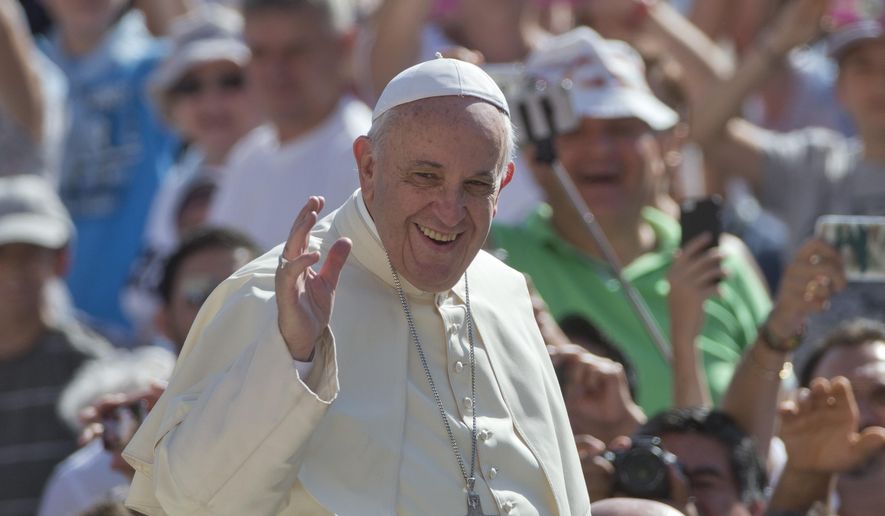

In preparation for the visit to America by Pope Francis I in a few days, it is helpful to look again at his first major publication, namely, his 152 page Apostolic Exhortation, “Evangelii Gaudium” (The Joy of the Gospel), issued on December 13, 2013. His recent encyclical, “Laudato si’, mi’ Signore” (“Praise to you, my Lord”) is a formal Vatican document, while The Joy of the Gospel, is a more personal statement of his concerns, written by the Pope himself, and therefore offers a significant insight into his own thoughts and priorities.
Pope Francis I’s extraordinary declaration is too packed with concerns to be condensed here. His topics range from reform of the Church, to dialog with Islam, to human trafficking, to world peace, It is the greatest application of Christianity to practical matters that this writer has ever read. To do him justice, it should be remembered that the pope’s discussion of economic systems, which has drawn so much attention in the United States, was but one piece of a very significant whole.
Yet it is important that this holy man comes to an understanding of America’s democratic capitalism. In his present attitude toward capitalism, he risks rejecting the system which has done more than any other system in the history of the world to help the poor, who are his main concern. He also risks overlooking his greatest ally in the fight against poverty, the United States of America, which was recently ranked first in the 2011 Charities Aid Foundation World Giving Index (pp. 5ff) for combining all three criteria measured:giving money, giving time, and giving to strangers.
Francis’ reliance on big government to redistribute the wealth of the nation is a direct challenge to America’s democratic capitalism, which is the foundation of America’s goal of providing opportunities for every person to reach his or her God-given potential.
While never mentioning the Americans by name, Francis has many criticisms of modern society, and no direct praise — although he blesses by implication many of America’s ways, such as pluralism, freedom of the individual, and freedom of speech. Francis’ criticisms of capitalism are indictments of a generic, unbridled capitalism – the “idolatry” of money, the ruthless pursuit of wealth, the focus on consumerism, the neglect of the poor. It is not clear exactly which form of capitalism Francis is talking about, or where it exists, although it sounds a lot like Argentina.
Theologically, the difference between the two views is this: The traditional view of government’s power – which is consistent with the papal view — is that it flows from God to the government (or king or pope) and thence to the people. Democracy sees the power of the government flowing from God to the people and then to the government. Thus the government is directly accountable to the people, not to God or the Church. It is the people, including politicians, who are accountable to God (a good thing to remember). No one disagrees with the pope’s goal of caring for the poor. The way in which that goal is pursued, however, differs fundamentally in America’s capitalistic democracy.
Francis takes a traditional view which sees the classes of society as predominantly static and does not really account for what Americans call “upward mobility”. Without the intervention of the government, the rich are the rich, and the poor are the poor. Period.
The chief challenge of social justice, in this view, is therefore to provide for the poor, which in practice means taking from the rich to do so. Government has the ultimate obligation to compel this redistribution of wealth through taxation, confiscation, or prosecution. Francis draws the obvious conclusion from this reasoning, which is that wealth is not truly private property, but a patrimony of the whole society which the “owners” hold in trust for the benefit of that society. The means by which this patrimony is to be shared with the poor is the power of the government. In this view, the government must be a virtuous defender of the poor. Unfortunately, this assumption has rarely proven true in human history.
It is this advocacy in papal thinking for the primacy of the government to control human affairs which leads Socialists and many other leftists to claim papal endorsement. Moreover, Francis’ entry into the world debate coincides with a similar debate raging in theUnited States. The big government advocates in America have claimed the pope as one of their own, just as post-World War II Socialists did with earlier popes.
For Americans, the fundamental error of this view is that it does not account for the creation of that wealth in the first place. Government cannot confiscate what isn’t there. Francis’ view foresees the proverbial pie being cut into more and more pieces; Americans keep creating a bigger pie. The reconciliation in the American system between economic growth and social justice comes from the interactions between individual freedom, economic capitalism and political democracy.
The United States of America has brought together economic capitalism and political democracy in a dynamic tension which we call democratic capitalism, and which has produced the most prosperous nation in the history of the world. Through philanthropy and the social safety net which has been provided by the American people through their government, Americans have provided sustenance and comfort to the poor in a measure which certainly equals the care of the poor undertaken by any other society or economic system that ever existed.
Its greater attribute is that it provides hope — hope that the poor may be able to escape the bonds of poverty as so many Americans have done in the past. This hope is the shining light on the hill which still attracts millions of immigrants.
It has taken Americans most of our history as a nation to achieve the balance by which capitalism is accountable to democracy, and there are still many problems to be solved. Nevertheless, Americans are always optimistic. The challenge to Americans is not to change an evil system; it is in living up to the ideals which are required for that system to succeed.
The motivation for individual Americans to persevere in pursuit of their personal goals is provided by the real and potential ownership of private property. No other motivator — not coercion, not slavery, not charity, not communal property — not even religion — has ever been found which can impel vast numbers of individuals in a society to be hard working and creative. Providing a good life for oneself and one’s family is a motivator above all others.
There is nothing static about the American version of a capitalist society. It is dynamic, constantly changing. The poor may not always be poor; the rich may not always be rich. In fact, most Americans (58.5 percent) will spend at least one year below the poverty line at some point between ages 25 and 75 according to Yale University’s Jacob S. Hacker (The great risk shift, New York, 2006).The wealth of the society is expected to grow constantly by the creation of new opportunities, new products and services, new jobs, new skills, and new technologies, leading to new and expanding wealth.
A necessary condition for this dynamic society to flourish is individual freedom. Individual freedom is protected by democracy, the counterforce to capitalism, and it is this political system which maintains the social ideals of justice and peace, because the laws of the nation are ultimately set in place by the representatives of the people. These representatives are accountable to the people through frequent and peaceful elections. American laws are not made by an insulated oligarchy which is accountable to no one. The transfer of political power in the United States has always been accomplished without violence or revolution, no matter how questionable the outcomes have been at times.
Personal freedom without economic freedom is no freedom at all. Capitalism, in a refined and mature linkage with democracy, provides the economic power which makes freedom possible.
Pope Francis I does not really understand the dynamism of America’s modern democratic capitalism, nor its potential for good. This misconception does not, however, invalidate the very real moral and religious imperatives which the Pope describes.
Americans as well as all other peoples on earth must heed the cries of the poor, seek the joy of the Gospel, reach out to those unlike ourselves, and find the peace on earth which was revealed by Jesus Christ so long ago.

Please read our comment policy before commenting.