



OPINION:
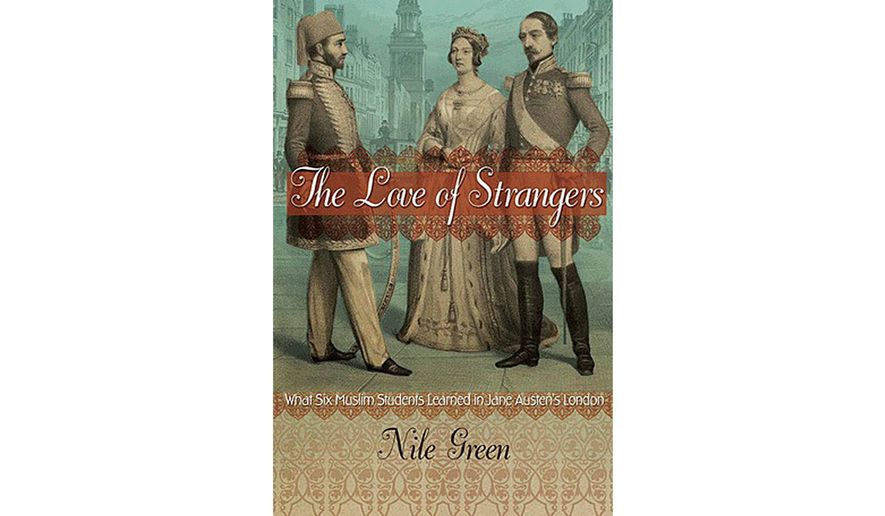
THE LOVE OF STRANGERS: WHAT SIX MUSLIM STUDENTS LEARNED IN JANE AUSTEN’S LONDON
By Nile Green
Princeton University Press, $35, 388 pages
Before considering the many merits of Nile Green’s diligently researched and elegantly written tale of five Persian students who arrived in London in 1815 to acquire knowledge of the “new sciences” that had brought the industrial revolution to “Inglistan,” a word of warning: Despite its title, this book has little if anything to do with Jane Austen.
The brilliant — and once again fashionable — lady novelist is merely along for the ride, perhaps in the hope that some of her fans will be drawn to a story they might otherwise ignore. There is no evidence that Jane Austen ever met — or even knew of — the five young Iranians at the center of this fascinating if occasionally overstated account of a successful encounter between members of two very different cultures and nationalities. Much of it was recorded in the journal kept by Mirza Salih, one of the students. Unfortunately, Mr. Green quotes from it sparingly, often preferring to offer his own speculation on what Mirza Salih saw, did and felt. Still, as the author explains in his preface, “this book is a study of the neglected virtue of xenophilia [as opposed to xenophobia]. Through the affection that Mirza Salih felt for the strange Inglis, and the affection felt for this Muslim stranger by his English friends, I hope to bring to life a less dystopian past that may in some small measure help us to find a less dystopian future.”
Hard as it is to focus on after Iran’s Great Leap Backward to clerical obscuritanism, Persian culture and civilization go back more than 1,000 years before the existence of Islam and its spread, mostly at sword point, by primitive warriors from what might be called the Arabian “outback,” far removed from ancient centers of Middle Eastern civilization — and once of Middle Eastern Christianity — like Egypt and Syria. In the case of once Zoroastrian Iran, despite the imposition of Islam of the virulent Shia variety, the country preserved many fine, pre-Islamic cultural qualities that were admired and imitated. From Ottoman Turkey to Mogul India. Persian-illuminated manuscripts and paintings, Persian gardens and architecture, and Persian poetry and prose were all embraced by ruling Muslim elites, much as French art, architecture and language were imitated by European royal courts in the rest of Europe in the 17th and 18th centuries.
The man responsible for sending the five young Persians to England was Abbas Mirza, the progress-minded heir to the throne of Iran and governor of Tabriz near the strategic border with Iran’s most dangerous neighbor, Czarist Russia. Thanks to Abbas Mirza, Tabriz also became the center of modernizing efforts during his lifetime, including the introduction of the first printing presses in Iran, one of them brought back from England by Mirza Salih himself, who spent part of his English sojourn as an apprentice with a leading London printer. Other members of the little group returned with modern medical know-how and instruments, the latest military skills, and a knowledge of steam engines, all put to good use in their native land.
Unfortunately, their princely patron never lived to become a reforming monarch, predeceasing his royal father. Who knows? Had Abbas Mirza succeeded to the throne he might have played a role similar to Russia’s Peter the Great, who imposed western modernity — often by brute force — on a population that, in the early 1700s, was every bit as backward and superstitious as ordinary Persians were in the early 1800s. As it was, Persia’s Qajar dynasty became more and more reactionary with time, importing western luxuries and using inventions like the telegraph mainly as tools for suppressing opposition to their rule, all the while piling up vast foreign debt.
Still, the students’ effort had not been entirely wasted. Among other benefits, Mirza Salih, “through his central role in introducing the printing press and the newspaper to Iran … had transformed his society. He had transferred to Iran the media of public opinion and education that he had considered so crucial to England’s development into a vilayat-I azadi, a ’land of freedom.’ “
That wise man of Asia, Lee Kuan Yew, the founding father of Singapore, once told an old boss of mine, Richard Nixon, that Chinese civilization was stronger and deeper by far than the transient power of Chairman Mao. China, he said, was like a sturdy stone wall and communism was merely a thin coat of paint. The rains of time would eventually wash away the paint. The wall would remain. The same could yet prove true of the historic Iranian values and virtues underlying the crude “paint” of xenophobia and religious fanaticism.
• Aram Bakshian Jr., an aide to Presidents Nixon, Ford and Reagan, writes widely on politics, history, gastronomy and the arts.

Please read our comment policy before commenting.