



OPINION:
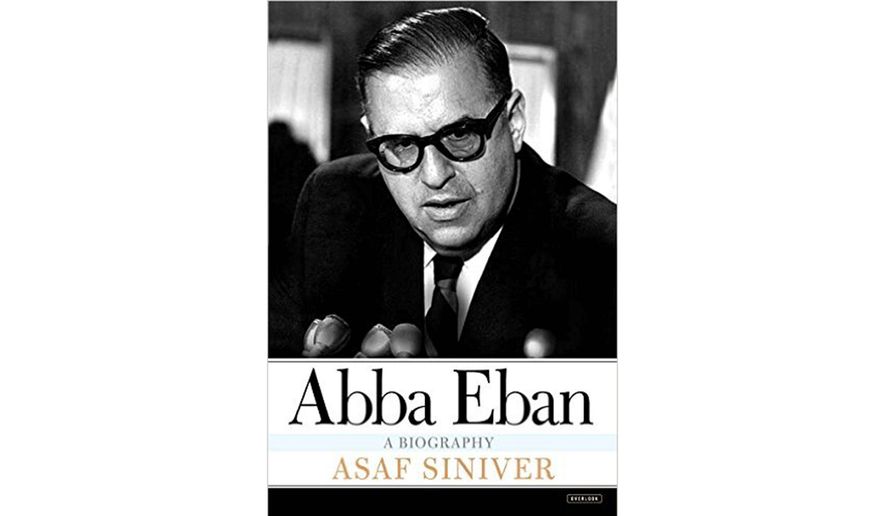
ABBA EBAN: A BIOGRAPHY
By Asaf Siniver
Overlook Duckworth, $40, 449 pages, illustrated
Few 20th century statesmen — indeed anyone — spoke with the almost preternatural eloquence and erudition of Israeli diplomat and later politician Abba Eban, something underlined by regular comparisons of him with the Olympian figure of Winston Churchill. The fact that he grew up and was educated in England, finishing with a brilliant and very unusual triple first-class degree at Cambridge University, gave him the enormous advantage of advancing the cause of Zionism and — after its success in establishing a Jewish nation state —Israel as a native speaker of the King’s English. (He was fluent in many other languages as well.)
Ironically, on his entry into politics at home, after his enormous diplomatic success as Israel’s first representative at the United Nations and concurrently ambassador in Washington during the Truman and Eisenhower administrations, these very qualities which had given such great national service, proved detrimental. As his biographer Asaf Siniver, an Israeli professor at Britain’s University of Birmingham, puts it, “while very few doubted his diplomatic forte and standing in the world community, his ’foreignness’ and uber-intellectualism remained unpalatable, especially to his colleagues and some sectors of the press.”
And this “perverse dichotomy in how Israeli society perceived Eban” is a throbbing presence in Mr. Siniver’s informative, often insightful, but in the end troubling biography.
Most of Eban’s eloquence was put to the service of the Zionist ideal and to Israel, but he was adept at using it for himself as well, in lectures, interviews and in two memoirs, albeit usually leavened with a sometimes self-deprecating but always witty bite. Nonetheless, it is remarkable that until this book, the only biography of this remarkable phenomenon was one written almost 45 years ago by American journalist and notable gentile Zionist Robert St. John. Mr. Siniver is a little harsh, although not entirely inaccurate, in writing that “it sits more comfortably in the company of unapologetic hagiographies than emphatically detached scholarship.” His own biography most certainly belongs in the latter category, which is for the most part a plus.
As Mr. Siniver avows at the outset, “My basic approach is one of sympathy to Eban, if not empathy. This biography highlights some of Eban’s acute shortcomings as a man, a politician, and a leader, but it is most definitely not a pathography either. Ultimately it is a story of a man who defined and defended a nation to the world, but never felt at home among his compatriots.”
A close reading of his book shows all these statements to be accurate, yet it is unfortunate that the chief impression left by it is of Eban’s flaws and faults, illuminated by comments ranging from the merely acerbic through many varieties of denigration to the downright vicious. Many of these come from political enemies he had made like Golda Meir and Yitzhak Rabin — usually honorably from the exhaustive accounts of disagreements and conflicts in these pages — but from other scornful sources as well.
It’s not that Mr. Siniver doesn’t give Eban his due: he is fulsome in his praise of his accomplishments. But just as mud sticks in the rough and tumble of politics, it has a lamentable tendency to do the same in establishing posthumous reputation. The reader is continually bombarded in the text with derogatory appraisals and aphorisms from enemies and even some friends. And a look at the chapter headings reveal that they often mirror these critiques and slaps, with the result that a great man is summed up more by his detractors than by his magnificent qualities. Mr. Siniver also ends his book with the harshest of self-judgments by Eban, given in an interview with a journalist two years before his death when he was already desperately ill.
Detachment in a biographer is undeniably a virtue, but I think that this particular exemplar has been too much determined by what other people have told him and certainly his picture of an aloof, awkward man uneasy in social situations reflects a widespread perception of Eban. Despite my admiration for him, to some extent I shared it — until I had the unexpected good fortune of encountering him in a purely social situation. He and his charming wife happened to sit down next my wife and myself in a restaurant in Los Angeles in 1997. In a most friendly manner, they initiated the conversation, which rapidly turned into a remarkable, two-hour-long give and take in which they were both extremely forthcoming about their opinions and memories.
Quite honestly, I had expected him to be pompous and insufferably full of himself, but the soft-voiced but outspoken man could not have been more open and generous, not merely about other figures, but in his genuine interest in us and what we had to say — although we were half his age and without any special position. I also observed his exquisite courtesy as he tirelessly complied with requests from autograph seekers who kept approaching his table, returning seamlessly each time to conversing with us. I cannot help thinking that if Mr. Siniver had witnessed such a universally graceful performance from this attractive figure, he might have painted a very different portrait.
• Martin Rubin is a writer and critic in Pasadena, Calif.

Please read our comment policy before commenting.