



OPINION:
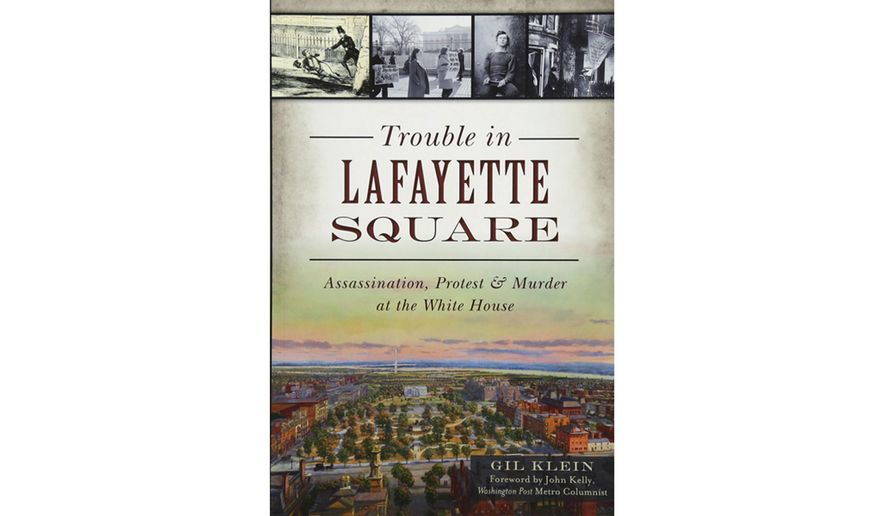
TROUBLE IN LAFAYETTE SQUARE: ASSASSINATION, PROTEST AND MURDER AT THE WHITE HOUSE
By Gil Klein
The History Press, $21.99, 139 pages
Washingtonians with roots going back several generations know just how small a town our nation’s capital used to be. When the English novelist Charles Dickens visited in 1842 he found muddy streets, rundown hotels, free-ranging hogs, and only a handful of impressive government buildings — notably the U.S. Capitol, the White House and the neo-classical Treasury Building — sprinkled amidst an otherwise desolate landscape.
“It is sometimes called the City of Magnificent Distances,” he wrote. “But it might with greater propriety be termed the City of Magnificent Intentions; for it is only on taking a bird’s-eye view of it from the top of the Capitol, that one can at all comprehend the vast designs of its projector, an aspiring Frenchman [Pierre L’Enfant]. Spacious avenues, that begin in nothing, and lead nowhere; streets, mile-long, that only want houses, roads, and inhabitants; public buildings that need a public to be complete are its leading features Such as it is, it is likely to remain.”
Boy was he ever wrong there. It took a bloody civil war, the Gilded Age, FDR’s New Deal, World War II and a mushrooming range of government departments, agencies and programs — along with a parasitic parallel universe of lawyers, lobbyists and journalists feeding on the federal Leviathan — but all of those empty spaces have been filled in.
One of the first stretches of semi-derelict land to be put to public use was what is now officially known as Lafayette Park, often referred to as Lafayette Square to include the historic buildings and other landmarks that surround the actual park land. It is named after the Marquis de Lafayette, an eager young French nobleman who crossed the Atlantic to serve at George Washington’s side in the Revolutionary War, ultimately attaining the rank of major general.
Returning home as a pop celebrity, Lafayette spent the rest of his life trying to become the George Washington of France. That second career never really took off — Lafayette was no Washington and France was no United States - but, in 1824, the aged, overweight Lafayette was given the adulation he never received in France during a triumphal, two-year tour of the United States. Cities, towns and counties across the country were named after him and, in the aftermath, the waste space facing the White House from the north side of Pennsylvania Avenue was unofficially christened Lafayette Park (made official in 1836). Given its pivotal location it has been the site of many a ceremony, crime, demonstration and scandal in its nearly two centuries.
Now Gil Klein, a veteran Washington reporter and journalism educator, has produced a brief, breezy and fact-filled history of the park at the heart of our capital city.
In 12 crisp, concise chapters he tells us about everything from the death of a naval hero, Stephen Decatur, fatally wounded in a duel and dying in his house on the square (where it still stands), to romantic scandals involving President Andrew (“Old Hickory”) Jackson and key members of his administration, a failed attempt on the life John Seward, Lincoln’s secretary of State, by one of John Wilkes Booth’s bungling co-conspirators, a 20th-century political suicide stemming from a vice squad arrest in the park, a semi-staged drug bust that was exploited in a speech by the late President George H.W. Bush, and a desperate shootout in which terrorists backing Puerto Rican independence nearly succeeded in assassinating President Harry Truman, who was temporarily living in the Blair House overlooking the park while the Executive Mansion was undergoing repairs.
There’s even a tale involving heroic suffragettes who engaged in civil disobedience and non-violent demonstrations there that later inspired the civil rights movement, and much, much more, including the tragic love story of novelist and historian Henry Adams and his wife, Clover, who lived in one of the mansions that once occupied the space where the elegant Hay-Adams Hotel now stands.
I found that chapter particularly interesting since a great uncle of mine, Mihran Mesrobian, was the hotel’s architect. Thanks to an aunt, Mary Bakshian, who was a pioneer woman attorney and actually knew some of the early suffragettes, I also had the opportunity of meeting a very ancient Alice Paul, head of the National Woman’s Party, whose early activism in the battle to get women the vote also figures in the book. But you don’t need personal links to find the intertwining tales told by Gil Klein both captivating and informative. Excellent illustrations — and an extensive bibliography for more detailed follow-up reading — round out a good little book on a very big subject.
• Aram Bakshian Jr., a former aide to Presidents Nixon, Ford and Reagan, has written widely on politics, history, gastronomy and the arts.

Please read our comment policy before commenting.