



OPINION:
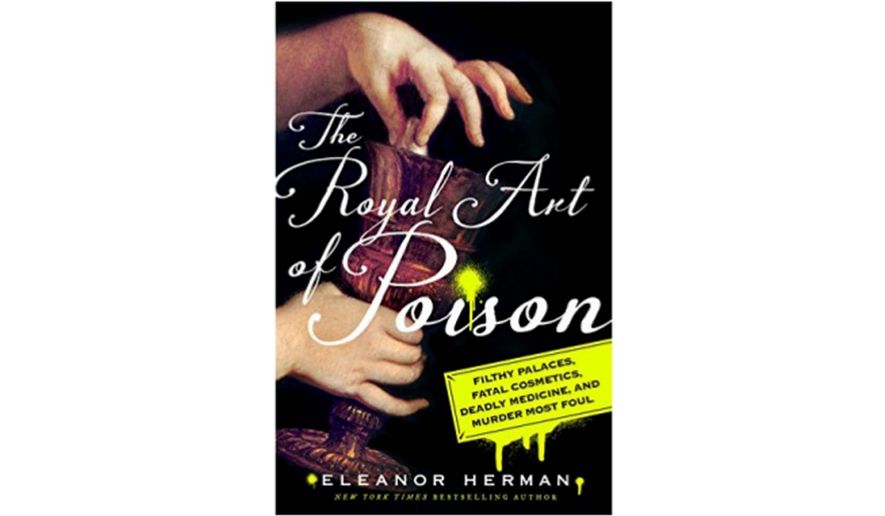
THE ROYAL ART OF POISON: FILTHY PALACES, FATAL COSMETICS AND MURDER MOST FOUL
By Eleanor Herman
St. Martin’s Press, $27.99, 286 pages
People were interested in these podcasts
Last autumn, the Renwick Gallery boasted a record number of visitors to its exhibit “Murder is Her Hobby: Frances Glessner Lee and the Nutshell Studies of Unexplained Death.” I can imagine those same morbid souls who enjoyed the exhibit are going to also thoroughly relish the macabre and entertaining romp through “The Royal Art of Poison” by Eleanor Herman.
With grisly enthusiasm, the author has devoured medical journals, autopsy reports, papers from the University of Maryland’s annual Historical Clinicopathological Conference and tomes bearing such tiles as “The History of Corpse Medicine.” The resulting harvest is a collection of stories about powerful people cut down before their time.
It helps that the author combines expert forensic research with a delicious sense of humor, so what might have been this reviewer’s usual diet of boredom and sawdust is actually a surprisingly amusing and intriguing adventure through the centuries.
And what an adventure this is. Who would have guessed that behind the portraits of bejeweled royalty was an entire subculture of poison prevention?
As early as 1198, Jewish physician Maimonides was warning his Egyptian sultan to avoid soups and stews, even wine, anything that could mask the taste of a deadly concoction. By the Middle Ages, an entire army of tasters was dipping into meat pies to make sure the king and his relatives would not end up vomiting blood. By the time their lukewarm food was served, “it may have looked more like a dog’s breakfast than a king’s dinner.”
In 1700s France, Louis XIV had his tasters kissing his napkins and licking his cutlery. “If the royal intestines got into an uproar,” writes Ms. Herman, woe to the tasters, who were tortured horribly. Other preventive measures included waving priceless objects over food or hoarding basins of live scorpions for the manufacture of anti-poison oil. Vast sums of money were paid to apothecaries, who prescribed pills made up of arsenic, mushrooms and viper, which monarchs obediently swallowed.
Alas, they were poisoned anyway.
Ms. Herman chronicles the stories and gives her post-mortem diagnoses from a rich mine of primary material, including physicians’ copious notes of royal illnesses (“probably,” she writes, “because they didn’t want to be accused of ineptitude or intentional murder”), and modern analyses from exhumations of ancient mummies and moldy bones. Some were deliberately poisoned.
Others were killed by vanity: Queen Elizabeth of England, who coated her face with a white mask of lead and arsenic, deteriorated mentally and physically. Court ladies who powdered their wigs with sulfur suffered nosebleeds and dehabilitating headaches; the beautiful mistress of Henri II was poisoned from mercury due to her drinking bits of gold metal just so her tresses could remain youthful. Others died via murderous medicines, ranging from mercury enemas and rat turd elixirs.
Some of the most fascinating chapters are devoted to scientific explanations to the mysterious deaths of Edward VI, Caravaggio, Mozart and Napoleon. Lesser-known characters are also given their due — such as the Queen of Navarre, who was reputedly poisoned not at a banquet (“the usual place for secret assassination”) but at a shopping expedition.
Certainly the most chilling are the contemporary stories of political poisoning, such as the mysterious fate of Palestinian President Yasser Arafat and the brother of North Korean dictator Kim Jong-un, struck by the most notorious toxic nerve agent produced, an odorless liquid called “venomous agent X,” that, once hurled at his face, killed him within minutes.
The most satanic are the lethal methods used against anti-Putin activists. One example recounts how poison was placed on the light bulb of a reading lamp, so that the heat of the light vaporized the poison, killing its intended victim sitting next to it, then dissipating without a trace.
Another recounts how ricin was inserted into a microscopic pellet, coated with wax, then shot out via the tip of a seemingly innocent umbrella that was poked in the back of the victim’s right thigh while he was waiting for a bus at London’s Waterloo Bridge. He died four days later. As the author puts it, those who publicly oppose dictators “must eye their food and drink with as much concern as any Renaissance king.” Or umbrellas. It is enough to give nightmares.
As a writer, Eleanor Herman has a British sensibility in her choice of metaphor or quirky oddity. She writes vividly and with great humor, combining detailed research with easy narrative, making her book both enthralling and sinister. For those suffering abusive workplaces or unhappy marriages, two glossaries (“Pick Your Poison” and “The Poison Hall of Fame”) seem to offer inspiration. Beware! Eleanor Herman makes clear that modern forensic research is expert at detecting such crimes.
• Marion Elizabeth Rodgers is the author of “Mencken: The American Iconoclast.”

Please read our comment policy before commenting.