



OPINION:
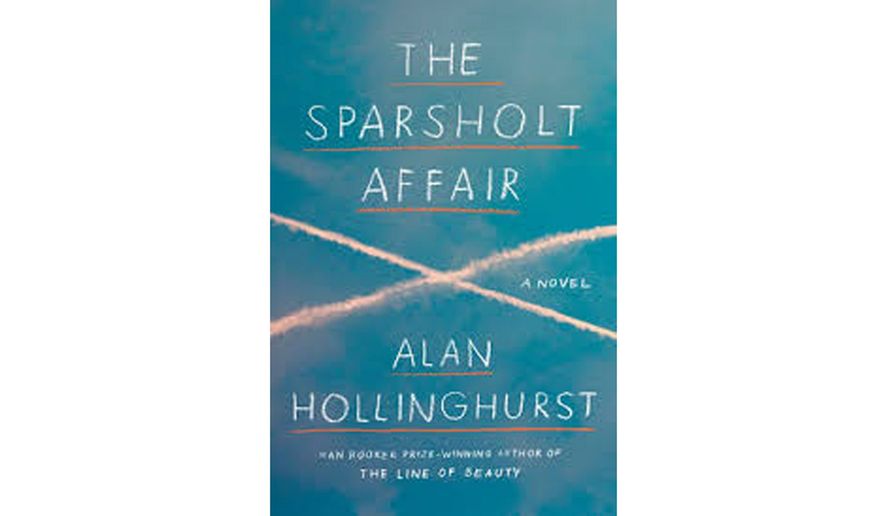
THE SPARSHOLT AFFAIR
By Alan Hollinghurst
Alfred A. Knopf, $28.95, 432 pages
In the early days of World War II, a group of mostly gay Oxford students spot an entrancing young man exercising in a room opposite. With “that glorious head, like a Roman gladiator those powerful shoulders the blue veins standing in the upper arms” he is seriously attractive.
His name is David Sparsholt. He is provincial and possibly less affluent than those watching his keep-fit regime. Certainly, he’s less sophisticated, interested in engineering rather than literature or art, eager only to join the Royal Air Force and marry his girlfriend. This ambition astonishes since he is only 17, and the more so when the besotted Evert Dax lures him into bed.
The first section of “The Sparsholt Affair” recounts these Oxford adventures as the memoir of Freddie Green, one of Sparsholt’s watchers. His account evokes those 20th-century tales of bumpkinish innocents wrong-footed by the urbane denizens of their college. Its tone is confidential with a titillating charge sparked by the discomforts of young people treading the sexual minefield. Who likes what? How are encounters to be negotiated? What will happen?
Some answers emerge in the following four sections, three of them snapshots taken from the perspective of David Sparsholt’s son, Johnny. We meet him in the 1960s vacationing with his family and Bastien, a French exchange student. All is not well since Bastien is a sexual tease, and the older Sparsholts are caught up in an awkward acquaintance with the neighboring Haxbys.
Later it transpires that David has been prosecuted because of a relationship with Haxby. This is the Sparsholt affair of the title. Ironically, had the events occurred just a year or two later, there would have been no problem because the law on homosexuality was changed. This “dim nexus of provincial misconduct” is still a fresh memory when Johnny moves to London, though mists of tact and time soon shroud it.
Eventually Johnny establishes himself as a portrait painter. He has a beloved long-term partner called Patrick, and also a daughter Lucy born after he agreed to “do a baby” for lesbian friends. Part of the fourth section is told from her point of view. When she and Johnny are looking at Evert Dax’s pictures she hears one valued at 30,000. “Lucy gave a stern look, as if haggling the price down. She thought it was nice as a little thing to have, but 30,000 made her want to laugh in protest.” She’s sharp; she spots details; puts two and two together — just like Alan Hollinghurst.
The appeal of his novel is its Lucy-like clarity of observation. It is full of lovely descriptions. There’s the Severn Bridge for example: “The two towers, the low arc of the roadway, at an angle and foreshortened, the two white arcs descending to kiss it, a haze of rain over the river and the Welsh shore.”
Even sharper is his feeling for the movement of feeling among people. Here he is describing a funeral reception: “The spirit of where they had come from still lingered in the dark suits and quiet postponing manner, until with a glass of wine down, people turned in sudden conversation towards the window or the sofa and the unselfconscious life of the party, which after all was life itself, began.”
Another appeal of the novel is its record of life, especially gay life, from the closeted 1940s and the still hide-bound 1960s to today’s world of once undreamt-of freedoms. Still, if possibilities have changed, human responses don’t. We often see people stumbling through dim-lit spaces. In wartime, Oxford students totter through the wartime blackout with only pencil beams of light. There are more blackouts during the 1970s economic crisis when Johnny was settling in to London. Dark stairs or rooms are common. Even the thrilling clubs of contemporary London have many dark spots and opportunities to trip.
This new world is a satisfying place for the novel to end because the reader has not only watched Johnny but several characters from its early pages step through the stages of life. Yet for all the pleasures scattered through its pages, and the chronological structure that strings it together, it often seems out of focus. The many minor or newly introduced characters can be distracting. That’s what life is like of course: People come and go and we don’t get to know them all well. But then, novels are not life, and so these minor presences are a nuisance, especially during in the meandering middle sections.
Alan Hollinghurst writes brilliantly. Almost every page holds some delight. The first two sections of “The Sparsholt Affair” can be read as almost virtuoso exercises in period forms: The Oxford memoir, the bildungsroman with an awkward teen at its center. So, though this novel never quite gels, it repays attention.
• Claire Hopley is a writer and editor in Ameherst, Mass.

Please read our comment policy before commenting.