



OPINION:
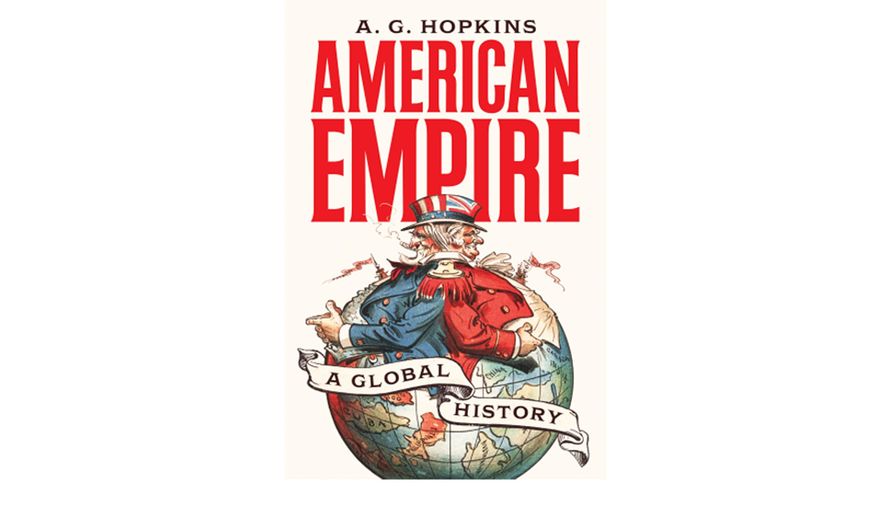
AMERICAN EMPIRE: A GLOBAL HISTORY
By A.G. Hopkins
Princeton, $39.95, 980 pages
If, as France’s fiery World War I Prime Minister Georges “The Tiger” Clemenceau famously observed, “War is too important to be left to the generals,” perhaps history is too important to be left to the historians.
There are certainly moments, when reading Professor A.G. Hopkins’ massive, sometimes impressive, sometimes oppressive, everything-but-the-kitchen-sink history of America’s scattered, rather checkered dabbling in colonialism and empire building, when this certainly seems to be the case.
As academic history has morphed into “historiography” and formulaic jargon sometimes supplants good prose and narrative clarity, one comes across too many passages like the following: “The concepts of ’informal empire,’ ’sub-imperialism,’ and ’collaboration’ would have entered the historiography long ago, and the literature would now be bulging with debates on the respective merits of ’metropolitan’ and ’peripheral’ theories of causation and on the ’excentric’ [sic] thesis of empire-building.”
I guess so.
What makes the frequent injections of learned gobbledygook into Mr. Hopkins’ overweight work on an understudied subject doubly annoying is the fact that the man is perfectly capable of writing well.
Witness his introductory assertion that sound history is a cumulative process and “[h]istorical understanding proceeds incrementally. Epiphanies are awaited but rarely arrive . [T]he theme of the book is one facet of U.S. history and not its totality. Even with these qualifications, the subject is still huge and the hazards formidable.”
America’s flirtation with an external empire — as opposed to the steady, internal advance from the Atlantic to the Pacific coasts of North America, mainly through backward, sparsely populated areas of what some now call “flyover country” — was a late and largely imitative development.
It was very much a monkey-see-monkey-do reaction to the much older, much more vast wave of European colonialism that had engulfed the entire Indian subcontinent, all of Latin America and large chunks of Asia and Africa.
Most of our overseas imperium was acquired after the 1898 Spanish-American War by driving out an ancient, decrepit colonial power, Spain, from its last footholds in the Americas — notably Puerto Rico and Cuba — and from occupying Spain’s oversized, underdeveloped Pacific possession, the Philippine archipelago.
To this day, educated Filipinos refer to the successive colonial rules of Spain and the United States as “Three hundred years in a convent and fifty years in Hollywood.” A more robust version replaces the word “Hollywood” with the word “bordello.”
In the case of Puerto Rico and the Philippines, rather than quickly turning things over to the locals, we simply replaced the Spanish as colonial landlords. Mr. Hopkins calls the result an “insular empire” because most of it consisted of islands.
It was also an undigested empire, short-lived by colonial standards and largely invisible and uninteresting for Americans other than those stationed there as soldiers, sailors and colonial administrators or with private commercial ties.
“American Empire” tells its story with frequent excursions into the more substantial colonial-imperial projects of countries like England, France and their lesser, later continental rivals.
Ironically, the one European example the author totally ignores, the maritime empire of the Venetian Republic, is the one that offers the most interesting parallel to the American experience; this even though the Venetian project ended long before the American venture began, with the death of the Venetian Republic in the early Napoleonic wars.
Like ours, the Venetian empire was mainly a string of islands (and coastal enclaves) held for strategic and trade reasons. In the case of Venice, it was sprinkled throughout Adriatic, Aegean and Mediterranean waters. With us, it was mainly the Caribbean and the Pacific.
An aspect of empire that Mr. Hopkins downplays is the positive long-term impact of exposure — admittedly in less than ideal circumstances — to Western humanism, literacy, science, medicine and concepts of individual rights and representative government — that have made possible most of the material and political progress of the post-colonial Third World.
Introduction of a unifying official or semi-official language on top of tribal and regional dialects — English in the case of places like India and the Philippines — resulted in a rising class of educated locals imbued with democratic ideals, while the beginnings of modern educational systems and infrastructure made possible the emergence of imperfect but real nation-states where only tribal and feudal backwardness and disunity had existed before.
Mr. Hopkins deserves credit for tackling so vast and demanding a subject, although his attempt to weave in the occasional pop culture reference to figures like Tarzan and Captain America fall a bit flat. A little less bulk and a little more focus would have made a good book even better.
• Aram Bakshian Jr., an aide to Presidents Nixon, Ford and Reagan, writes widely on politics, history, gastronomy and the arts.

Please read our comment policy before commenting.