



OPINION:
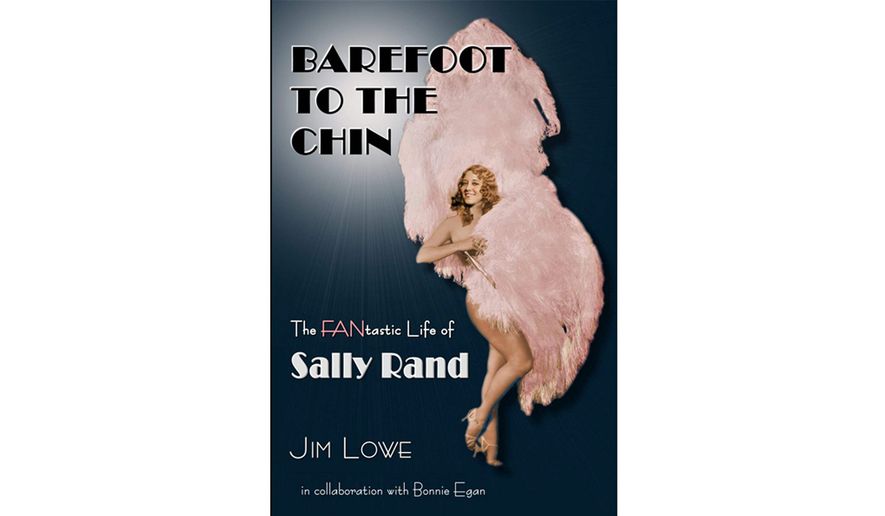
BAREFOOT UP TO THE CHIN: THE FANTASTIC LIFE OF SALLY RAND
By James Lowe with Bonnie Egan
Sentry Press, $39.95, 754 pages
Back in the day, when the day was the late 1920s and the 1930s, moviemaker Cecil B. DeMille described Sally Rand as “the most beautiful girl in America,” and in their ads for her show, producers called her “the most famous woman in the world.”
Yet, in the day known as 2018 most of you never heard of her. So, if you weren’t around in the 1920s and ’30s you are forgiven, and can relax, read on and learn. And for those of you acquainted with this remarkable woman, reminisce.
Born Helen Gould Beck in 1904 on a farm near Elkton, in the Missouri Ozarks, she was having a normal beautiful-little-girl childhood when, at age 6, an aunt took her to see the famous Russian ballerina Anna Pavlova, and the kid was hooked on ballet for the rest of her life.
This is not to suggest that young Helen’s life was perfect, for when her father returned from WWI he came back with a French wife and a couple of kids and moved to New Yok City. Throughout her life Sally often said she did not feel her father had rejected her mother, but that he had rejected her.
Barely five feet tall, but blessed with good looks, curly blond hair, arrestingly blue eyes and a great deal of charm, plus well-above-average intelligence, Helen began modeling early. A stint as a chorus line dancer in New York City at age 13, temporarily soured her on show business and show folk — “They jested about matters that had always been sacred to me. I rebelled. I went back home and studied dancing some more.”
She also started college (Christian College in Columbia, Missouri) and loved the academic side, but her mother could only afford only one semester; young Helen had to go back to Elkton and look for a job. But she’d caught the education bug, and for the rest of her life was interested in learning, though it now had to be self-administered. In future decades, interviewers would express surprise at the scope of her knowledge.
Next came a series of jobs in show business, even vaudeville (which was far from dead in the 1920s) and then a series of small parts in silent movies, where she worked with such established stars as George Raft, Sophie Tucker and Mae West, as well as up-and-and-comers like Jack Benny, Bob Hope, Milton Berle, George Burns and Jackie Gleason. (It was at this point that DeMille, who found her current stage name, “Billie Beck,” too girlish, glanced at an atlas on his desk and dubbed her Sally Rand. Just think,” she later commented, “I could have been Sally McNally.”)
Sally never broke back into Hollywood. Instead, stints as a cigarette girl, a chorus line dancer, and even an aerialist with a circus, kept Sally in the public eye. But her own eye was on the 1933 World’s Fair in Chicago.
She came up with a stunt designed to ensure that the Fair’s producers knew her name. On Christmas Eve in 1932, she crashed a well-publicized charity ball held in a major Chicago hotel astride a horse — and dressed (or, rather, undressed) as Lady Godiva. The resultant publicity served its intended purpose, and when the Fair opened, the featured act was the soon-to-be-famous fan and bubble dancer Sally Rand.
Author Jim Lowe describes her impact: “few [of the Fair’s producers] could have predicted that a diminutive young lady not that far from wondering where her next meal might be found would end up being the star of the whole shebang.” From then until her death in 1979 at 75, she worked — 40 hours a week for 40 years, says Mr. Lowe — to support herself, her mother, and a younger brother (not to mention at least one of her three husbands). She could easily have given James Brown a run for the title of Hardest Working Performer in Show Business.
All this history gets the reader only to page 200 of this doorstopper of a book. But, in addition to being a very detailed biography of its subject, it is simultaneously a wonderfully readable history of the era’s popular culture, making it worth its above-average price tag.
(Full disclosure: When I was starting out as a freelance writer, I was introduced to Miss Rand by Babs Shankman, a mutual friend who’d danced in one of Sally’s troupes (see pages 630-631 and 709) and I started to help Sally write a book (see page 620), but when she moved on the project didn’t. However, I had liked Sally, and later, when I read that she — then in her mid-60s, but still on the road performing her dances — had been hospitalized in the Midwest, I sent her a get well card, to which she replied with thanks, adding characteristically, “We should have done it together the book that is.”)
• John Greenya, a Washington writer and critic, is the author of “Gorsuch: The Judge Who Speaks For Himself” (Simon and Schuster, 2018).

Please read our comment policy before commenting.