



OPINION:
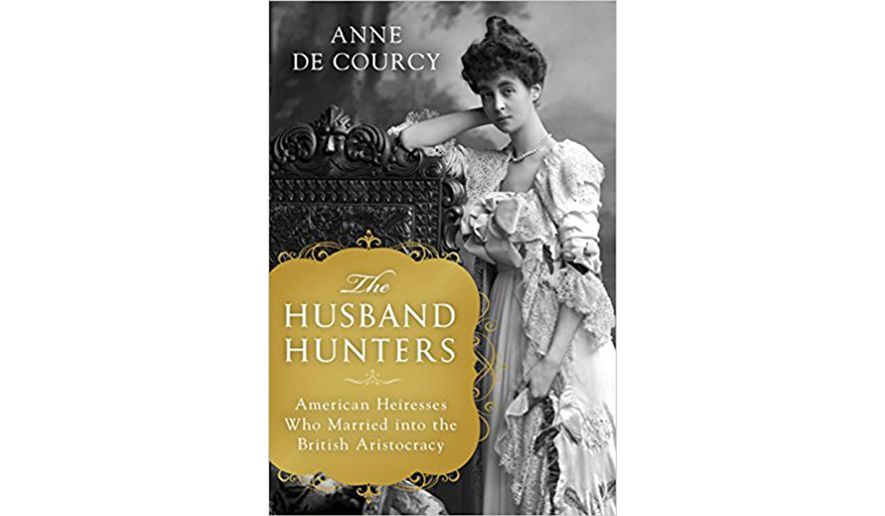
THE HUSBAND HUNTERS: AMERICAN HEIRESSES WHO MARRIED INTO THE BRITISH ARISTOCRACY
By Anne de Courcy
St. Martin’s Press, $27.99, 307 pages
People were interested in these podcasts
A chapter or so into Anne de Courcy’s amusing, breezily readable “The Husband Hunters” I was reminded of Oscar Wilde’s throwaway line about English fox hunters: “the unspeakable in pursuit of the uneatable.”
Ms. De Courcy is dealing with a different kind of hunt, one in which the roles of pursuer and prey were often interchangeable, and which dominated the society pages of the British and American press for a few short decades in the late Victorian and early Edwardian eras.
One might call the phenomenon “the insufferable in pursuit of the insolvent,” a money and snobbery driven mating game in which pushy, nouveau riche American mothers seeking a social status denied them by old line families at home, went shopping for titled husbands for their eligible daughters abroad.
The motivation was simple enough. Once Mrs. Gideon Gump became the mother of Lady Prunella Puffington, the doors of New York Society — not to mention Washington and London — could be pried open for mother and daughter alike.
If a burning desire to make it into the social directory was what drove the American mothers, what was in it for their intended quarry? Nothing more or less than what W.C. Fields used to call “the elusive spondulicks,” money in general and the newly surging Yankee dollar in particular.
Because the making of so many industrial and Wall Street fortunes in the Gilded Age America coincided with many of the oldest titled families in Britain becoming almost as insolvent as they were inbred, it was sometimes hard to tell the hunters from the hunted.
At times, two negatives combined to make a positive. Consider the case of Jennie Jerome, the most beautiful of three beautiful daughters of a flamboyant American millionaire.
“It was while she was dancing at Cowes that Jennie, by now a stunning beauty with the dark hair, lustrous eyes and strong coloring so admired then, was noticed by Lord Randolph Churchill, the third son of the 7th Duke of Marlborough, who asked to be introduced to her. The spark between them was instant: The two fell in love so quickly that a mere three days after their first meeting Lord Randolph proposed to Jennie and was accepted.”
The storybook beginning did not have a storybook ending. After an initially promising political career, the increasingly erratic Lord Randolph died early, of complications from syphilis, but not before becoming a tragic, public disgrace. Between his spendthrift ways and the unstable state of her father’s fortunes, Jennie found herself a widow with two sons to support.
Fortunately, her beauty, sophistication and innate charm — plus a willingness to flirt and even sleep with influential VIPs — kept her afloat. She lived in style as well as in debt through a long, flamboyant life that, besides her numerous affairs, included two later marriages to much younger men. The most important of her old flames was no less a figure than the prince of Wales, afterward Edward VII, the fat, wheezy playboy who put the “Edward” into the word “Edwardian.”
All this would fall into the category of period trivia if one of Jennie’s two sons hadn’t been a slow-learning, late-blooming overachiever by the name of Winston Churchill. The hero who led England to victory through her darkest hours was a one-man English-Speaking Union who inherited a strong sense of family duty and tradition from his paternal ancestors but almost certainly drew most of his wit, charm and grit from his unsinkable American mother.
Although many, if not most, of the transatlantic marriages chronicled by Anne de Courcy didn’t come close to producing heirs like Winston Churchill, and countless American brides lived to bitterly regret being bound to gambling, dissolute or simply doltish branches of noble family trees, the clever, vivacious American beauties who shoved their way into Burke’s Peerage made three lasting contributions to their adopted class and country.
Firstly, because they tended to be more confident, sophisticated and style-conscious than their frumpy noble sisters-in-law, they exercised a liberating effect on the fusty setting they were dropped into. Secondly, the paternal big bucks they brought to their marriages saved many a stately home of England from foreclosure or disintegration, thereby preserving a valuable part of the national heritage. Last but not least, as the example of Winston Churchill illustrates, they infused fresh blood as well as fresh cash into a significant chunk of the ruling class.
All in all, Britain came out ahead on the deal.
• Aram Bakshian Jr., a former aide to Presidents Nixon, Ford and Reagan, has written widely on politics, history, gastronomy and the arts.

Please read our comment policy before commenting.